


ABA grew faster than any payer built controls for. According to the CMS State Medicaid and CHIP ABA Toolkit, Medicaid and CHIP spending on ABA rose from roughly $1.94 billion in 2021 to $10.1 billion in 2025. States have responded with rate cuts, hour caps, accreditation mandates and tighter prior authorization. Commercial payers are following with claim edits and preferred networks rather than published rate cuts.
We cover the state-level detail in ABA Reimbursement Cuts 2026 and ABA Medicaid Changes by State 2026. This guide is the playbook: what you can actually do about it.
Strategy 1: Benchmark your rates before you do anything else
You cannot negotiate, or decide where to expand, without knowing where your rates sit. Rates vary widely. Reported 2025 Medicaid fee-for-service rates in Appendix E of the CMS Toolkit show that technician-delivered treatment (CPT 97153) ran from $10.39 per 15-minute unit in North Dakota to $22.63 in Alaska, and assessment (CPT 97151) from $18.79 in Washington to $112.65 in New Mexico.
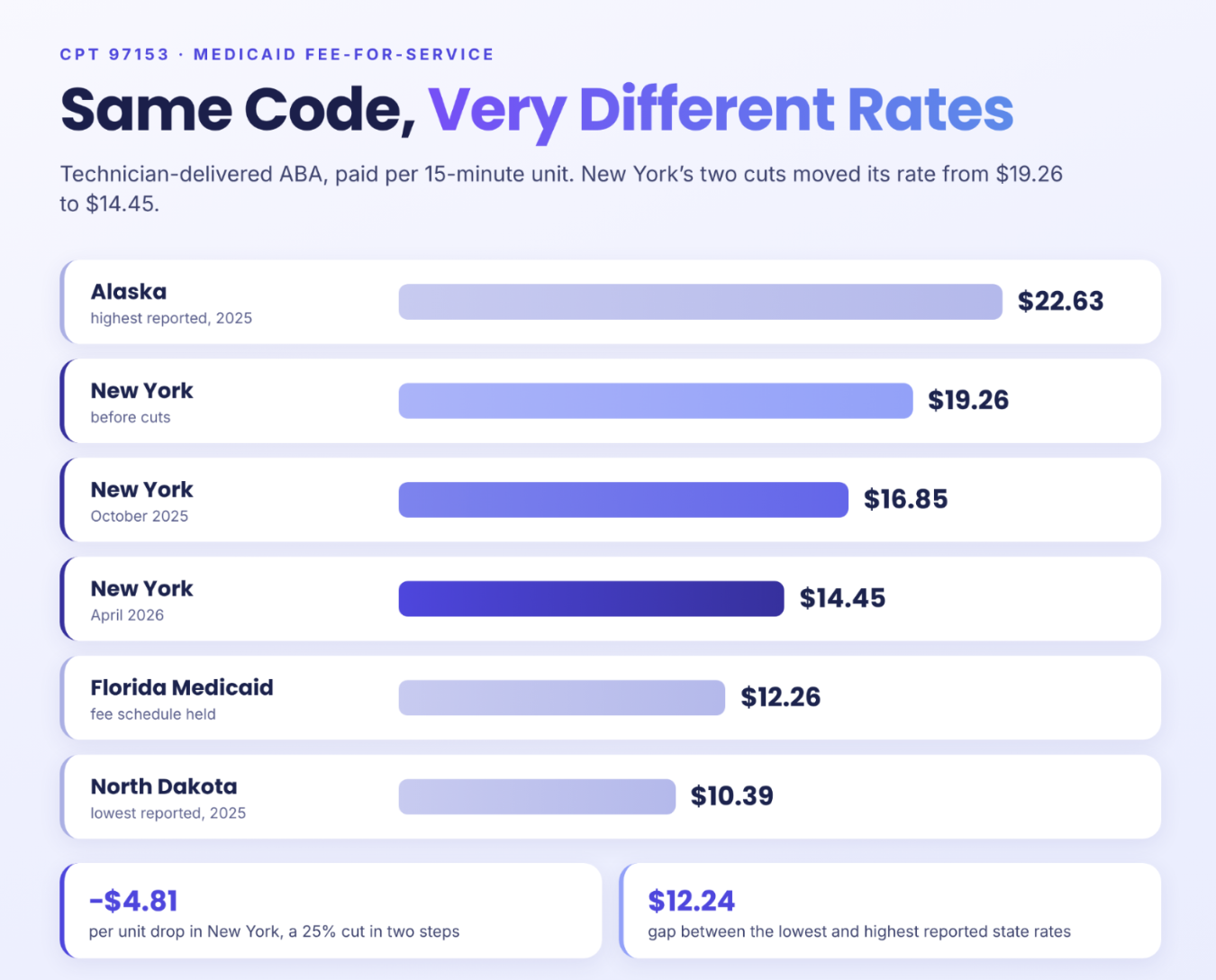
Florida held its fee schedule while New York cut technician-delivered ABA by 25%. Check where your own rate sits in this range.
What to do: build a one-page rate sheet by payer and CPT code (97151–97158 today, plus the 2027 additions). Compare it with your state's fee schedule and with Appendix E. Flag every code where a commercial payer pays less than your state Medicaid program. Those are your first negotiation targets.
If you operate in several states, model the rate before the market. A high-demand state with a bottom-quartile rate is not an opportunity.
Strategy 2: Negotiate commercial and managed care rates with evidence
Know what is negotiable. State Medicaid fee-for-service schedules are not. Commercial contracts and Medicaid managed care plan contracts are, and plan-level cuts have been the source of some of 2026's sharpest reductions (for example, CareSource Georgia's 20% ABA cut and Mercy Care's cuts in Arizona). Do not assume a steady state fee schedule means your plan contract is steady too.
Commercial ABA rates often run well above Medicaid. Industry estimates put them roughly 15% to 25% higher, but payers are also tightening requirements and building preferred networks. Aetna, for instance, is assembling a preferred network of autism providers. Network access increasingly depends on data, not just price.
Build an evidence pack before you ask:
- Accessibility. Clients served, wait times, hours delivered, ages and severity levels, geographies and languages covered, and any gaps you fill for the payer's members.
- Outcomes. Results on a standardized instrument (the CMS Toolkit names the VB-MAPP, ABLLS-R, AFLS, Essential for Living and PEAK), goal mastery rates, step-down and discharge rates, and caregiver engagement. Our data collection graphs and reporting and analytics dashboards generate this on demand.
- Quality and compliance. Accreditation status, supervision ratios, credential tracking and a clean audit history. See ABA billing audit protection.
- Administrative efficiency. First-pass clean claim rate, denial rate and days in A/R. Payers value providers who are cheap to administer.
- A specific ask. Name the codes, the rate, the effective date and the escalator.
What to ask for, beyond the headline rate:
| Ask | Why it matters |
| Rate increase on 97153 and 97155 | Highest-volume codes; most margin impact |
| Parity on 97151/97152 assessment rates | Assessments are often underpriced versus effort |
| Rates for the 2027 codes (97180, 97173, 97159/97160, 97148/97149) | CMS keeps carrier pricing for these codes, so each payer sets its own |
| Longer authorization periods | Fewer re-authorizations means fewer gaps and less admin time |
| Annual escalator | Protects against margin erosion from wage inflation |
| Telehealth parity and modifier clarity | Avoids rejected or down-coded telehealth claims |
| Written medical-necessity and unit-limit policies | Removes surprises at reauthorization |
Timing. Start 120 to 180 days before a contract anniversary, or when a payer announces a network change. Escalate through the provider relations representative to the contracting manager, and keep every concession in writing.
A caution on collective action. Joining a regional provider association can add leverage, but coordinating rates among competitors raises antitrust questions. Talk to legal counsel before you do.
Strategy 3: Fix credentialing and enrollment data
A rate you negotiated is worth nothing if claims are rejected. Payers are validating more provider data on every claim. Optum, for example, now requires NPI and taxonomy codes for both the billing and rendering provider on commercial behavioral health claims and validates them against NPPES. A taxonomy mismatch becomes a rejection.
- Audit every rendering provider's NPI, taxonomy and enrollment status by payer each quarter.
- Make sure the person on the claim is the person who delivered and supervised the session. Our guide to rendering providers in ABA billing explains the rules.
- Keep credential and license documents current in one place with documentation management.
- In states with new certification or accreditation rules (North Carolina, Massachusetts, Indiana, Pennsylvania), treat the deadline as a project start date. See ABA Medicaid Changes by State 2026.
Strategy 4: Code accurately and prepare for the 2027 CPT changes
Under-coding leaves money on the table. Over-coding invites recoupment. The goal is the code that matches who delivered the service, what they did and for how long.
- Review the full code family in ABA CPT Codes Explained.
- Load payer-specific service codes and modifiers correctly. These help-center guides walk through it: How to add CPT codes and activities, Attaching payer service codes to payer activities, Adding new modifiers to payer activities and Adding modifiers for telehealth.
Six new Category I codes take effect January 1, 2027. The most relevant for revenue is 97180, which recognizes ongoing non-face-to-face BCBA work that was historically unbillable or bundled.
| Code | What it covers | Revenue angle |
| 97148 / +97149 | Supporting assessment of harmful behavior with 2 technicians, plus add-on for each additional technician | Captures multi-technician assessment |
| 97159 / +97160 | Supporting treatment of harmful behavior with 2 technicians, plus add-on | Captures multi-technician high-acuity care |
| 97173 | Direct treatment with analysis by the QHP, no technician present | Distinct pathway for direct BCBA treatment |
| 97180 | Non-face-to-face QHP analysis (note review, protocol changes, transition planning) | Recognizes previously unbilled clinical work |
A code describes a service. It does not guarantee coverage or payment. Contact each payer early about coverage, authorization rules and rates. Our 2027 ABA CPT Code Updates cheat sheet and Prepare Your ABA Practice for 2027 CPT Changes Q4 checklist cover the transition.
Strategy 5: Close the gap between authorized and delivered hours
Hours you are authorized for but never deliver are revenue you earned the right to bill and left on the table. Under lower rates, unused authorization is the most expensive line item in the practice.
- Track utilization per client per authorization period. Flag anything below 90%.
- Tie scheduling to authorization balances so staff cannot overbook past the approved units. See ABA therapy scheduling.
- Use these guides: Authorizations, How to view authorizations and track units and Restricting scheduling based on documents.
- Start reauthorization early. Managed care plans must issue standard prior authorization decisions within 7 calendar days (extendable by up to 14) for rating periods starting on or after January 1, 2026, so track the clock and escalate when a plan misses it.
- Expect scrutiny of very high hours. The CMS Toolkit says 40 hours per week is not a best practice and suggests aligning hours to DSM-5-TR severity. Document why this child needs these hours.
Strategy 6: Raise your first-pass clean claim rate and work denials fast
Every reworked claim costs staff time that lower rates no longer fund. Aim for a first-pass clean claim rate above 95%. The most common ABA denials trace back to a short list of causes:
| Denial cause | Prevention | Help-center guide |
| Expired or exhausted authorization | Authorization-linked scheduling and utilization alerts | Authorizations |
| Rendering provider, NPI or taxonomy mismatch | Quarterly credentialing audit | Adding payers |
| Wrong CPT, modifier or place of service | Payer-specific service codes | Adding modifiers for telehealth |
| Wrong primary payer or eligibility | Verify at intake and each reauthorization | How to switch primary payers |
| Corrected or secondary claim errors | Standard correction workflow | Submitting corrected claims, Secondary billing |
| Payment posting and ERA problems | Clearinghouse and ERA setup | ERA troubleshooting, Claim.MD setup |
| Late or incomplete session notes | Documentation lag target under 24 hours | Managing and completing session notes |
Build a denial routine. Review denials weekly. Code each one to a root cause. Fix the upstream process, not just the claim. Appeal inside the payer's window, and keep a log of every payer's appeal deadlines. Our Ready to Bill claims guide and Submitted claims guide show the workflow inside the platform. For the broader process, read ABA revenue cycle management and ABA billing compliance.
For scale, KFF reported that ACA marketplace insurers denied 19% of in-network claims in 2024 (as cited by VG Soft Co). That is not ABA-specific, but it shows why denial management is a revenue function, not clerical work.
Strategy 7: Document so your rates and hours survive review
Payers and auditors now use the same checklist. The CMS Toolkit flags patterns such as identical documentation across clients, sustained high hours without documented progress, copy-and-paste treatment plans, group therapy above 10% of treatment time and billing the maximum authorized hours for 80% or more of a caseload.
- Standardize structure, individualize content. Use consistent fields and assessment cadence, but write individual goals, baselines and rationale for hours.
- Adopt a standardized outcome instrument before a state or payer requires it.
- Make supervision airtight. The Toolkit describes 1 to 2 hours of supervision per 10 hours of direct treatment, and RBTs need at least 5% of monthly direct hours supervised. Use RBT supervision tracking and scheduling for RBT supervision.
- Match payer-specific note requirements with session note templates by appointment type and payer.
- Use AI carefully. AI can shorten documentation time and flag gaps, but clinical oversight stays with the BCBA. See Documentation and Compliance: Enhancing Audit-Readiness with AI.
- Keep the chain intact: schedule, note and claim must agree. Offline mobile collection with GPS-verified signatures in the Theralytics mobile app helps for home-based sessions.
Strategy 8: Understand what a rate cut really does, then manage payer mix
Almost none of your costs move with the rate. Take a practice with 2Minrevenue,a17%operatingmargin(340,000) and fixed costs of $1.66M:
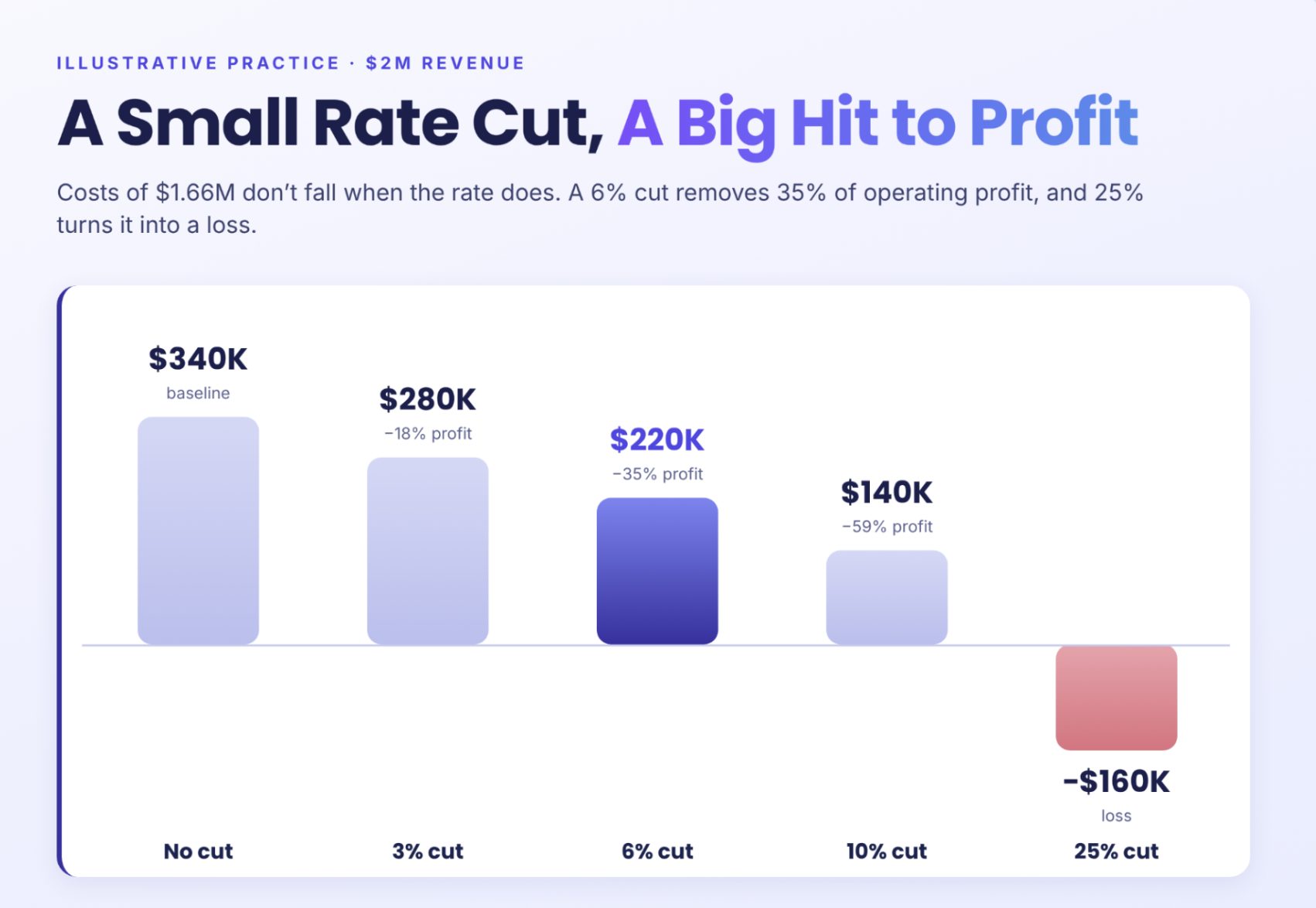
That is why the answer cannot be "absorb it." Offsets have to come from collections, utilization and administrative cost, together. For more, see How ABA Agencies Can Survive Constantly Rising Costs and the cost of running an ABA company.
Payer mix. Dropping Medicaid for commercial-only is rarely the right first move, because commercial payers are tightening too. A diversified mix spreads risk better than either extreme. Model it with real collection data per payer, not rate cards. Include denial rate, days in A/R and authorization turnaround for each payer in the comparison.
Service mix. Make sure you capture legitimate billable work, including assessments and, from 2027, qualifying non-face-to-face QHP time under 97180, where payers cover it. Where telehealth is allowed, use it as an adjunct, and confirm modifier and supervision rules by state.
Strategy 9: Choose the right tools, and know what they cost
The right stack keeps scheduling, authorizations, documentation and claims connected so errors never reach the payer. Costs fall into two buckets: software and optional billing services.
ABA software cost by brand
Full-feature monthly cost (practice management, data collection and billing combined), assuming roughly 2.5 clients per staff member. Competitor figures come from published pricing compiled by VG Soft Co as of August to October 2026. Theralytics figures come from its pricing page. Confirm current prices with each vendor.
| Brand | Pricing model | Published starting price | 25 clients / 10 staff | 50 clients / 20 staff | 100 clients / 40 staff |
| Theralytics | Per client (or per user) | $20 per module, $30 for the combined bundle; 200–300 monthly minimum | $750 | $1,500 | $3,000 |
| AlohaABA | Per staff plus per-client data collection | $29.99/staff + $10/client | $549.90 | $1,099.80 | $2,199.60 |
| Motivity | Per learner, per module | $24 PM, $26 data, $50 all-in-one | $1,250 | $2,500 | $5,000 |
| VGPM | Flat per staff | $50/staff | $500 | $1,000 | $2,000 |
| RethinkBH | Custom | From about $20/user (indicative) | Quote | Quote | Quote |
| CentralReach | Custom enterprise | Not published | Quote | Quote | Quote |
| Passage Health | Custom | Not published | Quote | Quote | Quote |
| Raven Health | Percentage of collections | Software free with managed billing | Scales with revenue | Scales with revenue | Scales with revenue |
Theralytics also advertises a promotional $25 per client for both modules for new customers, which would make the three columns $625, $1,250 and $2,500. Per-client pricing scales with caseload, per-staff pricing scales with headcount, so compare at your current size and at twice your size.
ABA billing service cost by brand
If you would rather hand off claims, outsourced billing is almost always a percentage of what is actually collected.
| Brand or model | Fee model | Published rate | Notes |
| Theralytics Full-Service Billing | % of receivables, paid when you are paid | 4.5% | Claim scrubbing, denials and appeals, payment posting, A/R follow-up, authorization and eligibility checks, patient invoicing. Includes 50–100% discounts on software |
| CentralReach (CR BillMax) | % of collections | Not published | Sold separately from the core platform |
| Raven Health managed billing bundle | % of monthly claims collected | Not published | Software included at no charge |
| Passage Health managed RCM | Fee based on monthly collections | Quote | Optional add-on |
| VG Soft Co RCM | % of collections | Benchmarks: 3–5% A/R-only, 5–8% full-service | Percentages are industry benchmarks quoted by the vendor |
| Cube, Missing Piece, AnnexMed, Plutus Health, MBW RCM, Operant Billing | Mostly % of collections | Not published (as of May 2026) | Ask for scope in writing |
| General market | % of net collections | 4%–10% typical | Varies by volume and scope |
What the fee looks like in dollars:
| Annual collections | 4.5% | 5% | 8% |
| $1,000,000 | $45,000 | $50,000 | $80,000 |
| $2,000,000 | $90,000 | $100,000 | $160,000 |
| $5,000,000 | $225,000 | $250,000 | $400,000 |
Compare those numbers with the fully loaded cost of in-house billing staff, plus the revenue you lose when denials age past appeal windows. Ask every vendor what is included (denial appeals, patient invoicing, authorization checks), how they report, and who owns your data if you leave. Moving platforms? Read Switching ABA Software: How Theralytics Handles Your Practice Migration.
What better collections are worth
One multi-location California practice moved from a 78% to a 98% collection rate in under a year. As an illustration, here is what each collection rate means on $2.4M of expected reimbursement:
| Collection rate | Cash collected | Gain versus 78% |
| 78% | $1,872,000 | n/a |
| 85% | $2,040,000 | +$168,000 |
| 92% | $2,208,000 | +$336,000 |
| 98% | $2,352,000 | +$480,000 |
Your results will differ, but the shape holds: a few points of collection rate usually outweigh the cost of the tools and services that produce them.
Strategy 10: Track the right metrics weekly
Under falling rates, monthly review is too slow. Watch these weekly:
| Metric | Target | Why it matters now |
| Net collection rate | 95% or higher | Below 95%, a rate cut compounds with leakage |
| Days in accounts receivable | 30–45 days | Lower rates shrink the cash buffer |
| First-pass clean claim rate | Above 95% | Rework cost per claim does not fall with rates |
| Authorization utilization | 90%–100% | Unbilled authorized hours are the cheapest revenue available |
| Billable utilization, RBT | 75%–85% | Non-billable time costs more at lower rates |
| Documentation lag | Under 24 hours | Late notes become denials, and denials become recoupments |
Pulling these by hand is unrealistic for most teams. Use automated reporting and analytics and the Summary of Reports guide.
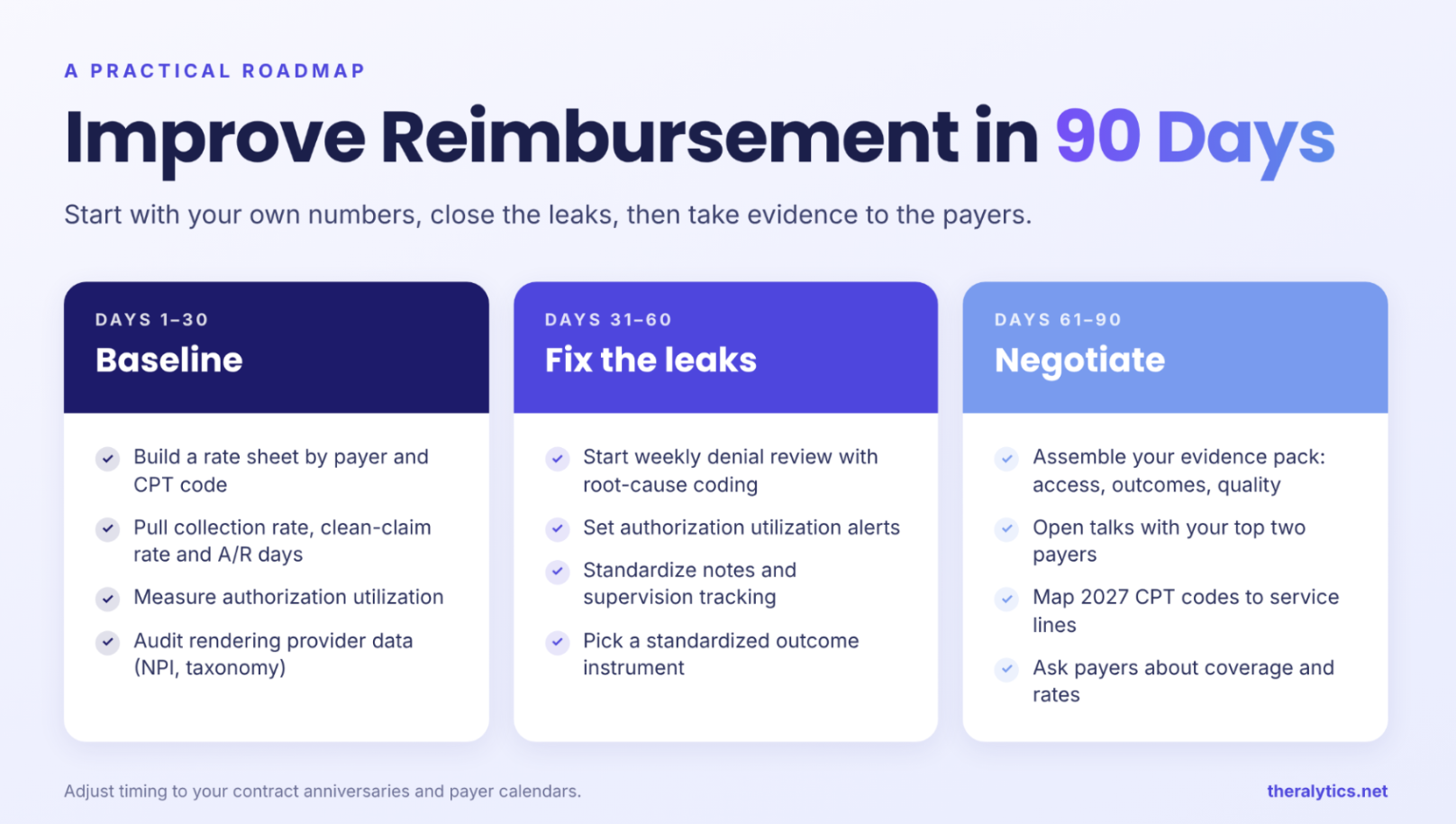
A 90-day action plan
| Timeline | Focus | Actions |
| Days 1–30 | Baseline | Build your rate sheet by payer and code. Pull net collection rate, clean-claim rate, A/R days and authorization utilization. Audit rendering provider data. |
| Days 31–60 | Fix leaks | Start weekly denial review with root-cause coding. Set utilization alerts. Standardize notes and supervision tracking. Pick a standardized outcome instrument. |
| Days 61–90 | Negotiate and prepare | Assemble your evidence pack. Open talks with your top two commercial or managed care payers. Map 2027 CPT codes to your service lines and contact payers about coverage. |
Frequently asked questions
How can an ABA practice increase insurance reimbursement?
Work on both numbers: negotiate the contracted rate with commercial and managed care payers using outcomes and access data, and raise the realized rate by improving authorization utilization, clean-claim rate, denial management and documentation.
Can I negotiate Medicaid ABA rates?
Not for state fee-for-service schedules, which the state sets. Managed care plans often set their own contracted rates, which can be negotiated and which have changed on their own in several states.
What is a good clean claim rate for ABA billing?
Above 95% on first pass is a common target. A lower rate means staff time spent on rework and revenue delayed by weeks.
Do the 2027 CPT codes increase reimbursement automatically?
No. A CPT code describes a service. Each payer decides whether to cover and price it, and CMS has indicated carrier pricing will continue for these services. Contact payers early.
Should I outsource ABA billing?
It depends on volume, staff expertise and denial rates. Outsourcing is typically priced at a percentage of collections, so compare the fee with your in-house cost and your current collection rate. See Theralytics billing services for one model.
Where can I find rates for my state?
Start with your state Medicaid fee schedule and Appendix E of the CMS ABA Toolkit, then compare with your commercial contracts.
The bottom line
Reimbursement rates are not only something payers do to you. The practices that hold margin through 2026 and 2027 can prove what they did: who delivered each session, who supervised it, what the standardized outcome instrument showed, why the child needs these hours, and whether the claim matches the schedule and the note. None of that is new clinical work. It is a records problem, and records problems are solvable.
Theralytics connects scheduling, data collection, documentation and billing in one platform so the audit trail builds itself. Want help finding where your revenue is leaking? Book a 15-minute demo, or browse the support center.