


Accurate ABA billing goes far beyond selecting the correct CPT code. Authorization management, modifier requirements, provider credentialing, eligibility verification, and documentation standards all impact whether a claim gets paid or denied. Understanding these requirements is what separates practices that collect consistently from those chasing denials every month.
While this article focuses on the adaptive behavior CPT codes (97151–97158), some Medicaid programs, waiver programs, behavioral health programs, and state-funded services may require HCPCS codes such as H0031, H0032, H2019, H2014, H2020, T1016, and other state-specific billing codes. Providers should always follow payer-specific billing requirements, fee schedules, and authorization guidelines.
What Are CPT Codes and Why They Matter for ABA Practices
CPT codes are the standardized terminology used to describe ABA assessments, direct therapy, and family guidance sessions for billing purposes. Every claim you submit to a commercial insurer, Medicaid, or TRICARE is built around at least one CPT code; pick the wrong one and the claim fails, regardless of how well the session was delivered.
Accurate code selection is the foundation of both reimbursement and compliance. A code that doesn't match the provider's credential, the session type, or the documentation triggers a denial or, worse, a post-payment audit. Most ABA CPT codes are also time-based, billed in 15-minute increments, so 4 units equal one hour of service. That structure runs through assessment, treatment, and family guidance codes alike.
How CPT codes differ from ICD-10 and HCPCS codes
CPT codes describe the service delivered. ICD-10 codes describe the diagnosis. HCPCS codes (like H2019) are a parallel system used by some Medicaid programs when they haven't adopted the CPT-based ABA codes. You need both CPT and ICD-10 on every claim; the ICD-10 establishes medical necessity, the CPT tells the payer what was done and for how long.
Assessment CPT Codes for ABA Billing
ABA assessment codes split across Category I (97151 and 97152) and Category III (0362T and 0373T). As of 2024, there are 8 Category I and 2 Category III codes covering adaptive behavior services.
Category I assessment codes (97151-97152)
97151 and 97152 together cover the full evaluation picture: indirect administrative work plus direct time with the client. They aren't interchangeable; each has a specific scope and credential requirement.
What CPT code 97151 covers and who bills it
97151 is the Behavior Identification Assessment code. It may include direct assessment activities with the client as well as indirect activities such as data analysis, report writing, and treatment plan development.
What CPT code 97152 covers and how it differs from 97151
97152 covers the technician-assisted portion of the same assessment. A tech gathers data under the BCBA's supervision during the observation. The important difference: 97151 requires the QHP's direct involvement and includes indirect time; 97152 captures the assistant-level observation time billed alongside it.
Category III assessment codes (0362T, 0373T)
0362T and 0373T are temporary Category III codes for adaptive behavior assessment in high-acuity situations. They cover intensive multi-provider or multi-setting assessments not captured by the standard Category I codes. These are often underused; practices treating complex cases should verify payer acceptance before billing them.
Treatment and Intervention CPT Codes You'll Use Most
Treatment aba billing codes run from 97153 through 97158, covering everything from one-on-one direct intervention to group therapy and family guidance. Getting the right code to the right session type is non-negotiable.
Category I treatment codes (97153-97158)
| Code | Service | Typical Provider |
|---|---|---|
| 97153 | One-on-one direct intervention | RBT / technician |
| 97154 | Group adaptive behavior treatment | Technician |
| 97155 | Protocol modification (BCBA present) | BCBA |
| 97156 | Family adaptive behavior guidance | BCBA |
| 97157 | Multiple-family group guidance | BCBA |
| 97158 | Group treatment by QHP | BCBA / QHP |
What CPT code 97153 covers and who performs it
97153 is the workhorse of ABA treatment. It covers face-to-face, one-on-one adaptive behavior treatment delivered by a technician under a BCBA's supervision. RBTs use this code for the bulk of direct therapy hours. TRICARE reimbursement for 97153 runs TRICARE 97153 reimbursement $31.25-$36.43 per unit depending on geography, effective May 1, 2025.
What CPT code 97154 covers and its group delivery model
97154 covers group adaptive behavior treatment, two or more clients in the same session with one technician. The service delivery model differs from 97153 in two ways: the technician divides attention across clients, and the reimbursement per client is lower to reflect that. Practices sometimes bill 97154 when they mean 97153; that's a misrepresentation of the service and an audit trigger.
Category III treatment codes and emerging procedures
0373T covers adaptive behavior treatment with protocol modification in high-intensity situations, similar to how 97155 works but for acuity levels that go beyond what Category I captures. These Category III codes follow an evolutionary path toward Category I status as evidence accumulates.
Specific Documentation Requirements and Minimum Time Thresholds by CPT Code
Each CPT code carries minimum time and documentation requirements that insurers verify before paying. Missing either is a fast path to denial.
Minimum time thresholds per code and what insurers verify
Many ABA payers use CMS-style 8-minute billing methodology as the floor. A session must reach at least 8 minutes to count as one billable unit. Each additional 15-minute block adds another unit. Insurers cross-reference the time logged in session notes against the units billed; discrepancies flag the claim automatically.
Theralytics' integrated ABA documentation management software automatically tracks session time against billed units, catching mismatches before claims leave the system.
How modifier and documentation sequencing is monitored by payers
Payers now use algorithmic reviews to check that the modifier on a claim matches the session type and the rendering provider's credential. If you bill 97155 with an HN modifier- Bachelor's-level clinician (payer-specific requirements apply), that combination signals a compliance problem, 97155 requires a BCBA. Payer audit exposure is preventable when documentation sequences correctly from session note to claim.
Modifiers That Impact ABA Reimbursement
Modifier requirements vary significantly by payer. Some payers require modifiers such as HN, HO, HP, HM, U modifiers, or telehealth modifiers, while others determine provider credentials based on rendering provider enrollment. Providers should follow payer-specific billing requirements when applying modifiers.
Common ABA modifiers and when to apply them
- HN, Bachelor's-level clinician (payer-specific requirements apply)
- HO, Master's level clinician
- HP, Doctoral level (BCBA-D, PhD)
- 95, Synchronous telehealth service (payer-specific requirements apply)
- GT, Interactive audio/video telecommunications systems (payer-specific requirements apply)
How modifiers affect claim approval and payment
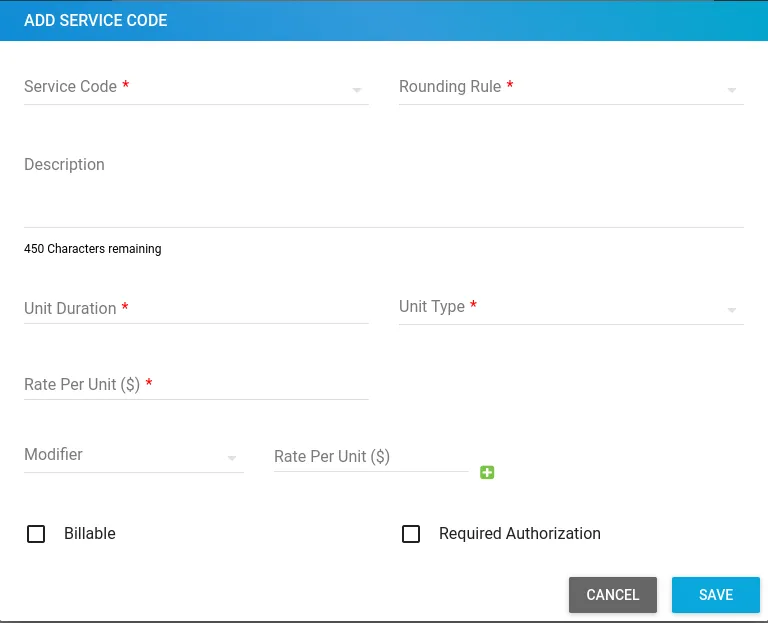
Reimbursement rates often tie directly to credential level. Some payers pay different rates for the same code depending on whether HN, HO, or HP is attached. Accurate modifier use isn't just compliance, it's accurate revenue capture. You can set payer-specific modifiers and service code mapping at the payer level in Theralytics to avoid manual modifier errors on every claim:
Compliance risks and audit triggers from modifier misuse
The research published on PubMed Central documents how MUEs misused as hard ABA caps by some payers compound the problem. Claims already fragile from modifier errors hit artificial limits and disappear. Modifier sequencing errors and MUE conflicts together represent one of the most common audit trigger combinations in ABA billing.
Time-Based Billing and the 8-Minute Rule Explained
Most ABA CPT codes bill in 15-minute increments, equating to 4 units per hour. That structure applies across 97151, 97153, 97155, and the other treatment codes. Understanding how the 8-minute rule converts session minutes into billable units is something every RBT and BCBA needs to have memorized.
Many payers use CMS-style time-based unit calculations; however, some payers and Medicaid programs have payer-specific billing methodologies.
Billing in 15-minute units for accuracy
One unit = 15 minutes. Four units = 1 hour. A 45-minute session bills as 3 units. A 90-minute session bills as 6 units. The math is simple, but errors creep in when staff round incorrectly or when session notes log a different duration than what the clock shows. Real-time ABA therapy scheduling software that ties directly to billing eliminates most of these rounding errors before they reach the clearinghouse.
Applying the 8-minute rule to avoid underbilling
The 8-minute rule sets the floor for a billable unit. Here's how it works:
- 8-22 minutes = 1 unit
- 23-37 minutes = 2 units
- 38-52 minutes = 3 units
- 53-67 minutes = 4 units
Practices that don't apply the rule consistently leave money on the table. A 22-minute session still captures 1 unit; treating it as 0 because "it wasn't a full 30 minutes" is underbilling.
Billing When a Session Includes Multiple CPT Codes
A BCBA who conducts a protocol modification (97155) during a session that also includes direct RBT time (97153) can bill both codes for the same session, provided the time for each service is documented separately and doesn't overlap.
Rules for same-day billing of assessment and treatment codes
Some payers may also restrict concurrent or overlapping billing between assessment, supervision, and treatment services. Providers should verify payer-specific billing guidelines before submitting claims. The submitted claims guide in Theralytics walks through how to handle multi-code submissions correctly.
Documentation strategies for multi-code sessions
Each code billed in the same session needs its own time stamp, provider credential, and activity description in the session note. A single SOAP note that lumps all services together without distinguishing time blocks won't hold up under review. Use separate note sections or distinct entries per code; that structure protects you if a payer requests records. Learning ABA session notes structure directly shapes how well multi-code sessions survive audit.
Linking CPT Codes to ICD-10 Diagnoses for Medical Necessity
Every ABA claim needs an ICD-10 diagnosis code that justifies the service billed. CPT codes 97151-97154 are most commonly paired with autism spectrum disorder diagnoses, but they can also support other developmental and behavioral health diagnoses.
Common ICD-10 diagnoses in ABA billing
- F84.0, Autism spectrum disorder (accounts for ASD holds 70.10% of ABA revenue in 2025, per Mordor Intelligence)
- F90.x, Attention-deficit/hyperactivity disorder
- F80.x, Developmental language disorders
- F70-F79, Intellectual disabilities
The CDC's April 2025 ADDM survey found autism prevalence 1 in 31 U.S. children, up from 1 in 36, which continues to fuel the bulk of ABA caseloads billed under F84.0.
Documentation requirements that support code selection
Medical necessity documentation must show that the service delivered matches the diagnosis and the treatment plan. A claim for 97155 (protocol modification) needs a treatment plan on file that shows an existing behavior intervention protocol being modified; without one, there's no clinical justification for the code. Payers also expect progress notes to reflect movement toward measurable goals tied to the ICD-10 diagnosis.
Payer-Specific Billing Considerations
Reimbursement rates, covered codes, and authorization requirements all vary by payer, sometimes dramatically. State Medicaid programs account for roughly 60% of ABA claims (Praxis Notes, 2025), which means state-level rules affect most of your claims volume.
Medicaid and state-level code variations
Some state Medicaid programs still require HCPCS codes (H2019, H0031) alongside or instead of the 97xxx codes. California's Medi-Cal, for example, recently updated enrollment requirements for ABA providers through the PAVE system starting May 2025. Checking Medi-Cal enrollment changes for ABA providers covers the specific credentialing steps California practices need to follow.
Commercial insurance and self-funded plan differences
Commercial insurers and self-funded ERISA plans aren't bound by state Medicaid rules. Many have their own medical policies that restrict units per day, require prior authorization for each code, or exclude certain Category III codes entirely. You need to pull the payer's specific ABA medical policy, not just assume a code is covered because Medicaid accepts it.
How reimbursement rates vary by payer, state, and facility type
The same code billed in a clinic versus a home versus a school can reimburse at different rates depending on the place-of-service modifier. And payer contracted rates for 97153 can vary by three to four times between a commercial plan and a Medicaid program in the same state. Setting up payer-specific service code rates in your billing system prevents the wrong rate from going out on every claim.
Recent Updates to ABA CPT Codes and What's Coming Next
The AMA's 2025 CPT cycle brought 420 total AMA CPT updates in 2025, 270 new codes, 112 deletions, and 38 revisions. The main ABA codes (97151-97158) remained stable, but payer policies around telehealth, modifiers, and medical necessity documentation continued to shift.
Telehealth requirements continue to evolve across payers. Some payers require Modifier 95, while others require GT or payer-specific telehealth indicators. Providers should verify current telehealth billing requirements, modifier usage, and coverage policies with each payer before claim submission.
Category III codes (0362T, 0373T) remain on the evolutionary path toward Category I status as clinical evidence accumulates. Practices using them should monitor AMA annual cycle announcements; a Category III code can become Category I, be revised, or be deleted within a single cycle.
Avoid These Common ABA Billing Mistakes
A 2023 ABA Coding Coalition review found roughly 40% of denials trace back to documentation errors or wrong code selection. The AMA's 420 total AMA CPT updates in 2025 raise that risk every year codes change. But the denial categories themselves are consistent.
Top reasons for claim denials and how to prevent them
- Wrong code for provider type: Billing 97155 when the BCBA wasn't present during the session.
- Missing or expired authorization: Submitting claims outside approved date ranges or unit limits.
- Modifier mismatch: HN modifier on a 97155 claim, or no modifier at all on a 97153.
- Place-of-service error: Home service billed with clinic POS code.
- Timely filing missed: Most payers have 90-day windows; some commercial plans are stricter.
Documentation and eligibility errors that cost you money
Eligibility errors are often invisible until the claim denies. A client whose insurance lapsed mid-month, billed for sessions in that window, will deny without warning. Run eligibility checks before every session, not just at intake. Documentation gaps (session notes that don't specify time, provider, or goals addressed) are the second most common cost driver. Every ABA billing service worth using will flag these before submission.
Denial appeal strategies for rejected ABA CPT code claims
Most payers give you a 90-day appeal window from the denial date. Use it. An appeal for a documentation gap needs the original session note plus a corrected or supplemental note that fills the specific deficiency the payer cited. Modifier and credential denials often require a letter of medical necessity co-signed by the BCBA plus the original clinical documentation. And for MUE-based denials, where the payer incorrectly applied a session cap, attach the peer-reviewed evidence that ABA hours are medically necessary and cite the CMS definition of MUEs directly.
How Theralytics Supports Accurate ABA CPT Code Billing
Getting CPT codes that every ABA practice needs to know right on paper is one thing. Getting them right on every claim, across every payer, every session, is an operational challenge. That's where Theralytics addresses the gap most practices struggle with.
- The platform's ABA billing workflows tie directly to session documentation. When a session is rendered, the claim pulls the CPT code, modifier, rendering provider, and authorization data from the client profile automatically, reducing the manual entry errors that cause most modifier mismatches and credential denials. This is reinforced through structured billing configuration and payer setup rules that ensure CPT logic is applied consistently across claims, as outlined in the billing configuration framework.
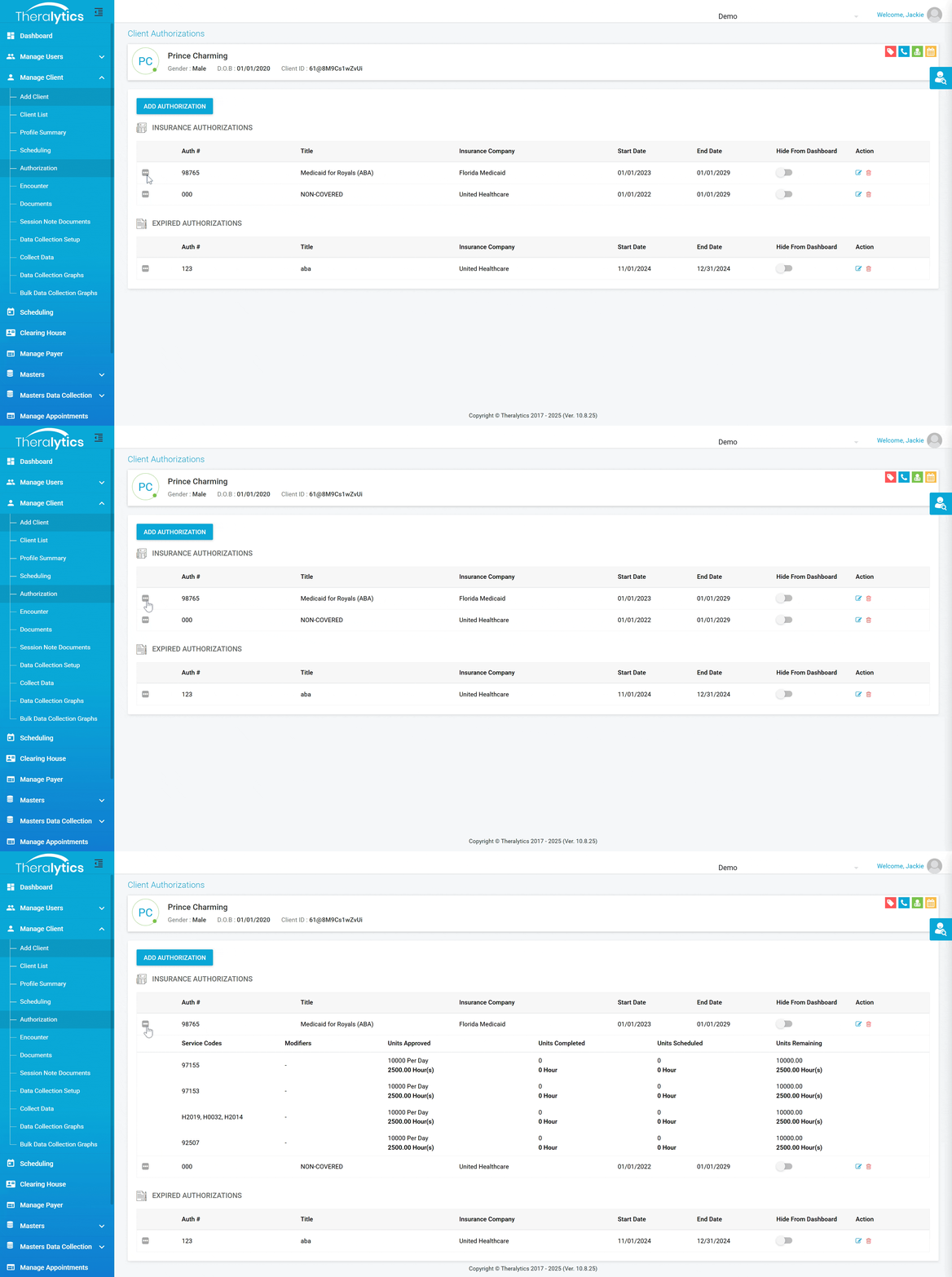
- Authorization data is also embedded directly into the billing workflow. Sessions cannot be cleanly billed without valid authorization alignment, which helps prevent overutilization and out-of-range billing errors before claims are generated. Practices can track remaining units and authorization status in real time, reducing one of the most common causes of ABA claim denials:
Inside each client's profile, you can easily view authorization details, including service codes, approved units, scheduled units, and units remaining, each broken down into units and hours. This keeps scheduling accurate, billing compliant, and service tracking clean for every client.
- Time-based billing accuracy is built in. The system applies CMS rounding rules to session duration automatically, so 8-minute rule calculations don't depend on a staff member's mental math at the end of a session. And for multi-code sessions, the claims workflow keeps each code's time and provider record separate, which holds up under payer review. Theralytics's flexible pricing plans are structured to fit practices of any size managing this complexity.
One ABA practice went from a 78% collection rate to a 98% collection rate after implementing standardized billing workflows through Theralytics, a direct result of fewer coding errors and faster denial follow-up.
Theralytics Payer-Specific Billing Configuration
One of the biggest advantages of Theralytics is its ability to configure payer-specific billing requirements.
Theralytics supports:
- CPT-based and HCPCS-based billing workflows
- Rendering provider vs practitioner-as-rendering-provider rules
- Group NPI and individual NPI billing requirements
- Medicaid and Medicaid MCO-specific modifier requirements
- EPSDT referral tracking
- Tricare-specific billing workflows
- Payer-specific service codes, modifiers, and reimbursement rates
- Custom Tax ID and NPI configurations by payer
- Concurrent billing restrictions and validation rules
These configurations help reduce claim rejections, denials, and credentialing-related billing errors.
Conclusion
Mastering the CPT codes every ABA practice needs to know is the difference between a clean revenue cycle and a constant claims recovery process. The main codes (97151-97158, 0362T, 0373T) don't change frequently, but modifier rules, telehealth requirements, and payer-specific documentation standards shift every year. Staying current on those changes, documenting precisely to each code's requirements, and building payer-specific billing rules into your system prevents the denial patterns that drain practices. If you want a billing setup that enforces CPT code compliance before claims leave your system, book a demo with Theralytics to see how the workflows operate in practice.