
For compliance officers and quality assurance teams in Applied Behavior Analysis organizations, maintaining impeccable clinical documentation is paramount. Recent industry publications highlight a growing focus on documentation integrity and the evolving role of technology in clinical oversight. In August 2026, the Centers for Medicare & Medicaid Services (CMS) released its State Medicaid and CHIP Applied Behavior Analysis Toolkit, which heavily emphasizes medical necessity, individualized treatment, and program integrity. Concurrently, the Council of Autism Service Providers (CASP) published its Practice Parameters for Artificial Intelligence Use in Applied Behavior Analysis, providing a framework for the responsible use of AI in clinical and administrative workflows. Together, these documents underscore the critical need for audit-ready documentation and the potential for AI to assist in that endeavor.
Meeting CMS Requirements and Leveraging AI-Assisted Auditing
The CMS ABA Toolkit outlines clear expectations for clinical documentation that substantiates the services billed. To ensure billing integrity and demonstrate medical necessity, clinical records must accurately describe the services delivered, including relevant dates, duration, and specific activities. Furthermore, treatment plans and session notes must reflect the individual client's assessed needs and clinical circumstances.
To meet these rigorous standards, many ABA organizations are exploring new tech solutions. CASP’s guidelines specifically identify documentation auditing as a highly valuable application of artificial intelligence, particularly when clinical documentation may fall short of adequately supporting medical necessity. AI-assisted documentation auditing can serve as an additional layer of review, helping quality assurance teams identify potential concerns in clinical notes, such as a lack of individualization or missing descriptions of client responses. Rather than replacing established quality assurance processes, AI acts as a supplementary tool to flag areas requiring clarification before a claim is submitted.
Theralytics’ AI Solutions: Flagging Compliance Gaps and Reducing Burden
Aligning with both the CMS toolkit's focus on documentation quality and CASP's endorsement of AI auditing, Theralytics has developed built-in, AI-powered features to support practice compliance. These tools are designed to help clinicians and compliance teams identify potential gaps within session documentation before they become audit liabilities, without replacing professional judgment.
AI Note Review
This feature serves as a proactive auditing tool, evaluating clinical notes across four primary compliance areas highlighted by CMS:
- Individualization: It assesses whether the session note reflects the specific client and their unique clinical circumstances, flagging generic or repetitive language.
- Services Performed: The feature reviews whether the documentation adequately describes the clinical interventions and activities delivered during the session.
- Clinical Justification: It evaluates if the note provides sufficient context to support the clinical rationale for the services rendered.
- Client Response: The tool reviews whether the documentation adequately describes how the client responded to the interventions and services provided.
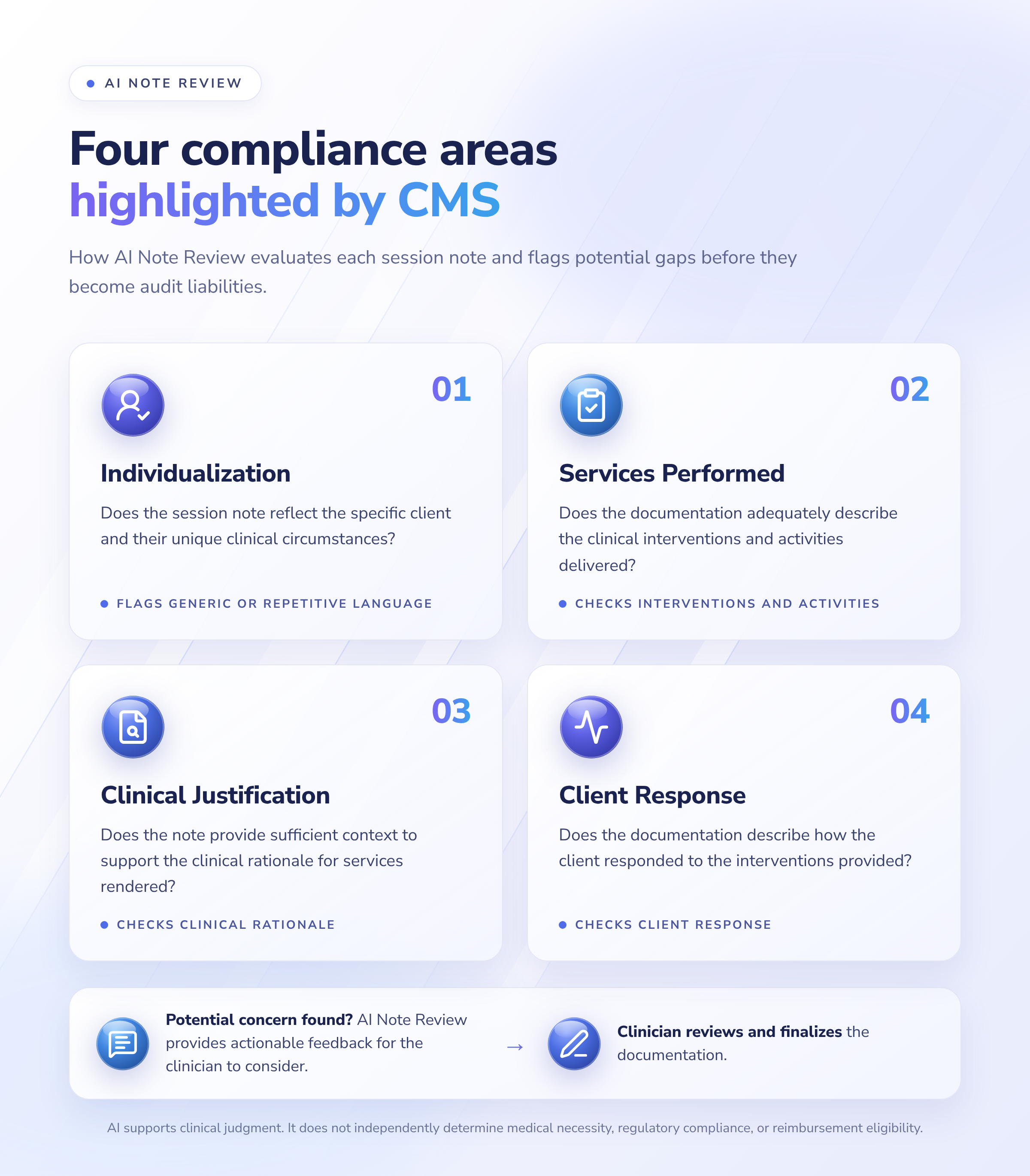
When AI Note Review identifies potential concerns in any of these areas, it provides actionable feedback for the clinician to consider, significantly strengthening the organization's overall documentation quality.
AI Narrative Summary To further assist with compliant documentation from the start, Theralytics includes an AI Narrative Summary tool at no additional cost. Rather than generating notes independently of the clinical encounter, it uses the actual data collected during the session to assist clinicians in drafting narrative summaries. This ensures the foundational documentation accurately reflects the services delivered while drastically reducing the time required to manually translate data into written text.
The Ethical Standard: Preserving Clinician Responsibility
While AI offers powerful tools for compliance and quality assurance, the ethical obligations of the practitioner remain unchanged. CASP's guidance clearly states that AI should support clinical judgment, not replace it. Clinicians must retain full responsibility for reviewing and finalizing their clinical documentation, ensuring it accurately reflects the specific services provided.
Maintaining professional integrity is essential. Practitioners are responsible for avoiding plagiarism and must ensure that AI-generated or AI-assisted content is carefully reviewed for originality. Clinicians must verify that the final documentation genuinely reflects the specific clinical encounter and does not reuse text from other sources without modification. AI tools like Theralytics' AI Note Review and Narrative Summary are designed to provide feedback and support documentation quality, but they do not independently determine medical necessity, regulatory compliance, or reimbursement eligibility. By keeping the clinician in complete control of the final output, ABA organizations can confidently use Theralytics to enhance their audit-readiness while upholding the highest ethical standards.