


The ABA reimbursement cuts 2026 are no longer a forecast. Several state Medicaid programs have already reduced rates, capped weekly and lifetime hours, or added authorization steps that function like a cut even when the fee schedule stays flat. CMS published a 173-page ABA Toolkit in August 2026 that gives every remaining state a template to do the same.
Commercial payers are moving in the same direction on a slower clock, mostly through claim edits and network design rather than published rate reductions.
This is not a story about one bad budget year. It is a structural reset of a benefit that grew faster than any state built controls for, or any state budget could afford. Practices that understand the mechanics can adjust. Practices that treat it as a temporary squeeze will find out too late that the old rates are not coming back.
Below is what changed, which states moved, what the CMS Toolkit actually asks for, and the billing controls that hold margin together at lower rates.
What Is Driving ABA Reimbursement Cuts in 2026?
ABA reimbursement cuts in 2026 are driven by a spending curve that outran utilization. According to CMS data published in the State Medicaid and CHIP Applied Behavior Analysis Toolkit, total Medicaid and CHIP payments for ABA services rose from roughly $1.94 billion in 2021 to $10.1 billion in 2025. That is a 421% increase over four years.
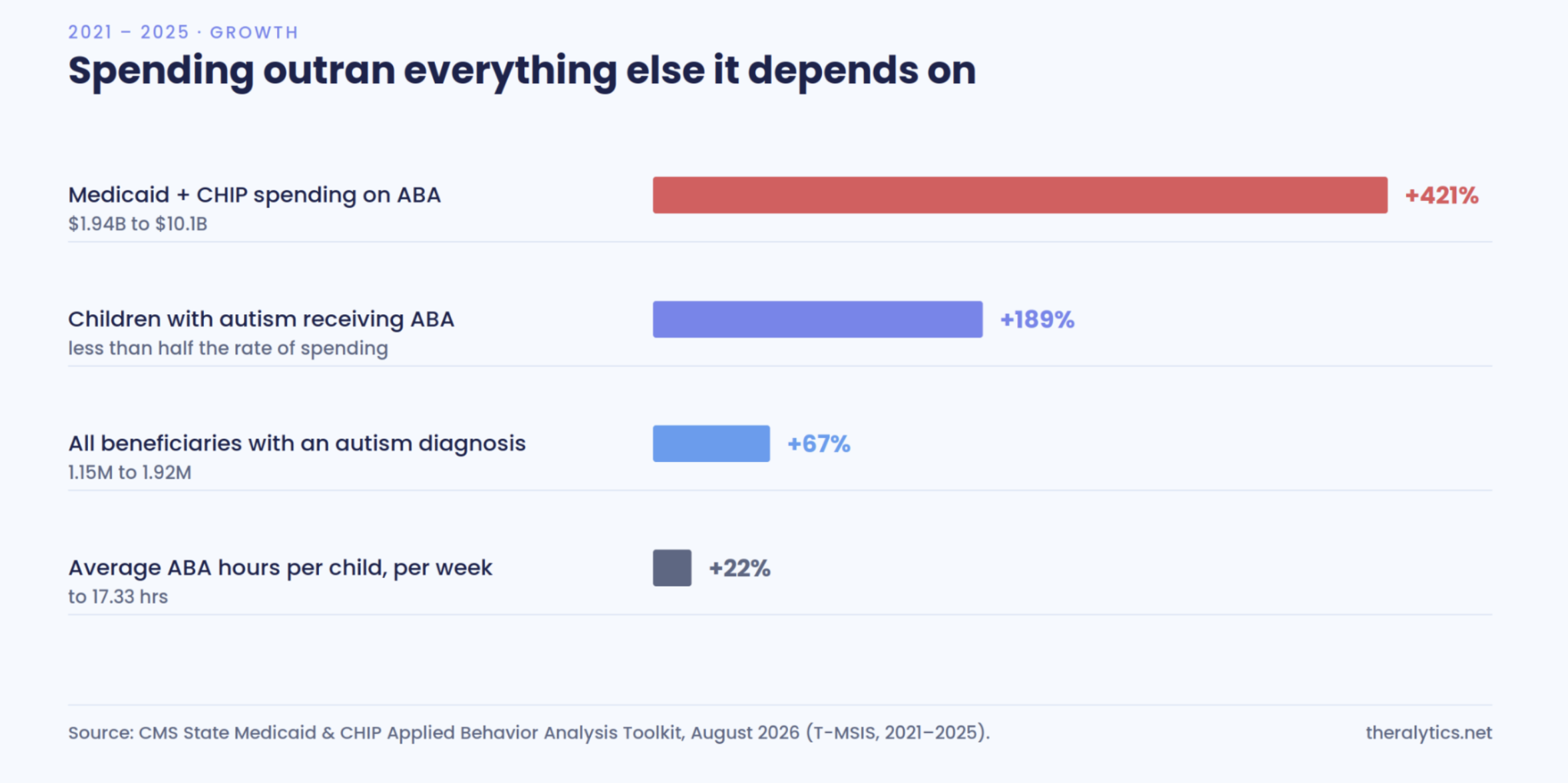
Over the same period, the number of children with an autism spectrum disorder diagnosis who received ABA services grew 189%. The number of Medicaid and CHIP beneficiaries with an ASD diagnosis receiving any service grew 67%, from 1.15 million to 1.92 million.
Spending grew more than twice as fast as the population being served. Two things explain most of that gap.
Hours per beneficiary increased. CMS reports that beneficiaries receiving ABA for ASD averaged 17.33 hours of weekly treatment in 2025, a 22% increase since 2021. More children, each receiving more hours, compounds quickly.
Audits found money that should not have been paid. Federal and state oversight reviews in Colorado, Indiana, Wisconsin, Maine, Massachusetts, Nebraska, and Nevada have collectively identified at least $198.4 million in improper Medicaid payments. Colorado produced the largest single finding: a February 2026 HHS Office of Inspector General report identified at least $77.8 million in improper fee-for-service ABA payments. The same audit flagged care delivered by an estimated 1,500 to 2,000 uncredentialed behavioral technicians.
There is a detail in those audits worth pondering. CMS states plainly in the Toolkit that not every improper payment is fraud. A missing supervision signature or an incomplete session note is a systems failure, and it recoups exactly the same way a fraudulent claim does. So while the error may not be the result of intentional activity, the dollars are recouped nonetheless.
There is also a piece of the spending picture that gets less attention. In 2025, $1.47 billion, or 14.5% of all Medicaid and CHIP ABA spending was related to ABA services delivered for conditions other than autism. That number is now visible to every state budget office in the country.
ABA Reimbursement Cuts 2026 by State
Six states have cut or attempted to cut ABA rates, and the changes take different forms. Some reduced the fee schedule. Others left rates alone and capped hours, which produces the same revenue effect.
| State | What changed | Effective |
| New York | 25% reduction for technician-delivered ABA, phased in two 12.5% tranches. CPT 97153 fell from $19.26 to $16.85, then to $14.45 per 15-minute unit. | Oct 1, 2025 and Apr 1, 2026 |
| Indiana | 6% maximum fee reduction on all non-group ABA services, plus weekly hour caps by diagnosis and a 4,000-hour lifetime cap. Coverage narrowed to EPSDT, meaning under age 21. | Apr 1, 2026 |
| Nebraska | Rate reductions reported between 28% and 79% depending on the service, plus a 30-hour all inclusive weekly cap. | Aug 2025 |
North Carolina | A 10% cut to research-based behavioral health treatment was implemented, challenged in court, and reversed. Restored fee schedules were republished January 5, 2026. Yet on August 1, 2026, hour caps and authorization periods were implemented for treatment plans with over 16 total hours per week resulting in a 90 day auth. | Cut Oct 2025, reversed Dec 2025 New caps August 2026 |
| Colorado | Payment reductions under discussion following the OIG audit. The state faces a recommended $42.6 million federal refund with a further $112.5 million under review. | Ongoing |
| Minnesota | No rate cut and enforcement-driven pressure instead. Eighty-five (85) open provider investigations and a $1 billion CMS payment deferral shared with California in July 2026. | Ongoing |
North Carolina is the most instructive case in that table. The state singled out the service category covering ABA for the steepest reduction on its fee schedule. Parents sued, arguing the state had targeted a protected class of patients. A Wake County judge granted a temporary restraining order, and the governor directed the department to restore rates in December 2025.
Providers won that round. They did not walk away unchanged. House Bill 696 followed with in-person assessment requirements, a 50% cap on telehealth supervision, and a minimum oversight floor for licensed supervising professionals. The rate came back with conditions attached.
That pattern is the critical factor. When a rate cut fails politically or legally, the money usually gets recovered through authorization limits, documentation standards, and audits instead. If a state is experiencing a shortfall in the budget, the money has to come from somewhere.
What ABA Rates Actually Look Like Across States
Before reading any cut as severe, check the base it was applied to. The CMS Toolkit publishes reported 2025 fee-for-service rates by state and CPT code in Appendix E, and the spread is wider than most providers assume.
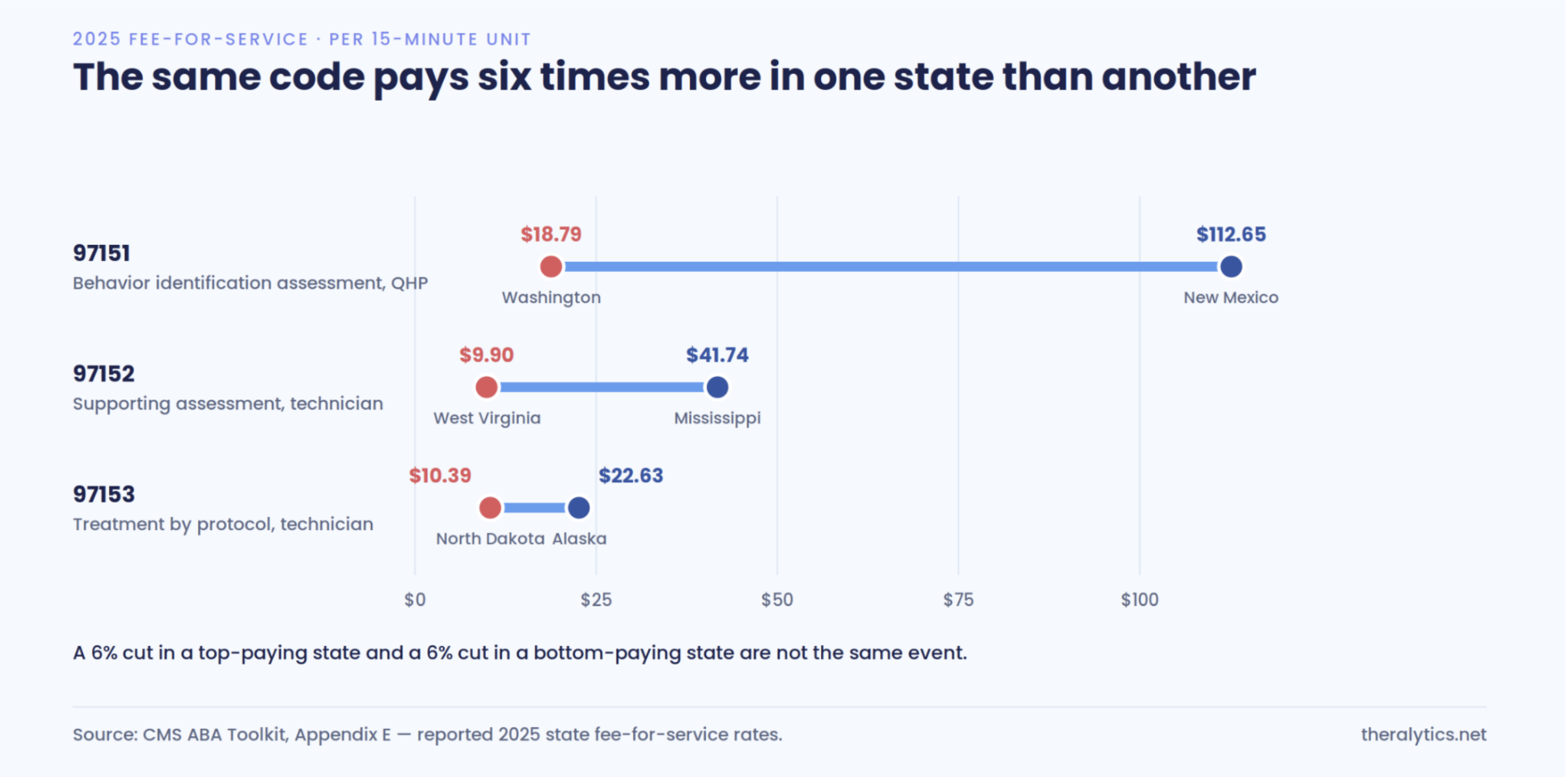
| CPT code | Lowest state rate | Highest state rate |
| 97151, behavior identification assessment by a qualified professional | $18.79, Washington | $112.65, New Mexico |
| 97152, supporting assessment by a technician | $9.90, West Virginia | $41.74, Mississippi |
| 97153, adaptive behavior treatment by protocol, technician | $10.39, North Dakota | $22.63, Alaska |
All rates are per 15-minute unit. The 97151 spread is six-fold for identical work.
This matters for two reasons. First, a 6% cut in a state paying near the top of the range lands very differently than the same cut in a state already near the bottom. Second, CMS is explicitly encouraging states to benchmark against each other. Indiana framed its April 2026 reduction as bringing rates closer to the national average. Any state currently paying above the median should expect that comparison to surface in its next budget cycle.
If you operate in more than one state, pull your own rates against Appendix E before planning next year's payer mix. Assume that over the next few years, rates and factors influencing rates will continue to shift to accommodate the change in the patient volume and industry landscape.
The Non-Autism Billing Problem
ABA billed for conditions other than autism is the fastest-growing and most exposed category in the entire benefit. Spending on non-ASD diagnosed services rose from $77.6 million in 2021 to $1.47 billion in 2025, an increase of 1,789%. That is more than four times the growth rate of ABA overall.
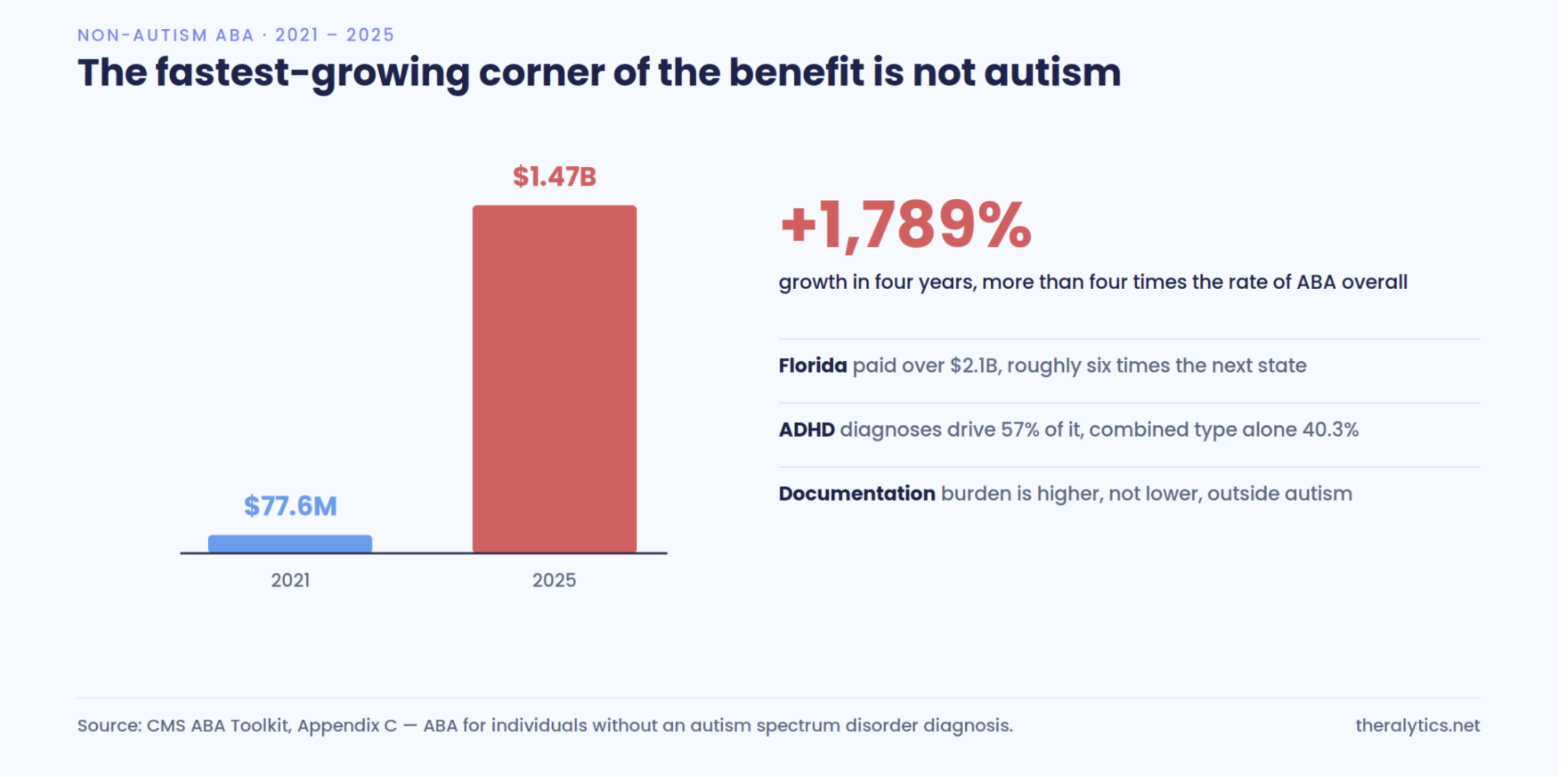
The concentration is stark. Florida paid more than $2.1 billion for non-autism ABA services across those five years, roughly six times Colorado, the next highest state. On the diagnosis side, ADHD as a diagnosis accounts for 40.3% of all non-autism ABA service spending, and five ADHD diagnoses codes together account for 57%.
CMS does not say this billing is improper. The Toolkit states that ABA must be medically necessary, clinically appropriate, and tailored to the individual regardless of diagnosis. But a category that grew nearly eighteen-fold in four years, concentrated in one state and one diagnosis family, is the kind of pattern that draws policy attention fast.
If your practice bills ABA outside of an autism diagnosis, the documentation burden is high. Medical necessity rests on functional impairment and treatment response, and the treatment plan must demonstrate why ABA specifically, rather than another behavioral intervention, is the most appropriate and least costly modality of choice.
What the CMS ABA Toolkit Actually Says
The CMS ABA Toolkit is guidance for state Medicaid agencies, not a federal rule for providers. CMS released the 173-page document in August 2026. It explicitly does not create new federal requirements; does not reduce EPSDT obligations for children under 21; does not endorse any single treatment approach; and does not direct states to restrict medically necessary care.
That is the accurate reading at best and is the reason the Toolkit matters. It gives 50 fragmented state programs a shared vocabulary and a shared checklist to implement. States rewriting Medicaid manuals, managed care contracts, prior authorization rules, and audit procedures now have a common template to use.
Seven chapters cover an ABA overview, clinical standards, coverage authorities, payment methodology, provider qualifications and credentialing, utilization management, and program integrity. Appendix A includes state checklists and Appendix E lists reported state rates by CPT code. The full toolkit is published on Medicaid.gov and is worth reading directly if your state has not yet updated its ABA policy, since it previews the principles upon which your next audit will be based.
The Hours Question
The Toolkit takes a clear position on treatment intensity. It states that 40 hours of ABA per week is not a best practice. The reasoning is that children need time for activities of daily living such as eating, toileting, and napping. CMS also warns that states authorizing 40-hour service weeks expose themselves to negative audit findings.
CMS suggests aligning weekly hours to DSM-5-TR severity levels, authorizing 10, 20, and 30 hours for Levels 1, 2, and 3, as an example. It also cites research finding no consistent correlation between higher weekly hours and better outcomes, including two meta-analyses that found no difference between programs under 20 hours per week and programs at 20 hours or more.
North Carolina is already ahead in the throes of such change. State law passed in 2026 requires that any ABA service plan exceeding a total of 16 hours per week be approved by the state health department or the managed care plan in three month increments.
If your median authorization sits at 30 or more hours per week, expect that number to be questioned. The defense is not a policy argument; it is a treatment plan that documents why this child, at this severity level, needs those hours and then demonstrates conformance with the treatment plan.
Documentation Flags That Trigger Recoupment
The Toolkit publishes a list of treatment documentation flags states can use to identify potential improper billing. Practices should treat this as an internal audit checklist, the same as state auditors will apply it.
- Identical documentation across individuals from the same provider or clinic
- Excessive service hours continuing without documented improvement in outcomes
- Reevaluations that show no progress and no adjustment to the treatment plan
- Group therapy accounting for more than 10% of treatment time
- Interventions and goals that are not age-appropriate
- High staffing ratios without clinical justification, such as two providers with one child
- Overlapping treatments billed for the same period
- Lack of parent or caregiver engagement
Two more items deserve spotlighting. CMS advises states to require at least one standardized outcome assessment instrument and to stop accepting provider-created outcome measures. It also suggests states consider disallowing consolidated billing, where every 15-minute unit is billed on a single claim line, because that practice hides whether therapy was ever paused for daily living activities.
Copy-and-paste treatment plans are named directly in the Toolkit. If your treatment plan template produces goals that read the same across a caseload, that is a finding waiting to be discovered. Reviewing your ABA billing compliance procedures against this list is a reasonable place to start.
The Numbers CMS Told States to Watch
Chapter 7 of the Toolkit is unusually specific about what triggers scrutiny. These are the risk indicators CMS recommends states monitor through claims analytics:
- Service hours above 32 units per day or 160 units per week per beneficiary
- Technician-to-supervisor ratios that exceed expected norms
- Providers billing maximum hours for 80% or more of their patients
- Rapid billing growth immediately following provider enrollment
- Claims clustering around supervision codes or modifiers
- High-volume providers with limited credentialed supervisory staff
- Excessive use of telehealth, including telehealth supervision
Run these against your own claims before someone else does. A practice that cannot explain why 80% of its caseload sits at the authorized maximum will have a challenging audit, even when every individual case is defensible.
The documentation stakes are real. CMS notes that in some state audits, 100% of sampled claims were missing documentation or had incomplete documentation. The three completed OIG audits also found large volumes of claims flagged as potentially improper beyond the confirmed findings: Wisconsin had $18.5 million confirmed and an additional $94.3 million under question, and Indiana had $56.5 million confirmed and $76.7 million additionally flagged.
CMS also recommends states extend Electronic Visit Verification to ABA, which federal law currently requires only for personal care and home health. Home-based ABA is named specifically as a vulnerability because of its volume and decentralized delivery. If you deliver in homes, assume EVV is coming to your state whether or not it is there today. Detailed guidance on preparing for review is in our guide to ABA billing audit protection.
Commercial Funders Are Following Medicaid
Commercial insurers are tightening ABA reimbursement on a parallel track, usually through claim requirements and network design rather than published rate cuts.
Optum now requires NPI and taxonomy codes for both the billing provider and the rendering provider on commercial behavioral health claims. Informational edits started in October 2025 to flag missing data and full enforcement during 2026. Optum validates those codes against the National Plan and Provider Enumeration System, so a taxonomy mismatch in NPPES becomes a rejected claim.
Aetna is assembling a preferred network of autism providers, steering members toward practices it judges to produce better results and bill by their standards. That is a different kind of pressure than a rate cut. It shifts the competitive question from what a plan pays to which providers get accepted into the network.
The industry read is consistent. Jim Spink, CEO of Autism Care Partners, has described the pattern as state Medicaid authorities reducing rates and commercial payers then attempting similar reductions.
For practices, the feasible exposure sits in rendering provider data. If you cannot prove, per claim, which technician delivered which session and which BCBA supervised it during that authorization period, both Medicaid audits and commercial edits become expensive. Getting rendering provider requirements in ABA billing correct is now a revenue control, not a paperwork detail.
The Shift to Managed Care, and the Deadlines That Protect You
ABA is moving into managed care fast. In 2025, total payments for ABA delivered through Medicaid and CHIP managed care encounters nearly doubled while fee-for-service payments declined. More states are folding ABA into managed care contracts, which changes who sets your rate, who reviews your authorizations, and who audits you.
One gap in that shift is worth understanding: National Correct Coding Initiative edits, the automated checks that catch incompatible code combinations and impossible unit counts, are federally mandated only for fee-for-service claims. They apply to managed care plans only when a state's contract requires them. CMS is telling states to close that gap, so expect claim edits you have not seen before as contracts renew.
Managed care also comes with enforceable timelines. For rating periods starting on or after January 1, 2026, a standard prior authorization decision and notice must be issued as quickly as the enrollee's condition requires and no later than 7 calendar days after the request. Extensions are capped at 14 additional calendar days and require justification. Expedited decisions must come within 72 hours, with no extension available in fee-for-service.
Track those dates. A managed care plan sitting on an authorization past the deadline is out of compliance, and knowing the number is what turns a follow-up call into a resolved authorization.
On telehealth, the Toolkit reports that 22 states permit ABA telehealth without significant restrictions while 28 impose conditional access, such as requiring an in-person assessment first or limiting telehealth to supervision and caregiver coaching. Medicaid and CHIP telehealth ABA payments passed $300 million in 2025. CMS is clear that telehealth should be an adjunct rather than the primary modality, and that supervision should never be delivered entirely by telehealth.
What a Rate Cut Actually Does to Your Margin
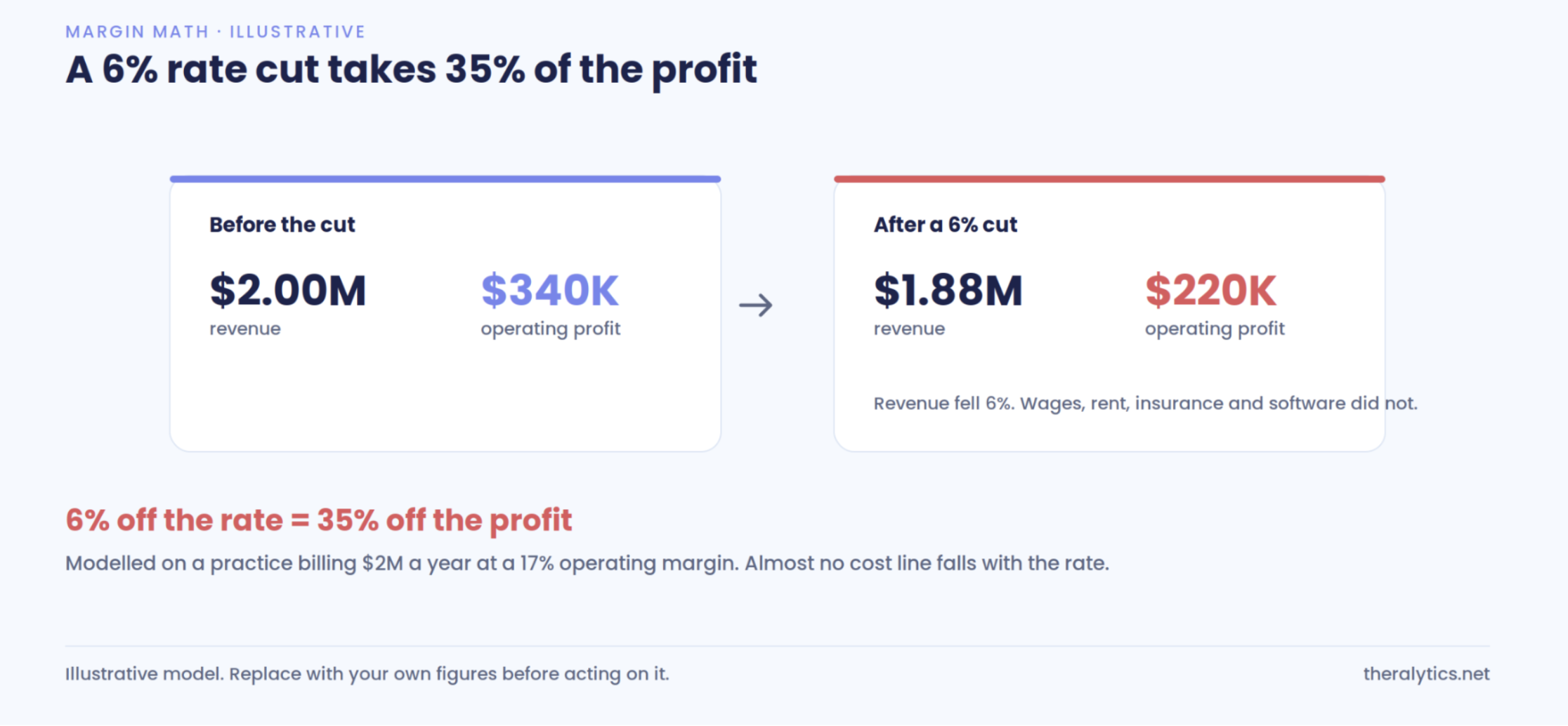
A rate cut hits net margin much harder than the headline percentage suggests, because almost none of your costs move with the rate.
Take a practice billing $2 million a year with a 17% operating margin. That is $340,000 in operating profit. Apply Indiana's 6% fee reduction across the board and revenue drops to $1.88 million. Wages, rent, insurance, and software cost do not decrease accordingly. Operating profit falls to roughly $220,000, a 35% reduction in profit from a 6% reduction in rate.
Now apply New York's 25% technician rate cut to a practice where 97153 direct therapy drives most of the revenue. That practice does not have a margin problem, it has a business model problem.
This math is why the response cannot be "absorb it." The offsets have to come from collections, utilization, and administrative cost, and all three have to move at once. Practices already managing rising costs against falling reimbursement know the arithmetic leaves very little slack.
Seven Moves That Protect Margin Under Lower Rates
1. Close the gap between authorized and delivered hours
Authorized hours you never deliver converts to revenue you already earned the right to bill. Under lower rates, unused authorization is the most expensive line item in the practice. Track utilization per client per authorization period and flag anything running below 90%. Scheduling that ties directly to authorization balances, like the authorization-linked scheduling in Theralytics, prevents both under-delivery and the overbooking that produces denials.
2. Get first-pass clean claim rate above 95%
Every reworked claim costs staff time that lower rates no longer fund. Claim scrubbing before submission catches CPT and modifier mismatches, missing authorizations, and credential errors while they are still free to fix. A connected ABA billing system that pulls session data straight into claim generation removes the manual re-entry step where most of these errors start.
3. Standardize treatment plans without templating them
This sounds contradictory and is not. Standardize the structure, the required fields, the assessment cadence, and the outcome instrument. Individualize the goals, the baselines, the rationale for hours, and the transition plan. That combination survives an audit. A template that produces identical goals across a caseload does not.
4. Adopt a standardized outcome instrument now
CMS named the instruments states should accept, including the VB-MAPP, ABLLS-R, AFLS, Essential for Living, and the PEAK assessment. If your practice relies on internally built progress measures, replace them and train your team before a state requires the change. Being able to produce a payer-facing outcomes report on demand is becoming a network access requirement, not a differentiator.
5. Make supervision documentation airtight
Supervision gaps are one of the most common audit findings and one of the easiest to fix. The Toolkit sets out the expected ratios: 1 to 2 hours of supervision for every 10 hours of direct treatment, or 1 to 2 hours per week when direct treatment runs 10 hours or less. Registered Behavior Technicians carry a separate minimum requirement of 5% of their monthly direct service hours, with at least two supervisory contacts and one direct observation per month.
One requirement that gets missed often includes BCBAs should personally hold at least 25% of the supervision across their caseload rather than delegating all of it to BCaBAs, unless there is a documented reason such as a planned fade-out, or an experienced assistant analyst. Every RBT-delivered session needs evidence of oversight with frequency, content, and the supervising BCBA's NPI. Where telehealth supervision is capped, as it now is in North Carolina at 50%, you need to easily demonstrate the breakdown of remote versus direct supervision.
Budget for the cost, too. The Toolkit notes that BCBAs may spend 25% to 30% of their time on indirect supervision and administrative work that may not be billable. That becomes a real line item with significant impact when rates fall.
6. Verify EVV and session data match your claims
States are increasingly reconciling claims against Electronic Visit Verification data and schedules. Any mismatch between the session as scheduled, the session as documented, and the session as billed is an audit opening. Offline mobile data collection with GPS-verified signatures, which the Theralytics mobile app supports, keeps that chain intact even when sessions happen in homes without reliable connectivity.
7. Cut administrative cost per billable hour
When the rate per unit falls, the admin cost per unit has to align. That usually means consolidating systems rather than adding staff. Practices running scheduling in one platform, data collection in another, and billing in a third pay for the same information three times and reconcile it by hand. For a more robust approach to revenue cycle mechanics, our guide to ABA revenue cycle management covers the workflow end to end.
The Metrics That Tell You Early
Under stable rates, monthly financial review is enough. Under falling rates, it is too slow. These are the numbers to watch weekly.
| Metric | Target | Why it matters more now |
| Net collection rate | 95% or higher | Below 95% means the cut compounds with leakage |
| Days in accounts receivable | 30 to 45 days | Lower rates shrink the cash buffer that hides A/R problems |
| First-pass clean claim rate | Above 95% | Rework cost per claim is unchanged when rates fall |
| Authorization utilization | 90% to 100% | Unbilled authorized hours are the cheapest revenue available |
| Billable utilization, RBT | 75% to 85% | Non-billable time is more expensive at lower rates |
| Documentation lag time | Under 24 hours | Late notes become denials, and denials become recoupments |
Pulling these by hand every week is not realistic for most teams. Reporting and analytics dashboards that surface them automatically turn a monthly postmortem into a weekly correction.
Frequently Asked Questions
Are ABA reimbursement cuts happening in every state in 2026?
No. Rate cuts are concentrated in states where ABA spending grew the fastest, including New York, Indiana, Nebraska, and Colorado. North Carolina cut rates and then reversed them, yet not without other implications to revenue. Most states have not changed their fee schedules. What has changed nationally is oversight, since every state now has the CMS ABA Toolkit as a template for tightening authorization and audit rules.
Does the CMS ABA Toolkit cut ABA reimbursement?
No. The CMS ABA Toolkit is guidance for state Medicaid and CHIP agencies. It creates no new federal requirements and does not reduce EPSDT obligations for children under 21. It gives states a menu of levers covering documentation, benefit design, credentialing, utilization management, payment methodology, and program integrity analytics that they can choose to apply.
Will 40-hour ABA authorizations still be approved in 2026?
Increasingly, no, at least not by default. CMS states that 40 hours per week is not a best practice and warns states that authorizing that intensity creates audit exposure. High-intensity authorizations now need documented clinical justification in the treatment plan, and some states require separate approval above a threshold. North Carolina requires state or plan approval for any plan above 16 hours per week, with reauthorization every 90 days.
What triggers an ABA Medicaid audit?
Common triggers include identical documentation across clients, sustained high hours without documented outcome improvement, and group therapy exceeding 10% of treatment time. Staffing ratios above one provider per child without justification also constitutes reason for review, as do credentialing mismatches between the rendering provider and the billed payer. Most of these are visible in claims data before anyone reads a client record.
How much notice do providers get before a state rate cut?
Less than most practices assume. Indiana's April 1, 2026 changes were announced through the state's provider bulletin process. New York's reduction came through the enacted state budget. North Carolina implemented cuts on October 1, 2025 with limited lead time following a legislative funding shortfall. Watching your state's Medicaid bulletin and budget process is the only reliable early warning, which is one reason state-level changes like the Medi-Cal enrollment updates in California are worth tracking closely.
What is the Medicaid reimbursement rate for ABA therapy?
It depends heavily on the state and the code. In 2025, technician-delivered adaptive behavior treatment under CPT 97153 ranged from $10.39 per 15-minute unit in North Dakota to $22.63 in Alaska. Assessment by a qualified professional under 97151 ranged from unit reimbursement of $18.79 in Washington to $112.65 in New Mexico. Rates also vary within states by provider credential and site of service. Appendix E of the CMS ABA Toolkit lists reported fee-for-service rates by state and CPT code.
Is Medicaid still paying for ABA when the diagnosis is not autism?
Yes, and that spending grew sharply. Payments for ABA delivered to beneficiaries without an autism diagnosis rose from $77.6 million in 2021 to $1.47 billion in 2025. ADHD diagnoses contributed to most of it, with ADHD combined type alone accounting for 40.3%. CMS has not restricted this billing, but it flagged the trend and reminded states that ABA must be medically necessary and individualized regardless of diagnosis. Practices billing outside an autism diagnosis should expect closer review.
Should we drop Medicaid and go commercial only?
Rarely, and not as a first move. Commercial rates typically run 15% to 25% above Medicaid, but commercial payers are tightening claim requirements and building preferred networks of their own. A payer mix weighted toward commercial with meaningful Medicaid volume spreads the risk better than either extreme. Practices weighing this should model it against real collection data rather than rate cards, and our breakdown of what it costs to run an ABA company walks through the payer mix math.
The Bottom Line
ABA reimbursement cuts in 2026 are a correction to a benefit that grew without cost controls. That framing is not a defense of the cuts, and it does not make them fair to providers who built responsible practices at the old rates. It does explain why they are unlikely to reverse across the board.
The practices that excel through this will be the ones who can prove what they did and why. Which technician delivered the session, which BCBA supervised it, what the standardized outcome instrument showed, why this child needs these hours, and whether the claim matches the schedule and the note. None of that is new clinical work. It is an understanding and records problem, and records and training problems are solvable.
Theralytics was built by a BCBA who ran ABA organizations, and it connects scheduling, data collection, documentation, and billing in one system so the audit trail assembles itself instead of being reconstructed after a request arrives. One multi-location practice moved from a 78% to a 98% collection rate after standardizing its billing workflows. Under 2026 rates, that 20-point difference is the difference between a viable practice and a struggling one.
If reimbursement pressure is already showing up in your numbers, book a 15-minute call and we will look at where the leakage exists.