


ABA Medicaid changes by state 2026 is not one story. Some states cut rates. Some left rates alone and capped hours, which produces the same revenue effect. Some added accreditation or licensure mandates that decide whether you can bill at all. And several tightened prior authorization without touching either.
If you operate in more than one state, the practical problem is that these four kinds of change require completely different responses. A rate cut is a pricing problem. An accreditation mandate is an 18-month project. Confusing the two is how practices get caught.
This guide covers what changed in each state, when it takes effect, and which category it falls into.
The Four Kinds of Change
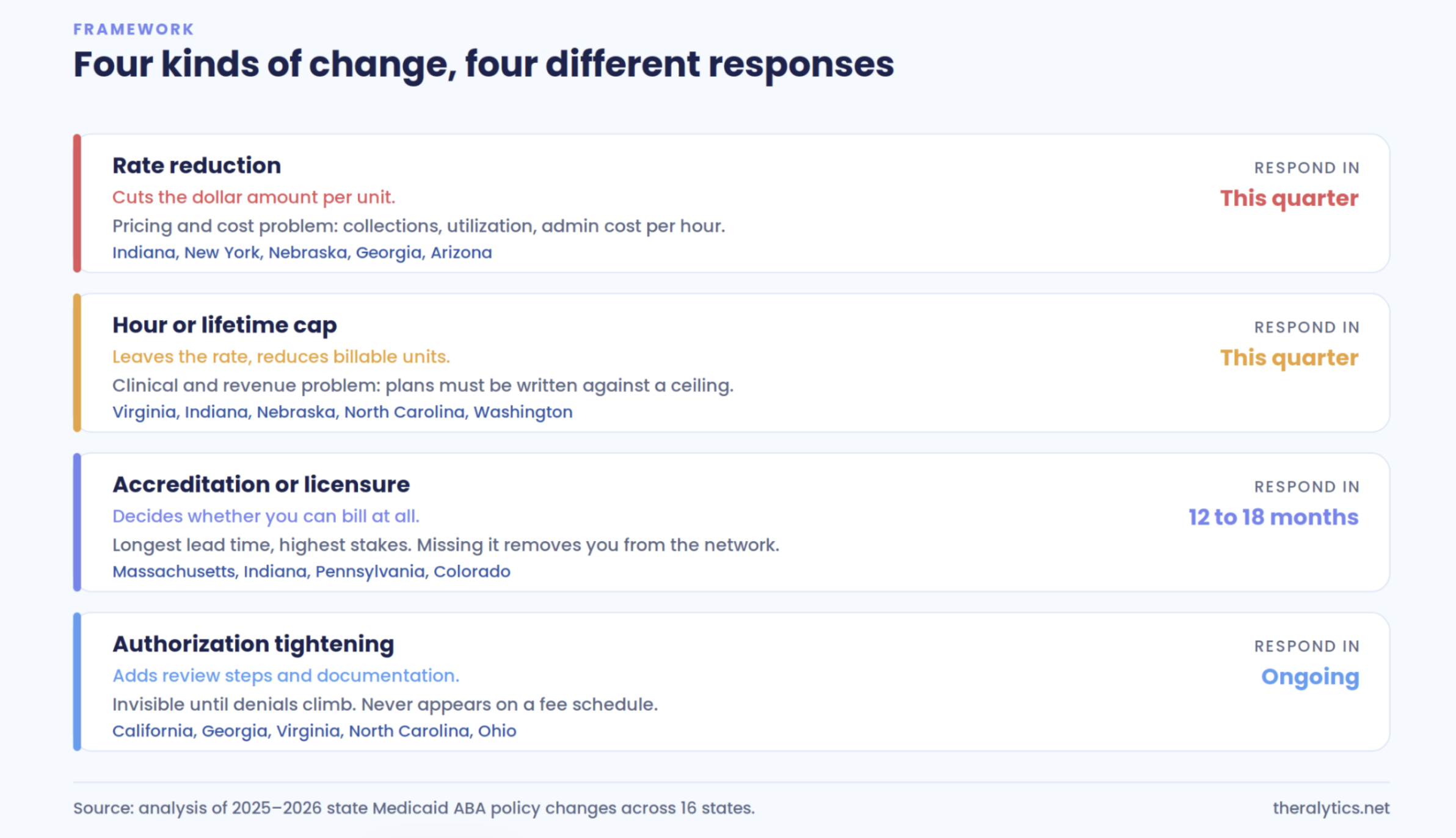
Before the state detail, it helps to know which category you are dealing with, because the response timeline is different for each.
Rate reductions cut the dollar amount per unit. The response is a pricing and cost problem: collections, utilization, and admin cost per billable hour. Indiana, New York, Nebraska, and several managed care plans have done this.
Hour and lifetime caps leave the rate alone and reduce the units you can bill. This hits revenue the same way a rate cut does, but it also changes clinical practice, because treatment plans have to be written against a ceiling. Indiana, Virginia, Nebraska, and North Carolina have moved here.
Accreditation and licensure mandates decide whether you can participate at all. These have the longest lead time and the highest stakes, because missing a deadline removes you from the network rather than shrinking your margin. Massachusetts, Indiana, Pennsylvania, and Colorado are the leaders.
Utilization management tightening adds authorization steps, documentation requirements, and review cycles. It does not appear on a fee schedule, so it is easy to miss until denials climb. California, Georgia, Virginia, and North Carolina have all moved here in 2026.
ABA Medicaid Changes by State 2026: The Full Table
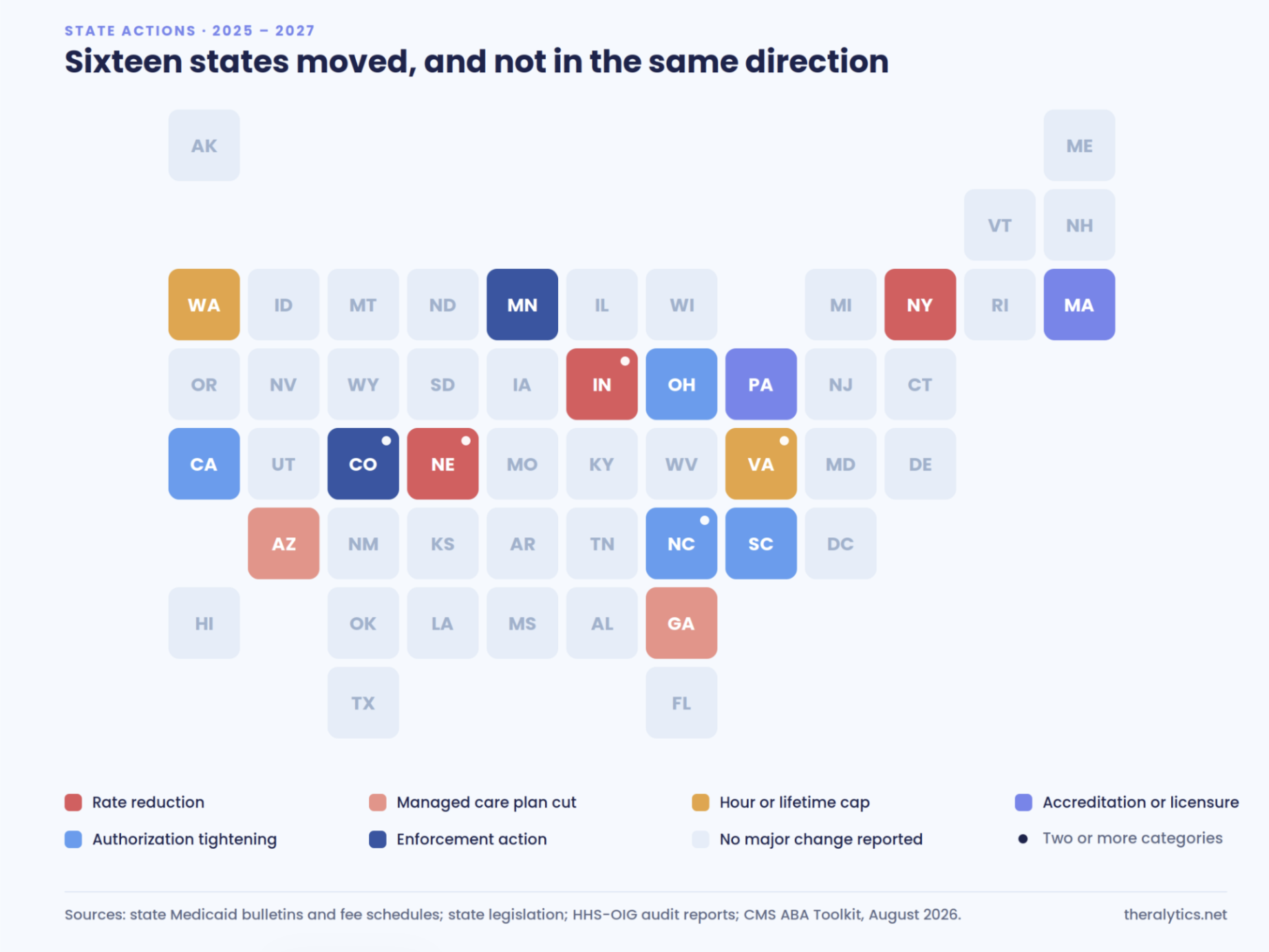
| State | Category | What changed | Effective |
| Indiana | Rate, caps, accreditation | 6% rate cut, further 4% scheduled, 4,000-hour lifetime cap, severity-tiered weekly caps, accreditation required | Apr 1, 2026 |
| Virginia | Caps, UM | 20-hour weekly limit, ASD diagnosis required, provisional diagnosis for age 5 and under | Pending CMS approval |
| North Carolina | Reversed cut, UM | 10% cut restored after litigation, then HB 696 and Policy 8F oversight rules | Aug 1, 2026 |
| California | UM | Draft All Plan Letter replacing APL 23-010, step-down and documentation requirements | Draft, June 2026 |
| Arizona | Plan-level cuts | Mercy Care cut 15% then 25%, followed by provider contract terminations | Jul and Oct 2025 |
| Georgia | Plan-level cut | CareSource 20% ABA rate cut; $15.86M rate parity funding vetoed | May 11, 2026 |
| South Carolina | Manual rewrite | New ASD Services Provider Manual and fee schedule; school-based ABA law | Jul 1, 2026 |
| New York | Rate | 25% reduction for technician-delivered ABA in two tranches | Oct 2025, Apr 2026 |
| Nebraska | Rate, caps | 48% cut for behavior technicians, up to 79% for some services, 30-hour weekly cap | Aug 1, 2025 |
| Colorado | Licensure, UM | Facility licensure, behavior analyst licensure enacted, prior authorization litigation | 2026 |
| Massachusetts | Accreditation | Managed care entities may contract only with accredited ABA providers | Jan 2027 and Jan 2028 |
| Minnesota | Enforcement | No rate cut. 85 open investigations, criminal convictions, $1B CMS deferral | Ongoing |
| Pennsylvania | Licensure | IBHS agency licensure requirements | In effect |
| Ohio | Enrollment | Revamped behavioral health provider vetting, slower new-applicant approvals | Ongoing |
| Washington | Caps | Limits on optional programs and home and community-based services including ABA | 2025 |
| Florida | Managed care | SMMC 3.0 carve-in operational, fee schedule held, no caps imposed | Feb 2025 |
The detail on the states with the largest changes follows.
Indiana
Indiana has the most comprehensive set of changes in the country, and it is worth studying even if you do not operate there, because other states are borrowing from it.
The Office of Medicaid Policy and Planning published notice of a phased rate adjustment: individual ABA service rates fell 6% on April 1, 2026, with an additional 4% reduction scheduled for April 1, 2027. That second cut is often missed. Practices modeling only the 6% are underestimating the two-year impact by roughly a third.
Alongside the rate reduction, Indiana imposed a 4,000-hour lifetime cap on ABA, weekly hour caps tiered by symptom severity, and narrowed coverage to EPSDT, meaning beneficiaries under 21. The state also announced in January 2026 that agencies enrolled in Indiana Medicaid must have begun the accreditation process by August 1, 2026.
The context is spending growth. Indiana Medicaid ABA spending rose from $21 million in 2017 to $611 million in 2024. A December 2024 HHS Office of Inspector General audit found at least $56 million in improper fee-for-service payments.
If you bill Indiana Medicaid, three dates matter: the April 2026 cut already in effect, the August 2026 accreditation milestone, and the April 2027 second reduction.
North Carolina
North Carolina is the clearest example of a cut that failed and came back as oversight instead.
The state implemented a 10% reduction to research-based behavioral health treatment on October 1, 2025. Families sued, a Wake County judge granted a temporary restraining order, and the governor directed the department to restore rates in December 2025. Corrected fee schedules were republished on January 5, 2026.
What followed was not a return to the previous status quo. Governor Stein signed House Bill 696 on April 30, 2026, a $319 million Medicaid funding bill that also requires monthly eligibility checks and funds a performance audit of the program. NC Medicaid then published an updated Clinical Coverage Policy 8F effective August 1, 2026, with follow-up bulletins on August 5 and August 31. The changes providers need to act on:
- Paraprofessional certification is now mandatory. Paraprofessionals delivering research-based behavioral health treatment must hold either the RBT certification from the BACB or the ABAT certification from QABA for services to be reimbursed. Existing staff have a 120-day grace period starting August 1, 2026. New hires have 120 days from date of hire.
- Uncertified paraprofessionals require LQASP supervision during the grace period, under Session Law 2026-1 Section 3C.18.(a)(8), and that requirement stays in place until certification is complete.
- In-state enrollment is required. Licensed Qualified Autism Service Providers and Certified Qualified Professionals, including BCBAs and BCaBAs, seeking to enroll in NC Medicaid must enroll as in-state providers.
- Some RB-BHT codes were discontinued for dates of service on or after August 1, 2026. Existing authorizations remain valid because they are managed under the base service code.
- Assessment standards tightened. Every beneficiary must receive a behavioral, adaptive, or functional assessment using documented, clinically appropriate, scientifically validated tools, and every treatment plan must be based on one.
- Provisional diagnoses expire. A beneficiary must have a confirmed ASD diagnosis within six months of a provisional diagnosis.
The certification requirement is the one to move on first. A 120-day grace period from August 1 means uncertified staff need to be enrolled in an RBT or ABAT pathway now, and every paraprofessional working under the grace period needs documented LQASP supervision in the meantime.
North Carolina Medicaid ABA spending went from roughly $1.9 million in 2020 to $505 million in the fiscal year ending 2025, and the state Attorney General opened an investigation into provider billing in April.
Virginia
Virginia's change is a cap rather than a cut, and it is the most restrictive weekly limit proposed by any state so far.
Item 291 of the 2026 to 2028 budget directs the Department of Medical Assistance Services to impose a 20-hour per week cumulative limit per recipient, effective July 1, 2026, and to require an autism spectrum disorder diagnosis before authorizing ABA. Children aged five and younger may receive a provisional diagnosis valid for one year under a DMAS-designated protocol.
Read the budget language carefully, because it contains its own escape valve. The limit can be exceeded based on documented medical necessity under EPSDT. This is a default limit, not an absolute cap, and it could not lawfully be an absolute cap for children under 21. What it actually does is convert anything above 20 hours into a documentation exercise.
Implementation is a separate question from the statutory date. DMAS has said that no changes to the current authorization process take effect until CMS approves them and the Mental Health Services Manual is updated, with the operative effective date announced in a later notice. Virginia already required detailed justification above 20 hours per week, so the practical shift is smaller than the headline suggests.
The same budget item moved in the opposite direction elsewhere. It directed DMAS to raise Developmental Disability waiver Therapeutic Consultation rates using an independent study, lifting behavior analyst pay 26.3% in Northern Virginia for procedure codes 97139 and 97530. That increase came from a Guidehouse rate study conducted under a federal court injunction rather than from a budget surplus. Virginia is capping state plan ABA hours and raising waiver rates in the same document.
California
California is tightening utilization management rather than rates. On June 22, 2026, DHCS circulated draft All Plan Letter 26-XXX, "Responsibilities for Behavioral Health Treatment Coverage, Including Applied Behavioral Analysis, for Members Under 21 Years of Age," to Medi-Cal managed care plans. It would replace APL 23-010 and significantly expand utilization management for members under 21.
The draft adds documentation and step-down requirements, and would allow plans to require independent confirmation of an autism diagnosis. It also directs families and providers to seek services through a school district before requesting plan authorization for treatment delivered on a school site.
Advocates have objected that the draft removes operative mental health parity directives and shifts cost to schools and Regional Centers without a corresponding reduction in plan capitation. DHCS frames the changes as care coordination and avoiding duplicative services.
Public comment closed on July 3, 2026. This remains a draft, so nothing has changed operationally yet, but the timeline is short once it lands: a finalized APL gives plans 90 calendar days to update their policies and procedures or attest that no changes are needed. That is the window in which your authorization requirements will shift.
The budget context is unavoidable: California is absorbing federal Medicaid reductions under H.R. 1 while its managed care organization tax expires at the end of 2026. In July 2026, CMS deferred $1 billion in payments to California and Minnesota.
Arizona
Arizona shows what happens when managed care plans, rather than the state, drive the change.
ABA runs through two parallel pathways: AHCCCS Complete Care plans for most members under 21, and the Division of Developmental Disabilities for ALTCS-enrolled members. Between mid-2025 and early 2026, Mercy Care applied a 15% rate reduction in July, a further 25% reduction effective October 1, and then notified Centria Autism Center on October 17, 2025 that it was terminating the contract. Mercy Care later terminated Action Behavior Centers as well, and Arizona Complete Health and UnitedHealthcare Community Plan each terminated Action Behavior Centers too.
Plaintiffs have estimated up to 1,000 children could lose access. AHCCCS disputes the figure.
Separately, the DDD HCBS Needs Tool launched October 1, 2025 under HB 2945 and was paused mid-month after community concerns. An Emergency Rule governs the transition and has been extended through October 10, 2026 while permanent rulemaking continues. AHCCCS has said its broader reform package will add licensure and fingerprint clearance requirements as a condition of provider registration.
Georgia and South Carolina
Georgia delivered a double blow in May 2026. Governor Kemp vetoed $15.86 million in autism rate parity funding on May 9, and CareSource Georgia's 20% ABA rate cut took effect on May 11. The CareSource cut is notable because the plan is paid a fixed capitated sum to absorb demand risk; when demand rose, it reduced provider payment instead. A state hearing has examined that design.
Georgia also runs prior authorization through a centralized MMIS portal and requires reauthorization submissions to include a behavioral assessment dated no more than two months before the authorization effective date.
South Carolina replaced its ASD Services Provider Manual effective for dates of service on or after July 1, 2026, with an updated fee schedule taking effect the same day. Separately, Governor McMaster signed H.3974 on May 18, 2026, requiring districts to consider parent requests for BCBA, BCaBA, BCBA-D, and RBT services in schools as medically necessary, with a State Board of Education model policy due by January 6, 2027. Providers must meet background check, liability insurance, and written agreement requirements before billing for in-school services.
Accreditation Mandates: The New Category
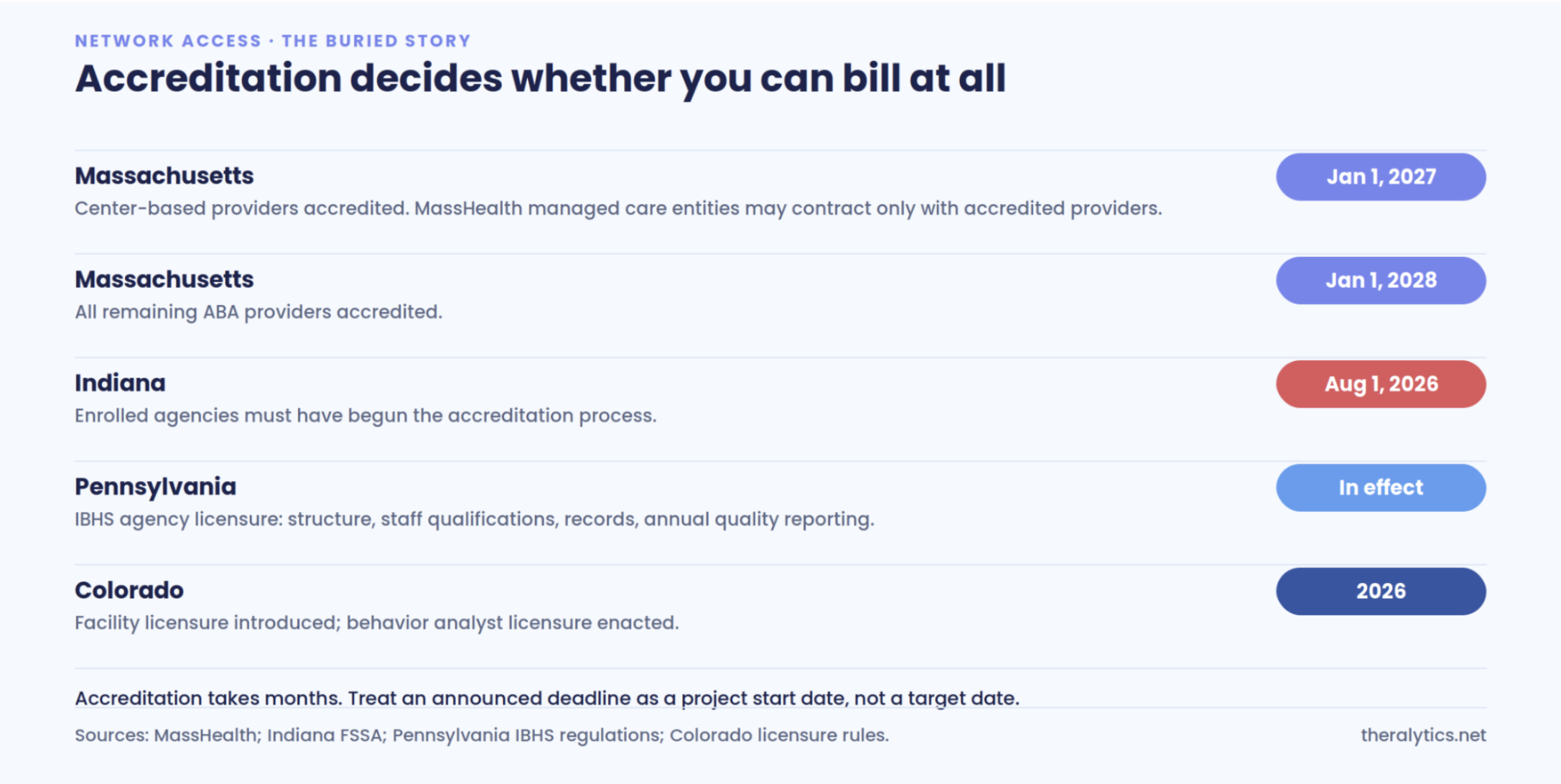
Accreditation requirements are the most consequential change of 2026 and the least discussed, because they determine network participation rather than payment.
Massachusetts moved first, requiring MassHealth managed care entities to contract only with accredited ABA providers. Center-based providers must be accredited by January 1, 2027, and all others by January 1, 2028.
Indiana announced its rule in January 2026, requiring agencies enrolled in Indiana Medicaid to have begun the accreditation process by August 1, 2026.
Pennsylvania requires practitioners to apply to operate an Intensive Behavioral Health Services agency, with specifications covering organizational structure, policies and procedures, staff qualifications and training, assessment and treatment record formats, record retention, and annual quality improvement reporting.
Colorado has taken a related approach through facility licensure requirements, and enacted behavior analyst licensure in 2026, making it the most recent of the 41 jurisdictions that now require licensure or registration for behavior analysts.
The common thread is that these mandates were introduced partly in response to private equity consolidation in ABA. Whatever the motivation, the operational reality is the same: accreditation takes months, requires documented policies, supervision records, and quality improvement processes, and cannot be assembled in the weeks before a deadline. Practices that keep documentation and supervision records in one system rather than across spreadsheets and email have a substantially easier time evidencing compliance.
Enforcement States: Minnesota and Colorado
Two states are applying pressure through enforcement rather than policy.
Minnesota had 85 open investigations into autism providers as of summer 2025. The FBI raided Smart Therapy Center and Star Autism Center in 2024, and in December 2025 the owner of Smart Therapy pleaded guilty to wire fraud in a $14 million Medicaid scheme involving unqualified staff and monthly kickbacks to parents who enrolled their children, agreeing to roughly $16 million in restitution. Minnesota's EIDBI spending grew from $671,000 in 2018 to $342.8 million in 2024.
Colorado faces a February 2026 HHS-OIG audit that identified at least $77.8 million in improper fee-for-service ABA payments, with $42.6 million recommended for federal refund and a further $112.5 million under review. Providers and parents are separately suing the state over prior authorization requirements and proposed rate reductions.
Enforcement states are the ones where clean documentation matters most, because the risk is retrospective recoupment on claims you were already paid for. Our guide to ABA billing audit protection covers what auditors actually request.
States That Held Steady
Not every state moved, and it is worth knowing which did not.
Florida is the notable case. SMMC 3.0 took effect February 1, 2025, restructuring managed care from eleven numbered regions into nine lettered regions under SB 1950. But the fee schedule held, 97153 stayed at $12.26 per 15-minute unit for RBT, BCaBA, or Lead Analyst delivery and 97155 at $19.17 for Lead Analyst, and Florida imposed none of the lifetime caps or rate phase-downs Indiana adopted. The Florida story for 2026 is adaptation to managed care contracting rather than a single regulatory shock.
Texas kept ABA in managed care with rates reviewed on a roughly two-year cycle. The pressure there has shown up as market exit rather than policy change, with Autism Learning Partners leaving the state entirely citing low Medicaid rates and administrative burden.
Ohio has not cut rates but revamped how it vets behavioral health providers, and the resulting slowdown in approving new applicants has strained an ABA network that was already short of providers.
What Is the Same Everywhere
One development applies to all 50 states regardless of what your state did in 2026.
CMS published a 173-page ABA Toolkit on August 4, 2026, giving state Medicaid agencies a shared template for tightening clinical standards, coverage, payment, credentialing, utilization management, and program integrity. It creates no new federal requirements and does not reduce EPSDT obligations for children under 21. What it does is give every state that has not yet acted a menu to act from.
Three positions in it will shape state policy over the next two years. CMS states that 40 hours per week is not a best practice and suggests aligning weekly hours to DSM-5-TR severity levels. It tells states to require at least one standardized outcome assessment instrument and to stop accepting provider-created measures. And it publishes the claims patterns states should flag, including service hours above 32 units per day or 160 units per week, and providers billing maximum hours for 80% or more of their patients.
You can read the full toolkit on Medicaid.gov. For a deeper treatment of the rate reductions specifically, see our companion guide to ABA reimbursement cuts in 2026.
Rate Variation Is Wider Than Most Providers Assume
Reported 2025 fee-for-service rates in Appendix E of the CMS Toolkit show how differently states value identical work. Technician-delivered treatment under 97153 ranged from $10.39 per 15-minute unit in North Dakota to $22.63 in Alaska. Assessment by a qualified professional under 97151 ranged from $18.79 in Washington to $112.65 in New Mexico.
This is why cross-state comparison is now a live risk. When a state benchmarks itself against neighbors and finds it pays above the median, that comparison tends to appear in the next budget cycle. Indiana explicitly framed its reduction as moving closer to the national average.
If you are considering expansion, model the rate before the market. A state with high demand and a bottom-quartile rate is not an opportunity.
How to Track Changes in Your State
State Medicaid changes rarely arrive with much notice, and they almost never arrive through a channel you are already watching. Four sources cover most of it.
Provider bulletins are where the majority of changes appear first. Every state Medicaid agency publishes them, most offer email subscription, and almost no practice subscribes.
Budget and appropriation bills carry the changes that have not reached a bulletin yet. Virginia's 20-hour cap appeared as a line item in an appropriation act months before any policy guidance. If your state legislature is in session, the ABA line is worth reading.
Managed care plan notices are increasingly where cuts originate, as Georgia and Arizona demonstrate. A state fee schedule holding steady tells you nothing about what your plans are doing on their own contracts.
Proposed rules and public comment periods give the longest lead time. Indiana's rate reduction ran a public notice period from February 25 to March 27, 2026, before taking effect April 1. That is a month of warning for anyone who was reading.
One caution on rate sources: a proposed rate is not an adopted rate, and a directed-payment floor is not a fee-for-service rate. Some states set a minimum that managed care plans must pay, layered on top of the plan's base contract rate. Read carefully before building a budget on either.
Frequently Asked Questions
Which states cut ABA Medicaid rates in 2026?
Indiana applied a 6% reduction on April 1, 2026, with a further 4% scheduled for April 1, 2027. New York completed a 25% reduction for technician-delivered ABA in April 2026. Nebraska cut behavior technician rates 48%, parent training 51%, and some services by as much as 79%, effective August 1, 2025. North Carolina implemented a 10% cut in October 2025 and reversed it in December after litigation. Separately, managed care plans in Georgia and Arizona cut rates on their own contracts, which affects providers in those states regardless of the state fee schedule.
Which states cap ABA hours?
Virginia is imposing a 20-hour weekly limit under its 2026 Appropriation Act, pending CMS approval. Nebraska caps direct services at 6 hours daily and 30 hours weekly. Indiana applies weekly caps tiered by symptom severity plus a 4,000-hour lifetime cap. North Carolina requires department or plan approval above 16 hours per week, with reauthorization every 90 days. Under EPSDT, these must function as soft limits that can be exceeded with prior authorization for children under 21, not absolute caps.
Do I need accreditation to bill Medicaid for ABA?
In a growing number of states, yes. Massachusetts requires MassHealth managed care entities to contract only with accredited ABA providers, with center-based providers accredited by January 1, 2027 and all others by January 1, 2028. Indiana requires enrolled agencies to have begun the accreditation process by August 1, 2026. Pennsylvania requires IBHS agency licensure and Colorado has introduced facility licensure. Accreditation typically takes months, so treat any announced deadline as a project start date rather than a target date.
Does the CMS ABA Toolkit override my state's rules?
No. The Toolkit is guidance for state Medicaid and CHIP agencies, not a federal rule for providers. It creates no new federal requirements and does not change EPSDT obligations. Your state's Medicaid manual, fee schedule, and managed care contracts remain the operative rules. The Toolkit matters because it gives states a shared template, so expect its recommendations to appear in state policy over the next two years.
Can a state cap ABA hours for children under 21?
Not as a hard limit. Under EPSDT, states must cover medically necessary services described in section 1905(a) for eligible children under 21, and they are not permitted to apply limits that can never be exceeded. States may apply soft limits that can be exceeded with prior authorization and a medical necessity review. In practice this means an hour cap is a review trigger rather than a ceiling, and a well-documented treatment plan is what gets you past it.
Which states have the lowest ABA Medicaid rates?
Based on reported 2025 fee-for-service rates, North Dakota had the lowest rate for technician-delivered treatment under 97153 at $10.39 per 15-minute unit, and West Virginia the lowest for technician supporting assessment under 97152 at $9.90. Washington had the lowest assessment rate under 97151 at $18.79. Rates vary within states by provider credential and site of service, so check your own fee schedule rather than relying on a national comparison.
The Bottom Line
The pattern across every state that moved in 2026 is the same underneath the local detail. Spending grew faster than any state built controls for, and the controls are arriving now, in whatever form each state's budget process and legal environment allows.
That means two things practically. First, whatever your state did this year is probably not the last change, because the CMS Toolkit gives every state a longer menu than most have used. Second, the practices that come through this are the ones that can prove what they did: which technician delivered the session, which BCBA supervised it, what the standardized outcome instrument showed, why this child needs these hours, and whether the claim matches the schedule and the note.
None of that is new clinical work. It is a records problem.
Theralytics was built by a BCBA who ran ABA organizations, and it connects scheduling, data collection, documentation, and billing in one system, so the audit trail assembles itself instead of being reconstructed after a request arrives. That matters more when you operate across states with different authorization rules, different supervision requirements, and different documentation standards.
If reimbursement or authorization changes in your state are showing up in your numbers, book a 15-minute call and we will look at where the leakage is.