


Errorless learning is a way of teaching where the clinician sets things up so the learner is very likely to respond correctly from the first trial. Instead of waiting for a mistake and then fixing it, the clinician adds support before the error can happen, then fades that support as the learner gets stronger.
The idea sounds simple, and it still gets misunderstood a lot. Some teams hear "errorless" and assume the learner should never be wrong, or that it is always the kinder choice. Others write it off as outdated and lean on trial and error. The research sits somewhere in the middle, and that is where this guide lives.
Below you will find what errorless learning is, how it works step by step, the main errorless procedures, a full discrete trial example, how it compares with error correction in actual studies, when it fits and when it does not, and how to record data so you can tell whether the learner is moving toward independence.
Key Takeaways
- Errorless learning prevents errors by delivering a prompt or changing the materials before the learner can respond incorrectly, then fades that support on a plan.
- It is not the same as prompting in general. A prompt delivered after an error is error correction, not errorless teaching.
- Common errorless procedures include most-to-least prompting, 0-second time delay, simultaneous prompting, and stimulus fading.
- Errorless does not mean the learner never errs. Every program still needs a written plan for when errors happen.
- In a randomized trial of 28 children with autism, both errorless learning and error correction taught new tacts. Error correction produced more independent correct responding, and errorless learning produced fewer errors.
- The main risk is prompt dependence, so fading criteria and independent-response data matter as much as the prompt itself.
What Is Errorless Learning in ABA?
Errorless learning, also called errorless teaching or error prevention, is an instructional approach that arranges the teaching situation so the learner makes few or no incorrect responses while acquiring a new skill. In ABA, an error usually means an incorrect response or no response to the instruction.
There are two main ways to prevent errors:
- Response prompts. The clinician adds help before the learner responds, such as a gesture, a model, a physical guide, or an echoic prompt (saying the answer first).
- Stimulus changes. The clinician changes the materials instead, for example by making the correct item larger, placing it closer to the learner, or starting with an exaggerated difference between items and gradually fading it.
The idea traces back to basic research. In 1963, Herbert Terrace showed that pigeons could learn a discrimination with very few responses to the wrong stimulus when the task started out easy and was made harder step by step. In applied work, the same logic shows up as prompting plus fading. If you want the full ladder of prompt types, our guide to the ABA prompting hierarchy covers it.
Errorless Learning vs. Prompting
Prompting is the tool. Errorless learning is the goal and the way the tool is used. A learner can be prompted only after a mistake, which is least-to-most prompting and is not errorless. A most-to-least hierarchy or a 0-second delay, where the prompt arrives with the instruction, is errorless.
What Errorless Does Not Mean
- It does not mean the learner never makes a mistake. Errors still happen, and the plan needs a clear response to them.
- It does not mean prompts stay in forever. Fading is the other half of the procedure.
- It does not mean the learner never gets to try alone. Good errorless programs build in chances to respond independently.
How Errorless Teaching Works
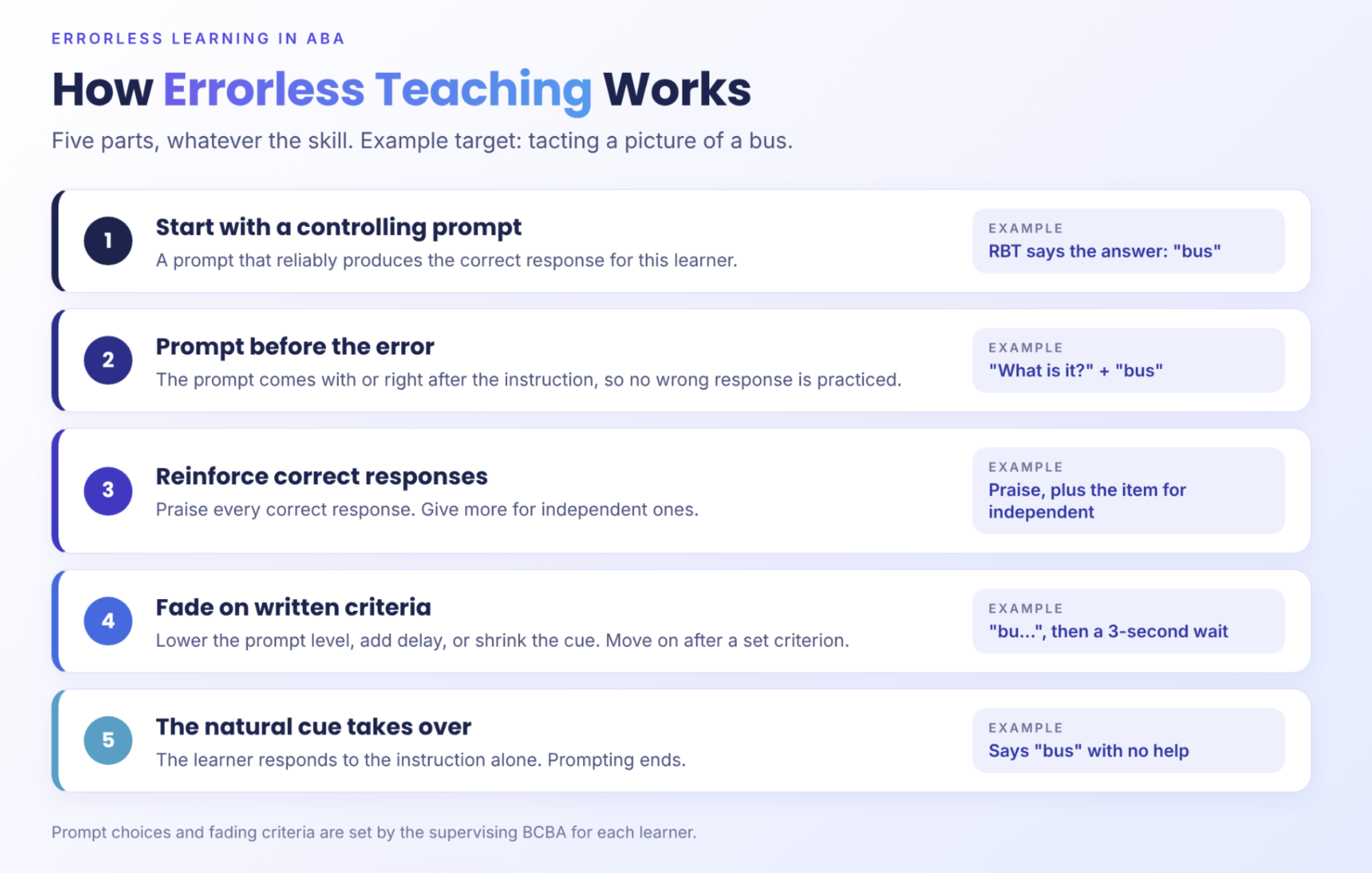
Most errorless programs follow the same five parts, whatever the skill.
- Start with a controlling prompt. This is a prompt that reliably produces the correct response for this learner. If a gesture does not work, it cannot be the starting point. Our prompting hierarchy guide explains how to test for this.
- Deliver the prompt before the error. The prompt comes right after the instruction, or at the same time, so the learner never gets a chance to practice a wrong response.
- Reinforce correct responses. Prompted correct responses earn reinforcement. Independent correct responses should earn more. In an early study of delayed prompting, Touchette and Howard (1984) found that transfer to unprompted responding was faster when reinforcement favored unprompted responses, and errors were rare under every schedule they tested.
- Fade the prompt on written criteria. Fade by reducing the prompt level, adding delay, or shrinking the stimulus difference. The criterion for moving on should be in the program, not in someone's head.
- Transfer stimulus control to the natural cue. The goal is for the learner to respond to the instruction or situation alone. We cover this in more detail in our guide to stimulus control transfer.
If the learner can respond without the prompt only when one particular person is in the room, or only with one particular set of materials, the transfer is not finished. That is where stimulus generalization planning comes in.
Errorless Teaching Procedures
There is more than one way to prevent errors. These are the ones teams use most.
| Procedure | How it prevents errors | What gets faded | Often a good fit for |
| Most-to-least prompting | Starts at the prompt level that guarantees a correct response | The prompt level, from full physical down to a gesture or nothing | New skills, chained tasks, safety skills |
| Time delay (0-second start) | The controlling prompt arrives with the instruction on early trials | The wait before the prompt, such as 0, then 2, then 4 seconds | Single responses with a strong controlling prompt |
| Simultaneous prompting | The controlling prompt is given on every teaching trial | Checked in separate no-prompt probe trials | Skills where a steady routine helps |
| Graduated guidance | Physical help is adjusted moment by moment | The amount and location of touch | Motor skills and chains |
| Stimulus fading | Starts with an exaggerated difference between choices | The difference, until only the natural one remains | Discriminations like colors, letters, and shapes |
| Extra-stimulus prompts | A cue is added to the materials, such as a larger or closer correct card | The added cue | Receptive identification and matching |
Prompt-Based vs. Stimulus-Based Errorless Teaching
Most clinic programs lean on response prompts because they are fast to deliver and easy to fade on a hierarchy. Stimulus-based approaches change the materials instead. A systematic review of within-stimulus errorless learning covered 28 articles on teaching discrimination skills to people with intellectual and developmental disabilities. In most cases the errorless procedures improved discrimination skills, and stimulus fading was the most commonly evaluated method.
Adding Delay to Most-to-Least
A useful middle path is to run most-to-least prompting with a short delay. In a study by Libby and colleagues, adding a short delay to MTL produced learning almost as fast as least-to-most, with fewer errors than least-to-most. That is a good reminder that these procedures can be combined.
For free walkthroughs of the steps and data sheets, see the AFIRM prompting module and the University of Nevada, Reno constant time delay tip sheet.
Errorless Learning Example: Teaching a Tact in Discrete Trial Training
Here is how errorless teaching looks in a discrete trial program. The target is for the learner to say "bus" when shown a picture of a bus and asked, "What is it?"
The written plan:
- Prompt type: echoic (the RBT says the answer or part of it)
- Hierarchy: full echoic, partial echoic, no prompt with a 3-second wait
- Move to the next stage after 3 correct responses in a row at the current stage
- Go back one stage after 2 errors in a row
- Reinforcement: praise for every correct response, plus the preferred item for independent responses
| Stage | What the RBT does | Prompt level | Move on when |
| 1 | Shows the picture, says "What is it?" and immediately says "bus" | Full echoic | 3 correct in a row |
| 2 | Shows the picture, says "What is it?" and immediately says "bu..." | Partial echoic | 3 correct in a row |
| 3 | Shows the picture, says "What is it?" and waits 3 seconds, then prompts only if needed | No prompt, with delay | Independent correct on 4 of 5 trials across 2 sessions |
What happens when the learner makes an error: The RBT does not scold or repeat the question several times. In a short, neutral way, the RBT re-presents the trial at the previous prompt level so the learner responds correctly, then moves on. After 2 errors in a row, the program drops back one stage.
Sample data across four sessions (10 trials each, illustrative only):
| Session | Stage | Prompted correct | Independent correct | Errors |
| 1 | Full echoic | 10 | 0 | 0 |
| 2 | Partial echoic | 9 | 0 | 1 |
| 3 | No prompt, 3-second wait | 6 | 4 | 0 |
| 4 | No prompt, 3-second wait | 2 | 8 | 0 |
In four sessions the learner went from 0 to 8 of 10 independent correct responses with a single error. A BCBA looking at this table can see two things at once: the learner is moving, and the prompt is being faded on schedule. If session 4 had stayed at 0 independent, that would be the signal to review the prompt level, the reinforcement, or the criteria.
For how to build this into a full teaching sequence, see our guide to task analysis in ABA for chained skills and our overview of practical ABA therapy techniques.
Errorless Learning vs. Error Correction: What the Research Says
In error correction, the learner responds first. If the answer is wrong, the clinician gives corrective feedback or a prompted redo. Many blog posts claim errorless learning is faster or less stressful without pointing to any study. Here is what the comparisons actually found.
| Study | Who | What was compared | What happened |
| Leaf et al. (2020) | 28 children with autism, randomly assigned to two groups of 14 | Errorless learning (most-to-least with full echoic, partial echoic, and no prompt) vs. error correction, teaching tacts of six pictures | Both worked. Error correction mastered 41 of 42 sets and errorless 40 of 42, with about 16 sessions to mastery in each. |
| Carr and Felce (2008) | Children aged 3 to 7 with autism | Error prevention vs. error correction, teaching picture-to-object relations for picture-based requesting | The error prevention group made significantly fewer errors in teaching and on a later test. |
| Libby et al. (2008) | Children with autism | Most-to-least vs. least-to-most prompting | All learned with MTL with fewer errors, though three learned faster with LTM. |
| Cengher et al. (2016) | Children with autism | MTL vs. LTM after confirming the prompts worked | MTL was more effective and more efficient for all three participants. |
What the Leaf Trial Adds
The Leaf trial is worth a closer look because it was a randomized group design, while most earlier work used single-case designs. During teaching, the error correction group gave independent correct responses on 90.8% of trials, compared with 75.3% for errorless learning. On the post-teaching probes, correct responding averaged 85.7% for error correction and 77.1% for errorless learning. Error correction also produced more independent errors, 9.2% vs. 2.9%.
The finding many readers care about most is aberrant behavior. It was rare in both conditions, 0.07% of observations for error correction and 0.55% for errorless learning, and the difference was not statistically significant. The authors concluded that concerns about errors being harmful were not supported in their data.
How to Read This Without Overreaching
The authors note limits: the children had relatively strong verbal repertoires, only tacting was taught, and only one procedure from each category was tested. So this study does not show that error correction is better for every learner. It does show that "errors will cause problem behavior" is not a safe assumption, and that independent responding deserves as much attention as accuracy.
The practical reading is consistent across these studies. Both approaches work, fit matters more than label, and the BCBA should choose from the learner's history and keep checking the data. Some teams start a new skill with errorless teaching and shift toward error correction as the learner gains the skill. That is a clinical judgment call, not a research-backed rule.
This lines up with the BACB Ethics Code, which expects interventions to be chosen for the client's needs and evaluated on an ongoing basis.
When to Use Errorless Learning and When Not To
No rule picks this for you, but these situations help narrow it down.
| Situation | Errorless teaching is often a good fit | Think twice or consider another approach |
| Skill history | The skill is brand new and the learner has no entry repertoire | The learner already has part of the skill and just needs to firm it up |
| Reaction to errors | Errors have led to escape, protest, or aggression in the past | The learner has shown they can tolerate errors without problem behavior |
| Skill type | Chains where one wrong step derails the rest, and safety skills | Skills where practicing independent attempts is the whole point |
| Cost of an error | A mistake could be unsafe or hard to undo | A mistake is low stakes and informative |
| Prompt history | The controlling prompt is clear and easy to fade | The learner has a history of leaning on one prompt, so add delay early |
The second row deserves a note. A history of problem behavior around errors is a good reason to try errorless teaching, but it is not a guarantee that error correction would fail. In the Leaf trial, aberrant behavior was rare under error correction too. Watch the data for each learner instead of assuming.
These are starting points for a BCBA's judgment, not rules.
Benefits and Limitations of Errorless Learning
Benefits
- Fewer errors are practiced. Across the comparisons above, error prevention consistently produced fewer errors during teaching.
- A smoother start on hard skills. A learner who gets early successes is more likely to stay engaged, and reinforcement can be delivered often.
- Good for chains and safety. When one wrong step can derail a routine or create risk, preventing the error is sensible.
- A clear path to independence. When the plan includes fading criteria, the next step is always visible.
Limitations
- Prompt dependence. The more a learner is carried by a prompt, the more important fading becomes. A prompt that never fades turns into the skill. Our ABA prompting hierarchy guide lists the signs to watch for.
- Fewer independent attempts. In the Leaf trial, independent correct responding during teaching and on post-teaching probes was lower for errorless learning than for error correction. Errorless programs need independent chances built in, such as a delay or probe trials.
- Errors still happen. A program with no plan for errors is not errorless, it is just unprepared.
- Rigid responding in some cases. Some early basic research (Marsh and Johnson, 1968) reported that subjects trained without errors were slow to reverse a discrimination. In practice, this is one reason clinicians plan for flexibility and generalization after acquisition.
- Evidence is mixed on stress. Many articles say errorless teaching reduces stress and problem behavior. The research here does not show a clear difference, so treat that as a question for your own data, not a given.
Common Errorless Teaching Mistakes
Prompting late. If the prompt comes after the learner starts to respond, the error has already happened. In errorless teaching, the prompt goes first.
Skipping the controlling prompt check. A prompt that does not reliably produce the correct response cannot carry an errorless program.
Keeping the prompt too long. The learner starts waiting for it, and independent responses never appear.
Fading too fast. Dropping several levels after one good trial often brings the errors back.
No plan for errors. When an error happens, staff improvise. One RBT repeats the question five times, another scolds, a third gives the answer.
Unplanned prompts. Eye gaze, a head nod, or leaning toward the correct item all act as prompts. If they are not in the plan, they are not being faded.
Same reinforcement for prompted and independent responses. If both earn the same thing, the learner has little reason to give up the prompt.
Counting prompted responses as independent. This is the most common data mistake. "90% correct" can hide the fact that every response was prompted.
How to Record Errorless Teaching Data
For each trial, record four things: the instruction, the prompt level used (or "independent"), what the learner did, and what reinforcement followed. "What the learner did" should be one of four categories:
- independent correct
- prompted correct
- independent error
- no response
From those, you can calculate the numbers that tell the real story.
| Measure | What it tells you |
| Percent independent correct | Whether the learner is learning the skill |
| Percent prompted correct | Whether the learner is responding with support |
| Percent independent errors | Whether errors are being prevented, or just delayed |
| Sessions to mastery | Whether the procedure is efficient for this learner |
| Prompt level by session | Whether fading is on schedule |
Graph percent independent correct next to the prompt level. If the independent line climbs as the prompt level drops, fading is working. If it stays flat while prompted correct stays high, the learner is being carried by the prompt, and the plan needs a closer look. For more on picking measures, see our guides to ABA data collection methods and frequency data collection.
Paper makes this harder than it should be. In a busy session, "FE" and "PE" get scribbled, entries are skipped, and prompt data gets rebuilt from memory afterward. Digital collection at the moment of instruction removes most of that guesswork.
Session Notes, Supervision, and Training RBTs
Errorless teaching only works if every RBT runs it the same way, and the record should show that. Compare these two lines:
Vague: "Client did well with tacting today."
Objective: "Client tacted 'bus' independently on 8 of 10 trials after delay was increased to 3 seconds. Two trials required a partial echoic prompt. No errors. Plan: continue stage 3 and check 4 of 5 criterion next session."
The second version tells a supervisor, a parent, and a payer reviewer what happened and what comes next. Our guide to ABA session notes examples covers objective wording and the details notes should include.
When a BCBA reviews prompt data and changes the protocol, that clinical work is typically billed under 97155, protocol modification. Our ABA CPT codes guide explains what the code covers and what documentation supports it. Payer rules vary, so check current policy.
Training RBTs on Errorless Teaching
Prompting and prompt fading are core RBT skills in the BACB's RBT Task List (2nd edition), and the BACB has since moved to a 3rd edition RBT Test Content Outline as of January 1, 2026. Whatever version your staff trained under, a few habits help:
- Role-play the prompt timing, including how long to wait and what the first prompt looks like.
- Write down the error response, so every RBT does the same thing when a learner misses.
- Observe sessions with the written plan in hand and check fidelity.
- Review prompt-level data in supervision, not only percent correct.
- Use our guide to RBT competency assessment and our continuing education options, including Increasing RBT Effectiveness and Verbal Operants.
How Theralytics Helps Teams Run and Track Errorless Programs
Errorless teaching is a data problem as much as a teaching problem. Teams need the plan in one place, the data captured while the session is running, and the graph ready when the BCBA sits down to decide whether to fade, hold, or change course.
Theralytics was built by a BCBA who ran ABA organizations, and its clinical tools are designed around that workflow:
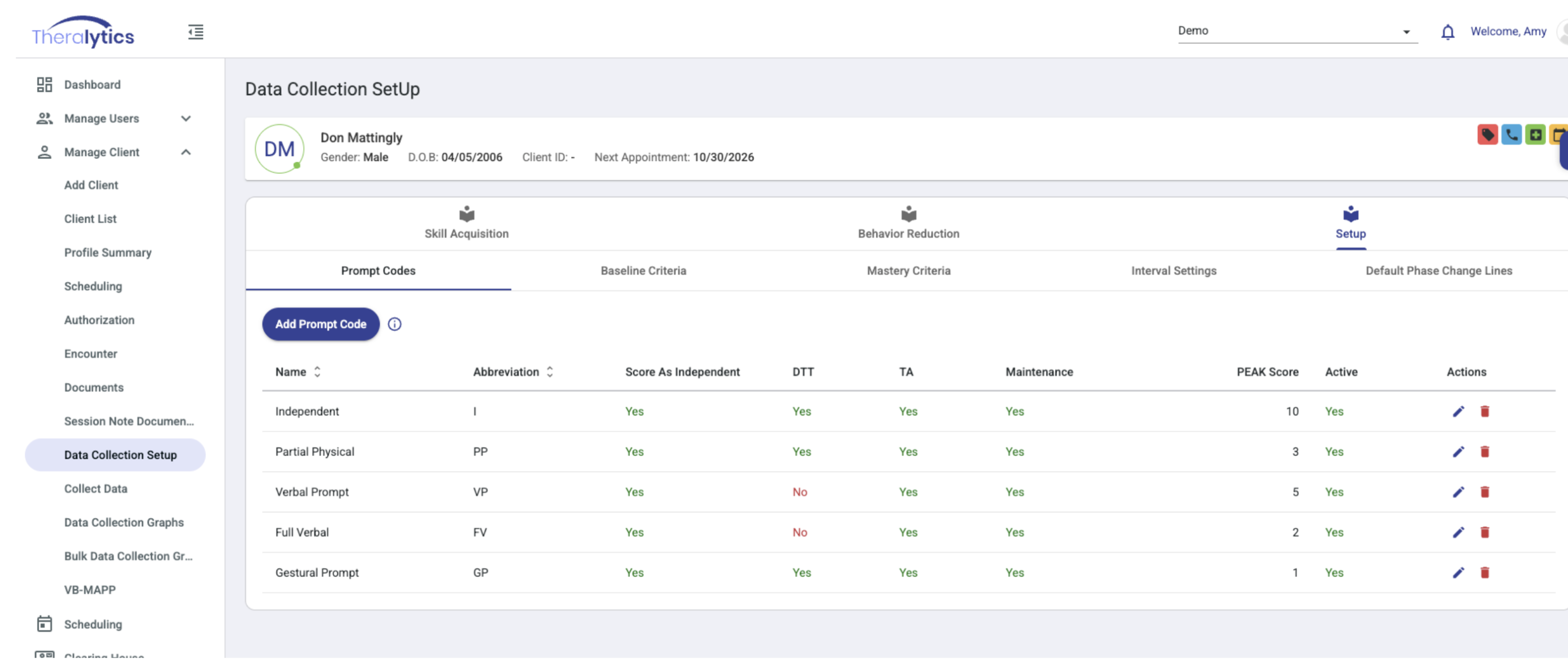
Data collection: Capture errorless teaching by customizing prompt codes to score as independent responses no matter the prompt code selected.
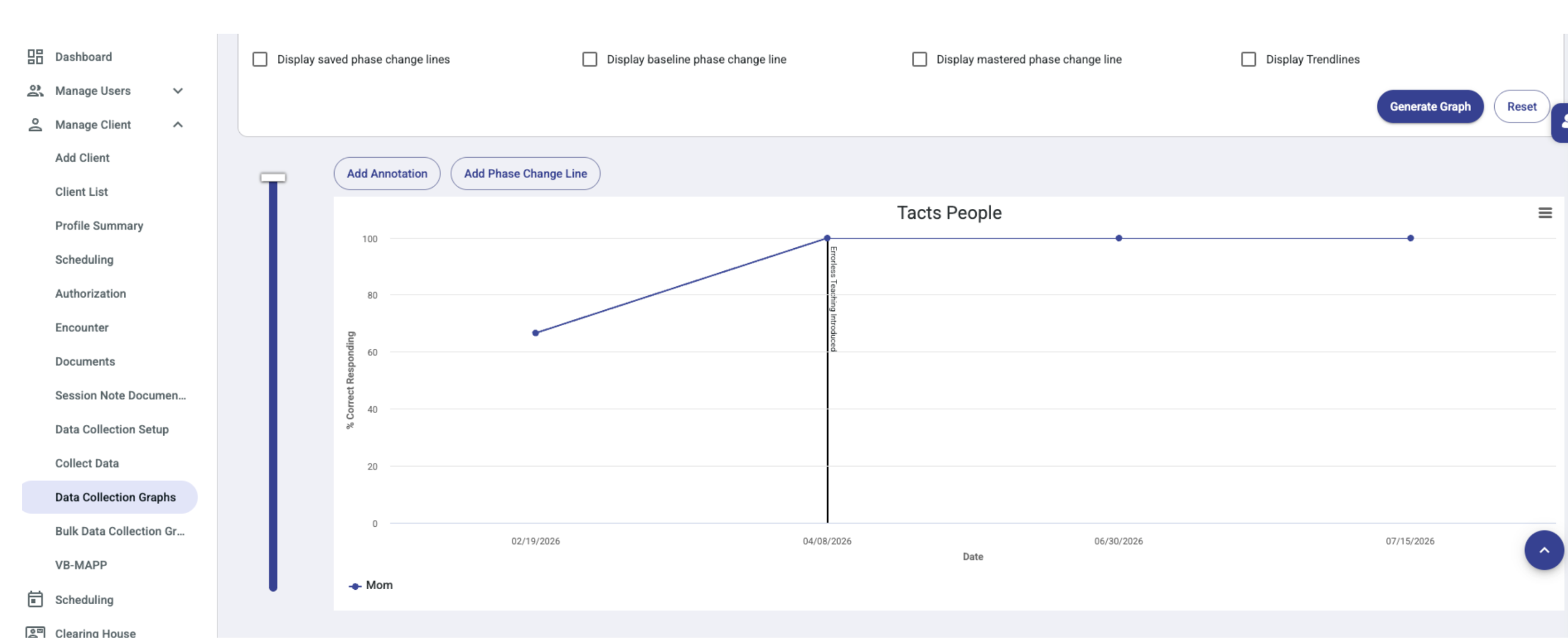
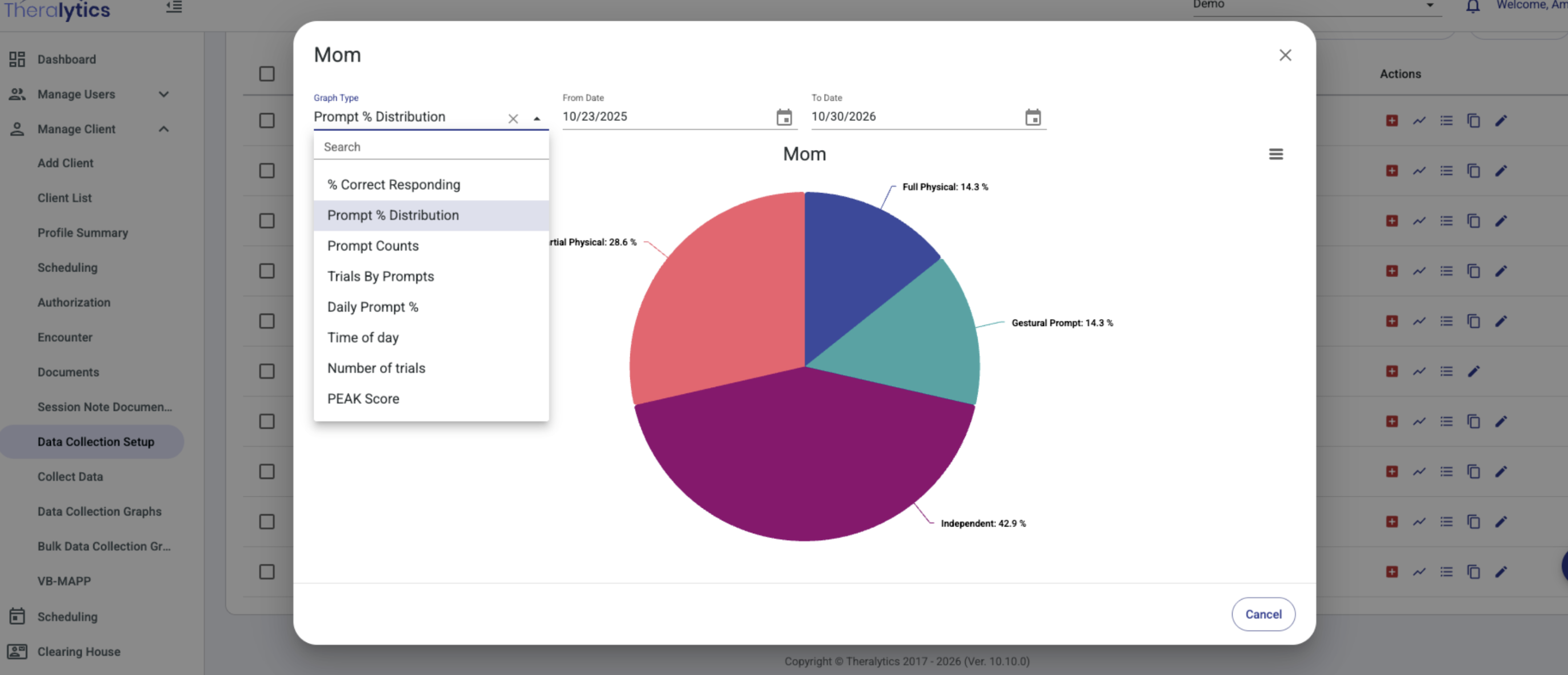
Reporting and analytics: Review progress by client, add phase change lines on when errorless teaching was introduced, and view different graph types to analyze the data in multiple ways.
If you are not sure how your current setup records prompted versus independent responses, a short demo is a good way to see how Theralytics handles it for your programs. You can also compare plans on the pricing page.
Conclusion
Errorless learning is a useful way to start a skill, and it works best when it is treated as the first half of a plan. Choose a prompt that actually controls the response. Deliver it before the error. Write down how and when it fades. Decide ahead of time what happens when an error does occur. Then record independent responses separately from prompted ones, so the graph can tell you whether the learner is moving toward independence.
If your team wants prompt and error data captured during the session and visible on a graph when it is time to decide, book a free 15-minute demo and see how Theralytics handles data collection, documentation, and reporting in one place.
Frequently Asked Questions
What is errorless learning in ABA?
Errorless learning is a teaching approach that prevents errors by delivering a prompt or changing the materials before the learner can respond incorrectly. The support is then faded on a plan until the learner responds independently.
What is an example of errorless learning?
A clinician shows a picture of a bus, asks "What is it?" and immediately says "bus." Over the next trials, the full prompt becomes a partial prompt, then a short wait with no prompt, until the learner says "bus" alone.
What is the difference between errorless learning and error correction?
In errorless learning, the prompt comes before the response so errors are prevented. In error correction, the learner responds first, and the clinician gives feedback or a prompted redo after a mistake.
Is errorless learning better than error correction?
Not in every case. In a randomized trial of 28 children with autism, both procedures taught new tacts. Error correction produced more independent correct responses, and errorless learning produced fewer errors. The better choice depends on the learner, the skill, and the data.
Does errorless learning prevent problem behavior?
The research does not show a clear difference. In the Leaf trial, aberrant behavior was rare under both procedures. A learner with a history of problem behavior around errors is a reasonable candidate for errorless teaching, but the data for that learner should decide.
Is most-to-least prompting the same as errorless learning?
Most-to-least prompting is one way to run errorless teaching, because it starts with enough help to prevent errors. Errorless learning also includes other methods, such as 0-second time delay and stimulus fading.
What is the risk of errorless learning?
The main risk is prompt dependence, where the learner waits for the prompt instead of responding to the natural cue. Written fading criteria, time delay, and independent-response data reduce that risk.
How do you fade prompts in errorless learning?
Fade by lowering the prompt level, adding delay before the prompt, or shrinking an exaggerated stimulus difference. Move on after a set criterion, such as three correct responses in a row, and go back a step after repeated errors.
Who should design an errorless learning program?
A BCBA designs the program based on assessment and ongoing data. RBTs run it as written and report what they see, and the BCBA adjusts the plan if the learner stalls.