


Every learner is different. Every setting brings its own challenges. What works in a quiet clinic room will not always transfer to a busy classroom or a home environment with competing demands. That is why a strong ABA practice is not built on one or two go-to strategies. It is built on a deep toolkit of evidence-based techniques that can be selected, combined, and adapted for each individual.
This guide covers 22 ABA therapy techniques used by therapists and caregivers, how each one works, when to use it, and what it looks like in practice.
Leading Practice Management Software
Streamline your practice with powerful, easy-to-use software designed for ABA providers.
What Is Applied Behavior Analysis (ABA)?
Applied Behavior Analysis is a scientific approach to understanding and changing behavior. It focuses on identifying how the environment influences behavior and using evidence-based strategies to teach new skills or reduce challenging ones.
ABA is most commonly associated with autism support, but its techniques apply across a range of developmental conditions and settings. The approach is grounded in seven dimensions: applied, behavioral, analytic, technological, conceptually systematic, effective, and generality. These dimensions ensure that ABA interventions target meaningful behaviors, are replicable, and produce changes that last across time and settings.
At the center of ABA is the ABC model: Antecedent (what happens before the behavior), Behavior (what the person does), and Consequence (what happens after). Understanding this relationship is what drives effective intervention design.
A Brief History of ABA Therapy
ABA therapy is rooted in the work of psychologist B.F. Skinner, who developed the theory of operant conditioning in the mid-20th century. Skinner's research demonstrated that behavior is shaped by its consequences: behaviors followed by positive outcomes tend to increase, and behaviors followed by negative outcomes or no outcome tend to decrease.
Therapists began applying these principles to support individuals with autism and developmental disabilities in the 1960s, most notably through the work of Dr. O. Ivar Lovaas at UCLA. Early ABA was highly structured and intensive. In the decades since, the field has evolved significantly, developing a range of techniques that balance structured teaching with naturalistic, learner-led approaches. Today, ABA is recognized as an evidence-based best practice by the US Surgeon General and the American Psychological Association.
Evidence Supporting ABA Therapy Techniques
ABA has one of the strongest evidence bases of any behavioral intervention. A 2022 scoping review by Gitimoghaddam et al. found improvements in seven out of eight outcome categories across hundreds of ABA studies, including cognition, language, and adaptive behavior.
Meta-analyses of comprehensive ABA-based interventions show medium to large effects compared to standard care. One analysis of 11 studies with 632 participants reported a standardized mean difference of 0.51 in intellectual functioning and 0.37 in adaptive behavior. Early intensive models like the UCLA Young Autism Project have shown gains in IQ, language, and everyday functioning when ABA is applied consistently over multiple years.
The Four Functions of Behavior
Before selecting any technique, understanding why a behavior occurs is essential. All behavior serves one of four functions:
- Attention: The behavior gets a social response from others
- Escape or Avoidance: The behavior removes or delays a demand or unpleasant situation
- Access to Tangibles: The behavior results in obtaining a preferred item or activity
- Sensory or Automatic: The behavior provides internal sensory feedback
Identifying the function through a Functional Behavior Assessment (FBA) is what separates reactive behavior management from targeted, effective intervention.
ABA Therapy Techniques
1. Pairing and Rapport Building
Before any instruction begins, the therapist must become a source of reinforcement. Pairing means associating yourself with preferred items, activities, and positive interactions before making any demands.
How it works: Spend time with the learner engaging in preferred activities with no demands attached. Follow their lead. Deliver reinforcement freely and frequently.
Example: A new RBT spends the first several sessions playing with a child's favorite toys, offering snacks, and following the child's interests without asking for anything in return. Only once the child seeks out the therapist does instruction begin.
Why it matters: A strong therapeutic relationship increases engagement, cooperation, and skill generalization. Team members should be viewed as a source of trust and reinforcement, not just instruction.
Tip: Pairing is not a one-time event. Return to it regularly, especially after breaks, during difficult periods, or when transitioning to new goals.
2. Discrete Trial Training (DTT)
DTT is a structured teaching method that breaks skills down into small, clearly defined steps. Each trial has three parts: an instruction (SD), a response from the learner, and a consequence (reinforcement or error correction).
How it works: Present a clear instruction. Wait for the learner's response. Deliver reinforcement for correct responses or provide an error correction and re-present the trial.
Example: Teaching color identification.
- Therapist: "Touch red." → Child touches red card → Praise and token
- Therapist: "Touch blue." → Child touches blue card → Praise and token
Why it matters: DTT creates a high volume of learning opportunities in a short amount of time. It is particularly effective for foundational skills like language, matching, and following instructions.
Tip: Keep sessions brisk. Too much time between trials reduces learning efficiency.
3. Natural Environment Training (NET)
NET embeds learning into everyday activities and the learner's natural surroundings. Instead of structured table work, teaching happens during play, routines, and real-life interactions.
How it works: Identify what the learner is motivated by in the moment and use that as the context for instruction. Teaching follows the learner's lead rather than a predetermined sequence.
Example: A child reaches for bubbles. The therapist holds the bubbles just out of reach and waits. The child says "bubbles" or approximates the word. The therapist immediately blows bubbles as the natural reinforcer.
Why it matters: Skills taught in natural contexts are more likely to generalize to real-life situations. NET is especially effective for language and social skills.
Tip: Have a loose plan for what you want to target, but stay flexible enough to follow the learner's motivation in the moment.
4. Pivotal Response Training (PRT)
PRT targets pivotal areas of development, specifically motivation, self-initiation, and responsivity to multiple cues, because improvements in these areas produce broad gains across other skills.
How it works: Use child-chosen activities as the context for instruction. Reinforce attempts as well as correct responses. Embed targets naturally within play.
Example: A child selects a block set. The therapist asks "Which color block?" The child says "Blue!" and immediately receives the blue block as the natural reward.
Why it matters: By building motivation and self-initiation, PRT produces gains that ripple across communication, social skills, and behavior management without targeting each skill individually.
Tip: Reinforce attempts, not just perfect responses. The goal is to build motivation to engage, not just accuracy.
5. Reinforcement Schedules That Adapt
Understanding when and how to deliver reinforcement is as important as what the reinforcer is. Fixed and variable schedules across ratio and interval arrangements all produce different behavioral effects.
How it works: Match the reinforcement schedule to the learning stage. Dense schedules (every response) build new skills. Thinner schedules (every few responses) build independence and maintenance.
Example: A learner in early skill acquisition receives reinforcement after every correct response. As accuracy reaches 90%+, the therapist shifts to a variable ratio schedule, reinforcing after an average of every 3-5 responses.
Why it matters: What works in a quiet clinic may not be practical in a busy classroom or community setting. Reinforcement must evolve with the learner and the environment.
Tip: Use variable schedules as learners become more independent. They are more resistant to extinction and better reflect real-world reinforcement patterns.
6. Prompting and Prompt Fading
Prompts are supports that help learners access correct responses. Prompt fading systematically reduces that support as independence increases.
How it works: Select a prompt type (physical, gestural, verbal, visual, or positional) matched to the learner's needs. Fade it systematically using most-to-least, least-to-most, or time delay procedures.
Example: Teaching hand washing.
- Week 1: Full hand-over-hand guidance through each step
- Week 2: Partial physical guidance at transition points only
- Week 3: Gestural prompt pointing to the next step
- Week 4: Verbal reminder only
- Goal: Independent completion with no prompts
Why it matters: Prompts get skills going. Fading them is what builds real independence. Failing to fade is one of the most common causes of prompt dependence.
Tip: Use natural cues as prompts whenever possible. A peer greeting the learner is a more meaningful prompt than the therapist initiating the interaction.
7. Errorless Teaching
Errorless learning prevents incorrect responses by providing an immediate prompt before the learner has the opportunity to make an error.
How it works: Present the instruction and immediately follow it with a prompt that ensures a correct response. Fade the prompt gradually as accuracy improves.
Example: Teaching shape identification. The therapist places a circle card directly in front of the learner while saying "Touch circle." The correct response is guaranteed. Over trials, the prompt is faded until the learner responds independently.
Why it matters: Particularly effective in early learning stages where errors can reinforce incorrect responses or increase frustration. Builds momentum and confidence quickly.
Tip: Pair with fast-paced sessions and fade prompts as soon as accuracy allows. Staying in errorless teaching too long can itself create prompt dependence.
8. Behavioral Momentum
Start with tasks the learner is confident with before moving to harder or less preferred ones. Success builds success.
How it works: Present a series of high-probability requests (tasks the learner consistently completes) and reinforce each one. Then introduce the low-probability or less preferred request while momentum is high.
Example: Before asking a child to complete a non-preferred math worksheet, the therapist asks three quick questions the child reliably answers correctly, reinforcing each one. The child is then more likely to attempt the worksheet.
Why it matters: In unfamiliar or overstimulating environments, behavioral momentum reduces avoidance and increases compliance with challenging goals.
Tip: Use this during transitions, community-based instruction, or when returning from a break.
9. Task Analysis and Chaining
Complex skills are broken into sequential steps. Each step is taught individually before being linked into the complete chain.
How it works: Define every step of the target skill. Choose a chaining method: forward chaining (teach from step 1), backward chaining (teach the last step first so the learner always finishes independently), or total task (teach all steps every session).
Example (backward chaining for hand washing):
- Sessions 1-3: Therapist completes all steps. Learner only turns off the tap.
- Sessions 4-6: Learner dries hands and turns off tap.
- Continue until learner completes the full chain independently.
Why it matters: Teaching functional life skills like toileting, meal prep, or getting dressed requires this kind of structured approach. The chain gives learners a clear, consistent sequence to follow.
Tip: Modify task analyses based on the environment. Steps that work in a clinic bathroom may not apply in a public restroom or school.
10. Generalization Programming
A skill learned in one setting with one person is not a functional skill yet. Generalization ensures the behavior shows up where it actually matters.
How it works: Deliberately vary the people, materials, and settings involved in teaching from early on. Build generalization into the treatment plan rather than addressing it as an afterthought.
Example: A learner masters requesting "more" with their BCBA in clinic. The team then programs the same target with the RBT, the parent, a teacher, and in the home and classroom settings before marking it mastered.
Why it matters: Skills taught in a therapy room will not automatically transfer to school or the playground. Generalization has to be planned and measured.
Tip: Schedule generalization goals directly into the treatment plan with specific data collection targets.
11. Antecedent Strategies
Modifying what happens before a behavior occurs is often more effective than reacting after it does.
How it works: Identify antecedents (triggers) for challenging behavior through an FBA. Modify the environment, routine, or expectations to reduce the likelihood of the behavior occurring.
Example: A learner consistently engages in challenging behavior during transitions. The team adds a 2-minute warning before transitions, introduces a visual schedule, and provides a preferred item to carry during the transition. Challenging behavior decreases significantly.
Why it matters: Proactive strategies prevent problem behavior rather than just responding to it. They are more efficient and less disruptive for everyone involved.
Tip: Collaborate with caregivers and teachers to ensure consistency in antecedent supports across all settings.
12. Functional Communication Training (FCT)
FCT teaches a communication response that serves the same function as a challenging behavior, giving the learner a more appropriate way to get their needs met.
How it works: Identify the function of the challenging behavior. Teach a replacement communication response (verbal, sign, AAC, PECS) that accesses the same outcome. Reinforce the communication response heavily. Withhold reinforcement for the challenging behavior.
Example: A child hits to escape non-preferred tasks. The team teaches the child to hand over a "break" card. Every time the card is used, a short break is provided immediately. Hitting is placed on extinction.
Why it matters: FCT is one of the most powerful behavior reduction tools in ABA because it addresses the function of the behavior rather than just the topography.
Tip: Ensure the communication method is accessible in every environment where the behavior occurs. An AAC device left at home does not help in a classroom.
13. Functional Behavior Assessment (FBA)
An FBA is the process of identifying why a behavior occurs so that interventions can target the function rather than just the behavior itself.
How it works: Gather data through indirect methods (interviews, rating scales), direct observation, and if needed, experimental functional analysis. Identify the antecedents, behaviors, and consequences that reveal the function.
Example: A child frequently leaves the classroom without permission. The FBA reveals this happens most often during independent work periods and that the child is sent back to the hallway (escape from work) every time. The intervention targets making work more manageable rather than punishing elopement.
Why it matters: Interventions that do not match the function of a behavior are unlikely to work and can make things worse. An FBA is the foundation of any effective behavior support plan.
Tip: Use ABA documentation management software to capture ABC data accurately across settings and team members so nothing gets lost between sessions.
14. Extinction
Extinction involves withholding the reinforcer that has been maintaining a behavior, resulting in a decrease in that behavior over time.
How it works: Identify the function of the behavior. Stop delivering the reinforcer that follows it. Maintain this consistently across all environments and team members.
Example: A learner whines to gain adult attention. The team stops providing attention following whining and instead delivers attention for appropriate requests or quiet behavior.
Why it matters: Extinction reduces behaviors that have been unintentionally reinforced. It is most effective when combined with FCT so the learner has an appropriate way to access the same outcome.
Tip: Expect an extinction burst. Behavior often gets worse before it gets better. Inconsistency during this phase will undo progress.
15. Video Modeling
Learners watch a video demonstrating a target skill and then practice imitating what they observed.
How it works: Create or select a video showing the target skill performed correctly. Have the learner watch the video, then immediately practice the skill in context.
Example: A learner struggles with greeting peers. The team creates a short video of a peer walking up to another child, making eye contact, and saying "Hi, want to play?" The learner watches the video before group sessions and practices the greeting.
Why it matters: Video modeling is highly effective for social skills, communication, and daily living skills. It leverages the visual learning strengths common in many ABA learners.
Tip: Keep videos short, clear, and close to the real context where the skill will be used.
16. Social Stories
Social stories are short, personalized narratives that describe a social situation and the expected or appropriate behaviors within it.
How it works: Write a story from the learner's perspective describing a specific situation, what typically happens, how others might feel, and what the learner can do. Read it regularly before the target situation occurs.
Example: Before a fire drill, a learner reads a short story: "Sometimes our school has fire drills. The alarm is loud. I will put my hands over my ears and walk quietly with my class. The alarm will stop soon and we will go back inside."
Why it matters: Social stories reduce anxiety, set clear expectations, and help learners understand social situations that may otherwise feel confusing or overwhelming.
Tip: Use photos of the actual setting and real people from the learner's life when possible to increase relevance.
17. Self-Management
Self-management teaches learners to monitor, evaluate, and reinforce their own behavior, building independence from external support.
How it works: Teach the learner to identify what the target behavior looks like, record whether it occurred, and deliver their own reinforcement when criteria are met.
Example: A learner is working on staying on task during independent work. They use a wrist counter to tally each time they return their eyes to their paper after being distracted. At the end of the session, if they reached the target count, they choose a preferred activity.
Why it matters: Self-management builds the kind of independence that external reinforcement systems cannot. It is a critical bridge between structured therapy and real-world functioning.
Tip: Start with simple, observable behaviors before moving to more complex self-monitoring targets.
18. Visual Supports
Visual supports use images, symbols, schedules, and written cues to enhance understanding, predictability, and independence.
How it works: Identify where a learner struggles with transitions, task completion, or understanding expectations. Create a visual support that makes the expectation or sequence clear without requiring verbal instruction.
Example: A learner struggles with the morning routine at school. A visual schedule with images of each step (hang up backpack, put folder in basket, sit at desk, begin morning work) is posted at eye level. The learner checks off each step as it is completed.
Why it matters: Visual supports reduce anxiety, promote independence, and decrease the need for verbal prompting across all settings. They are among the most transferable and low-effort antecedent strategies available.
Tip: Involve caregivers and teachers in creating visual supports so the same tools can be used consistently at home and school.
19. Data Collection in Real-Time Contexts
Accurate data collection in fast-moving natural environments is a clinical skill in itself. It requires choosing the right measurement method and the right tools for each situation.
How it works: Match the data collection method to the behavior and environment. Use frequency tallies for discrete countable behaviors, duration recording for behaviors where length matters, and partial interval or momentary time sampling when continuous recording is not feasible.
Example: An RBT tracking vocal requests during NET uses a simple frequency tally on a wrist counter. At the end of the session, the data is entered into the practice's ABA software, which automatically graphs the trend across sessions.
Why it matters: Reliable data informs every treatment decision. Without it, clinical decisions become guesswork. Good reporting and analytics turn session data into clear trends the whole team can act on.
Tip: Use partial interval recording, momentary time sampling, or frequency tallies as appropriate for the environment. Digital tools reduce transcription errors and make data immediately visible across the clinical team.
20. Picture Exchange Communication System (PECS)
PECS is an augmentative communication system that teaches individuals to exchange a picture for a desired item or action, giving non-verbal or minimally verbal learners a functional way to communicate.
How it works: The learner is taught to pick up a picture of a desired item and hand it to a communication partner in exchange for that item. Training progresses through phases, moving from single picture exchanges to building sentences and using PECS across different settings and people.
Example: A child who is unable to request food verbally is given a PECS book with images of preferred snacks. At snack time, the child picks the picture of crackers and hands it to the therapist. The therapist immediately provides the crackers and labels the item: "Crackers! You want crackers."
Why it matters: PECS gives learners without functional verbal communication an immediate, effective way to make their needs known. Research shows PECS use is associated with improvements in language and reductions in problem behavior related to communication frustration.
Tip: PECS works best when all communication partners across all settings are trained and respond consistently to picture exchanges.
21. Redirection
Redirection interrupts a challenging behavior in progress and guides the learner toward a more appropriate alternative behavior.
How it works: When a challenging behavior occurs, the therapist uses a brief interruption (a word, gesture, or light touch) to break into the behavior. The learner is then immediately directed toward an appropriate replacement behavior and reinforced for engaging with it.
Example: A child reaches to grab a toy from a peer without asking. The therapist steps in and says "Wait, how do we ask?" The child then says "Can I have that?" and is reinforced with access to the toy.
Why it matters: Redirection addresses behavior in the moment without removing the learning opportunity. It is particularly useful when a behavior is just beginning rather than fully escalated.
Tip: Redirection is most effective when paired with teaching an appropriate replacement behavior. Redirecting without teaching does not address the underlying skill deficit.
22. Exercise and Movement Breaks
Physical activity is an evidence-supported strategy for reducing problem behavior, improving attention, and creating the physiological conditions that make learning more accessible.
How it works: Incorporate structured movement into the session or schedule exercise breaks at predictable times. The activity can be as simple as a brief walk, jumping jacks, or a movement-based game before or between learning tasks.
Example: Before beginning a structured DTT session with a learner who struggles to sit and attend, the therapist runs a 5-minute gross motor activity involving a ball game. The learner enters the learning component of the session calmer, more regulated, and more ready to engage.
Why it matters: Exercise increases levels of neurotransmitters associated with focus and mood regulation. For learners who are sensory-seeking or who struggle with attention, movement breaks can meaningfully reduce the frequency of problem behaviors that serve sensory or escape functions.
Tip: Build movement into the session schedule predictably rather than using it only reactively. Learners who know a movement break is coming are less likely to escape non-preferred tasks to seek it.
ABA Therapy Techniques at Home
ABA techniques are not limited to clinic or school settings. Caregivers play a critical role in reinforcing progress and extending gains into daily life.
Positive Reinforcement: Praise or reward desired behaviors immediately and specifically. "Great job asking for help instead of getting frustrated" is more effective than a general "good job."
Prompting and Fading: Use visual or verbal cues to guide tasks, then gradually reduce support. Pointing to the toothbrush is a prompt. The goal is for the sight of the toothbrush alone to become the cue.
Visual Supports: Visual schedules and choice boards are easy to implement at home and dramatically reduce the need for verbal reminders during routines.
Behavioral Momentum: Before asking for something challenging, ask for two or three easy things first. It works because the science behind it is sound.
Antecedent Strategies: If a transition always leads to a meltdown, add a warning, offer a preferred item to carry, and make the destination more appealing. Change the setup, not just the response.
Parent-Implemented Intervention: With training from the clinical team, parents can deliver ABA strategies effectively at home. Research consistently shows that parent-implemented ABA accelerates skill generalization and produces better outcomes than clinic-only intervention. Caregivers who know the techniques and apply them consistently become the most powerful members of the treatment team.
Consistency across settings is what drives generalization. When the same strategies are used at home, school, and in the community, skills develop faster and last longer. ABA documentation management software helps clinical teams share strategies with caregivers clearly and keep everyone aligned on what is being worked on and how.
Frequently Asked Questions About ABA Therapy Techniques
What are the most common ABA therapy techniques? The most widely used techniques include Discrete Trial Training, Natural Environment Training, Functional Communication Training, Pivotal Response Training, prompting and prompt fading, task analysis, and reinforcement schedules. Most treatment plans use a combination of these rather than any single approach.
What ABA techniques work best for therapists in clinic settings? DTT works well in structured clinic environments where a high volume of trials can be run efficiently. Errorless teaching and behavioral momentum are also highly effective in clinic settings where the therapist has more control over the environment.
What ABA techniques work best in natural settings? NET, PRT, and incidental teaching are designed for natural environments. Antecedent strategies and visual supports translate well across home, school, and community settings.
How do ABA therapy techniques reduce challenging behavior? Challenging behavior is addressed by first identifying its function through an FBA, then combining antecedent strategies to prevent the behavior, FCT to teach an appropriate replacement, and extinction to stop reinforcing the original behavior.
Can parents use ABA techniques at home? Yes. With guidance from the clinical team, caregivers can implement reinforcement, prompting, visual supports, behavioral momentum, and antecedent strategies effectively at home. Consistency between therapy and home settings is one of the strongest predictors of skill generalization.
How does data collection support ABA techniques? Data collection tracks whether techniques are working and when to adjust. Without data, there is no way to know if a learner is progressing, plateauing, or regressing. Real-time data collection tools make this process faster and more accurate for the whole clinical team.
Final Thoughts on ABA Therapy Techniques
Knowing the techniques is the foundation. Knowing when to use which one, how to adapt it to the learner and the setting, and how to measure whether it is working is what clinical expertise actually looks like.
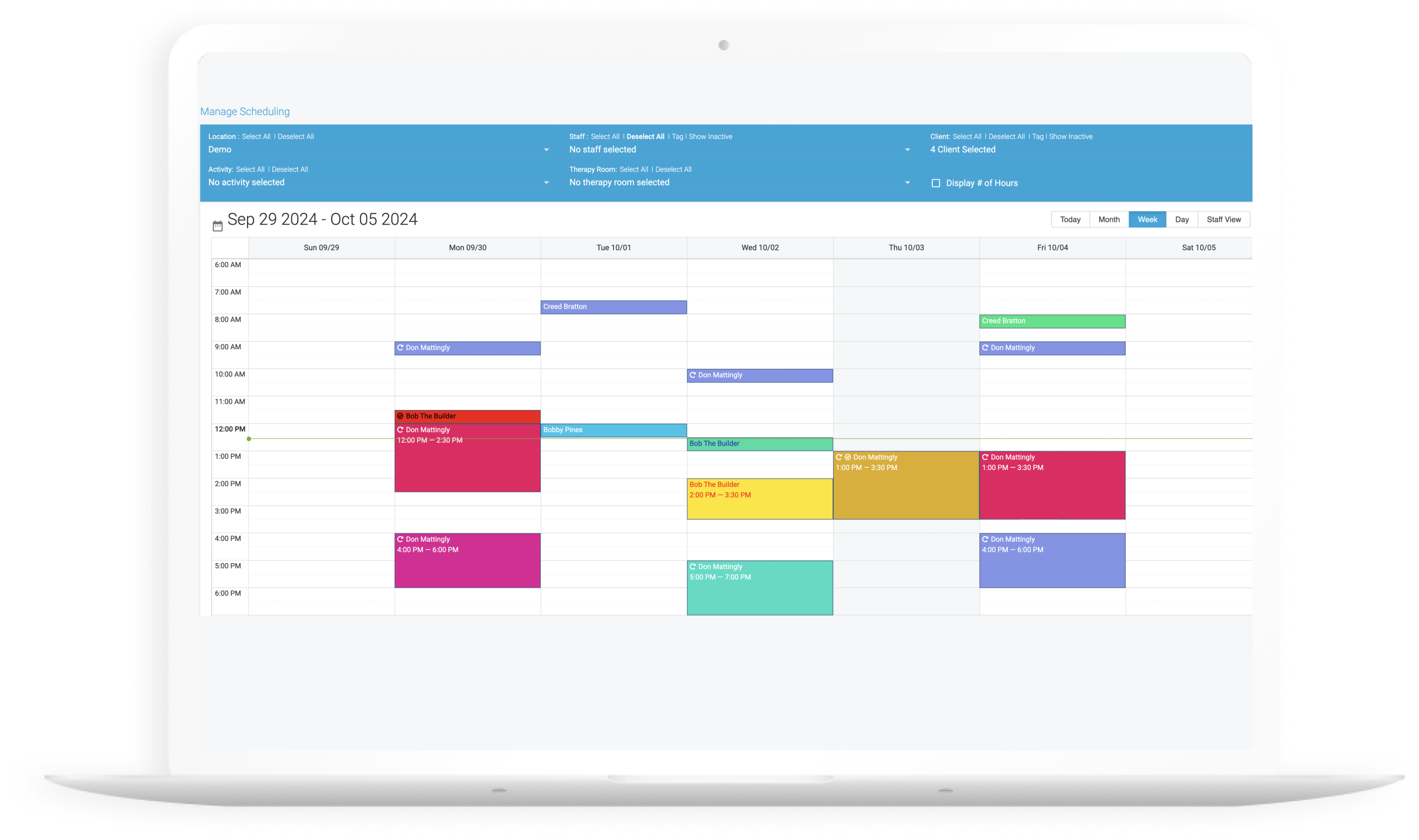
For practice owners and clinical directors, making sure every team member is applying techniques consistently and collecting reliable data across sessions is an ongoing challenge. Theralytics is built to support that. The platform brings ABA software for data collection, session documentation, reporting, and ABA scheduling software into one place so clinical teams can spend less time on administrative work and more time on the techniques that actually move the needle.
Book a free 15-minute demo to see how Theralytics supports ABA therapy delivery across your team.