


A prompting hierarchy is the ordered list of supports a clinician uses to help a learner respond correctly, from the most hands-on help to the lightest cue. Every ABA team uses one, whether it is written down or just lives in the RBT's head. The difference between a team that moves learners toward independence and a team that accidentally builds prompt dependence is usually how clearly that hierarchy is planned, followed, and recorded.
This guide explains what ABA prompts are, the main prompt types with real examples, how most-to-least and least-to-most prompting work, how time delay fits in, what the research says about choosing between them, and how to record prompt levels so fading is visible instead of guessed at.
What Is a Prompt in ABA?
In applied behavior analysis, a prompt is a cue that helps a learner perform a correct response. It comes after the instruction or situation (the discriminative stimulus, or SD) and before the response. Prompts are used when a learner does not yet respond correctly on their own, and they are meant to be removed once the skill is established.
Think of a prompt as scaffolding. It holds the response up while the learner builds the skill, then it comes down. If the scaffolding stays up, the learner never learns to stand without it.
Prompt vs. SD: What Is the Difference?
The SD is the natural signal that should eventually trigger the response on its own. A prompt is something extra that you add to make that happen early on.
Here is a simple example. A stranger says "hi" and waves. That greeting is the SD for the learner to say "hi" back. If the RBT whispers "say hi" right after the greeting, that whisper is a verbal prompt. The goal is for the learner to answer the greeting without the whisper. Moving control from the prompt to the SD is called transfer of stimulus control, and it is the whole point of fading.
Response Prompts and Stimulus Prompts
Most of what people mean by "prompts" are response prompts. Someone does something to help the learner perform the response: guide their hand, show the action, say the answer, point.
Stimulus prompts change the materials instead. You might make the correct card larger, place it closer to the learner, or highlight it in color. Researchers have also taught receptive identification using only positional prompts, changing where the correct card sat, and learners still reached mastery. That is a useful reminder that a prompting hierarchy does not always need hands, gestures, or voices.
Types of Prompts in ABA With Examples
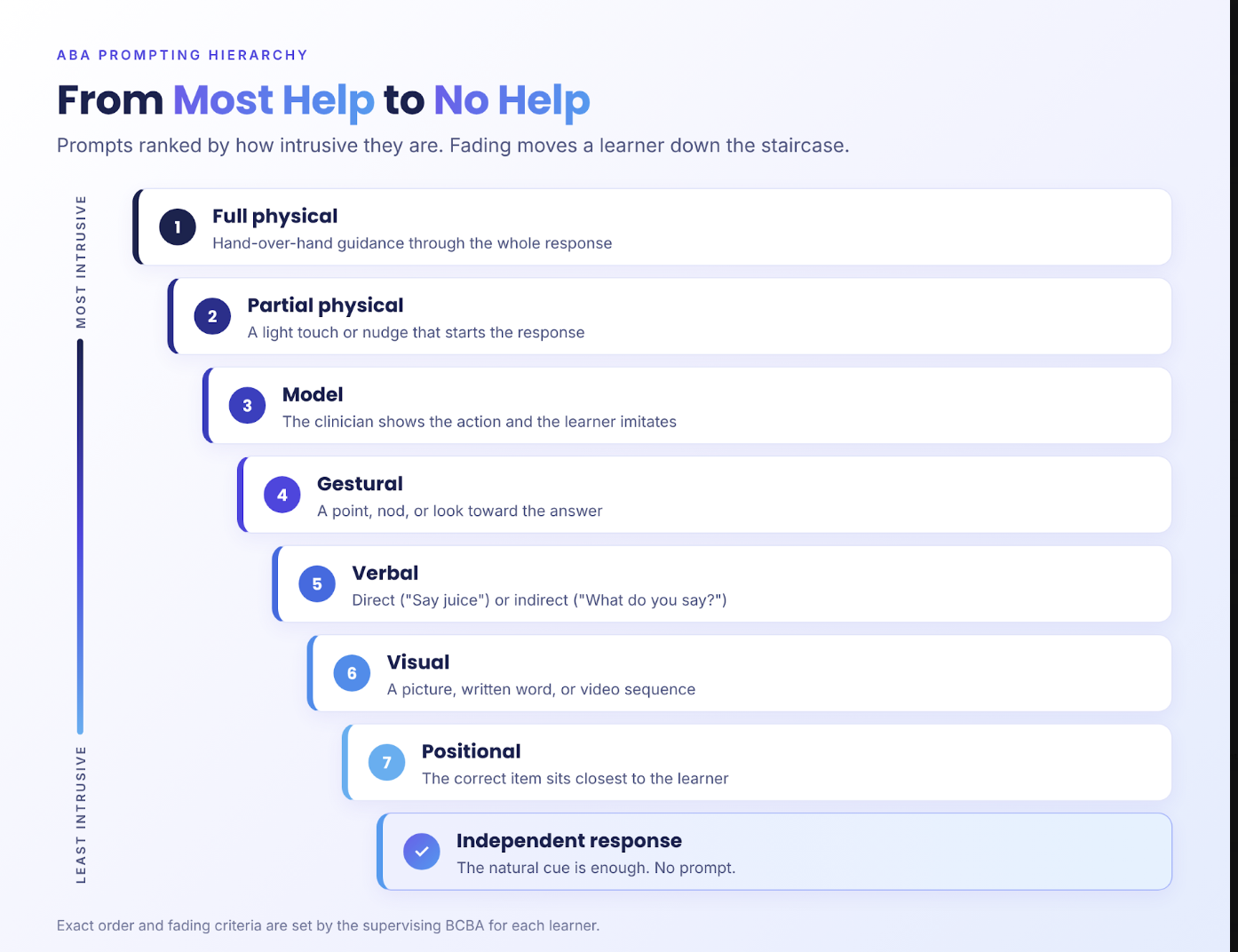
Prompts are usually sorted by how much help they give. The more help, the more intrusive the prompt, and the harder it tends to be to fade.
| Prompt type | What it looks like | Example |
| Full physical | Hand-over-hand guidance through the whole response | The RBT places a hand over the learner's hand and guides it to turn on the faucet |
| Partial physical | A light touch that starts or steers the response | A tap on the elbow to start the learner's arm moving toward the soap |
| Model | The clinician shows the response and the learner imitates | The RBT rubs their own hands together with soap, then waits for the learner to copy |
| Gestural | A point, nod, or look toward the answer | Pointing to the towel when it is time to dry hands |
| Verbal, direct | Says the exact response | "Say, I want juice" |
| Verbal, indirect | A hint or question that points toward the response | "What do you say when you want something?" |
| Visual | A picture, written word, schedule, or video | A photo sequence of handwashing steps posted above the sink |
| Positional | The correct item is placed closer to the learner | The correct card sits at the learner's fingertips while the others sit farther away |
A few notes on this table that often get skipped.
Order is not identical everywhere. Some sources put gestural above verbal, others reverse it. Some treat visual prompts as the lightest level, others place them in the middle. What matters is that your team agrees on one order for a given learner and writes it down.
Intrusiveness is about the learner, not the clinician. A verbal prompt is easy for the RBT to deliver, but for a learner who echoes everything, a verbal prompt can be the strongest cue in the room. Treat the table as a starting point, then adjust to what actually controls that learner's behavior.
Physical prompts have a safety role. Sometimes hand-over-hand guidance is needed for safety, for example when teaching a learner to use a knife during a cooking task. In those cases the physical prompt is a safety decision as well as a teaching decision.
What Is a Prompting Hierarchy in ABA?
A prompting hierarchy is a ranked list of prompts used within a teaching procedure. It tells the clinician which prompt to use first, which to use next, and what has to happen before moving up or down.
A useful hierarchy answers four questions before instruction begins:
- Which prompt types will be used for this learner and this skill?
- In what order will they be delivered?
- What performance means it is time to fade to the next level?
- What counts as independent, and when does prompting end?
If any of those answers lives only in someone's head, two staff members will run the same program two different ways, and the data will show it.
What Is a Controlling Prompt?
A controlling prompt is a prompt that reliably produces the correct response. If a learner does not respond correctly even with a gestural prompt, that gesture is not controlling, and building a fading plan around it will go nowhere.
This is why many clinicians test prompts before they write the hierarchy. A comparison of MTL and LTM in children with autism started by assessing which prompt types were strong enough to produce correct responding, then compared the two procedures using only those prompts. The authors suggested that mixed results in earlier comparisons may be partly explained by procedures that included prompts that did not work for the learner.
Most-to-Least vs. Least-to-Most Prompting
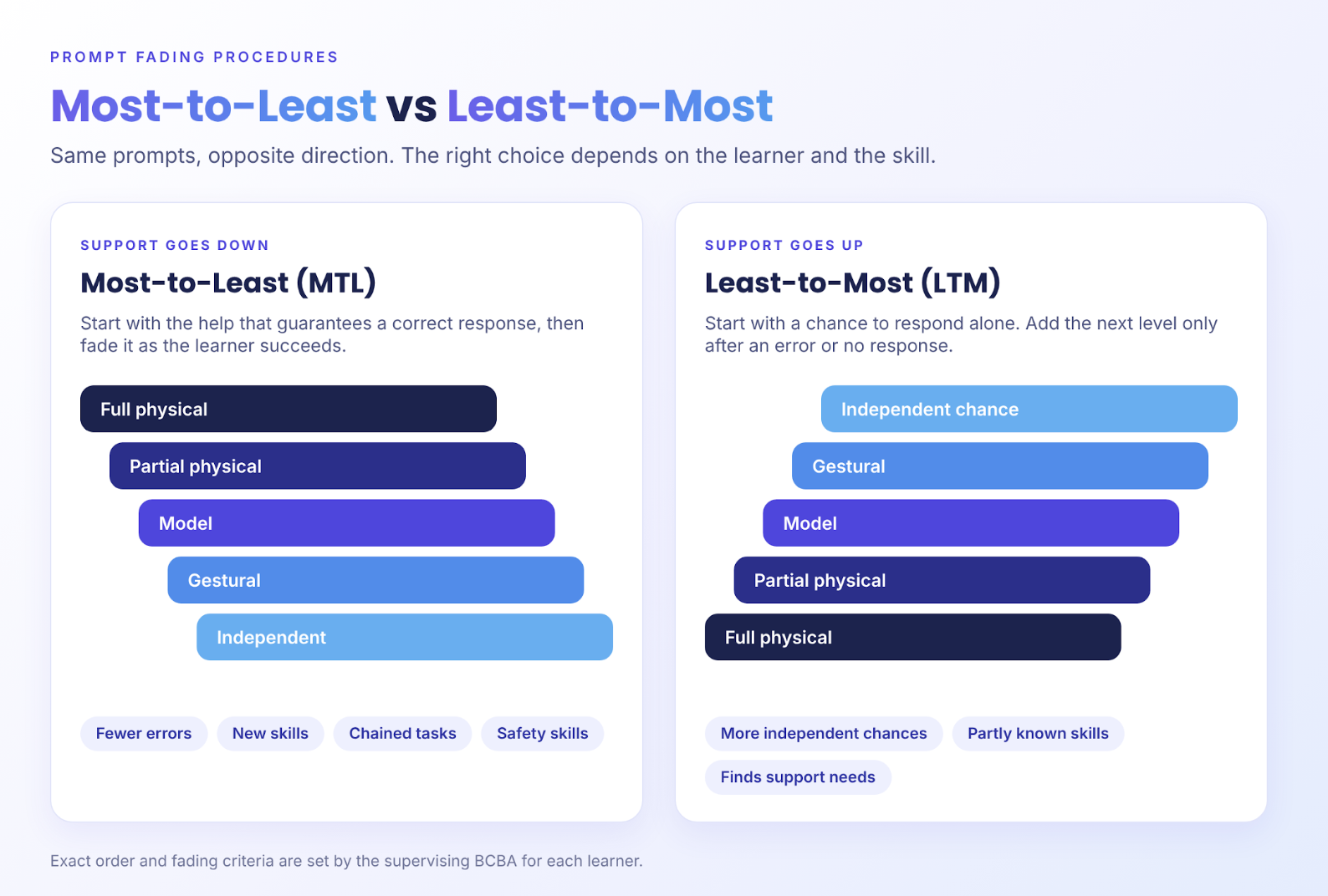
The two most common ways to use a prompting hierarchy move in opposite directions.
Most-to-Least (MTL) Prompting
MTL starts with the most amount of help that guarantees a correct response, then fades that help as the learner succeeds. For a learner starting a new handwashing routine, that might mean full physical guidance for the first sessions, then partial physical, then a model, then a gesture, then nothing.
MTL is a good fit when:
- the skill is new and errors would be frustrating or hard to undo
- the learner has a history of problem behavior when they get things wrong
- the task is a chain of steps (like dressing, brushing teeth, or making a snack) where one wrong step can derail the rest
- safety matters
The tradeoff is that MTL can keep help in place longer than the learner needs. If fading criteria are vague, a learner may stay at a high prompt level for weeks after they were ready to move.
Least-to-Most (LTM) Prompting
LTM, often run as a system of least prompts, gives the learner a chance to respond with minimal help first. If there is no correct response, the clinician adds the next level of support, and continues up the hierarchy until the learner responds correctly.
For example, when teaching a learner to hang up a jacket:
- Wait for the learner to respond to the SD, "Time to hang up your jacket" (no prompt)
- Point to the hook (gestural)
- Say "Put it on the hook" (verbal)
- Model hanging up a jacket
- Partial physical guidance
- Full physical guidance
LTM is a good fit when the learner already has part of the skill, when you want to find out how much support they actually need, or when you want to give plenty of chances to respond independently.
The tradeoff is that LTM allows more errors, because the learner has to miss before help arrives. For some learners that is fine and even informative. For others, repeated errors lead to frustration and escape behavior.
MTL vs. LTM at a Glance
| Most-to-least | Least-to-most | |
| Starts with | Most help needed for a correct response | No help or the lightest cue |
| Moves toward | Less help as the learner succeeds | More help only after an error or no response |
| Errors | Usually fewer | Usually more |
| Independence opportunities | Fewer early on | Built into every trial |
| Often used for | New skills, chains, safety skills, learners sensitive to errors | Skills the learner partly has, assessing support needs |
What the Research Says About Choosing
This is where a lot of blog posts stop at "it depends." Here is what the studies actually found.
In a well-known comparison using construction play tasks with children with autism, Libby and colleagues found that all participants learned with MTL and made fewer errors than with LTM. Three participants, however, learned faster with LTM. In a second study, adding a short delay to MTL produced learning almost as fast as LTM, with fewer errors than LTM.
Later, the Cengher team compared the two procedures after first checking that the prompts were strong enough to work. MTL was more effective and more efficient for all three participants.
A 2020 study compared most-to-least with an embedded constant time delay, least-to-most, and progressive time delay on a conditional discrimination task with three boys with autism. Two of the three met mastery in the assessment, one with progressive time delay and one with least-to-most. Both preferred the method that had worked for them.
A systematic review of prompt-fading research found that prompt-fading procedures were generally effective at producing acquisition. The most practical reading of all of this is that the procedure matters less than fit. A BCBA should choose, run it with fidelity, watch the data, and switch if the learner is not progressing.
That lines up with the BACB's Ethics Code, which expects behavior analysts to select interventions based on the client's needs and to keep evaluating whether they are working.
Time Delay Prompting
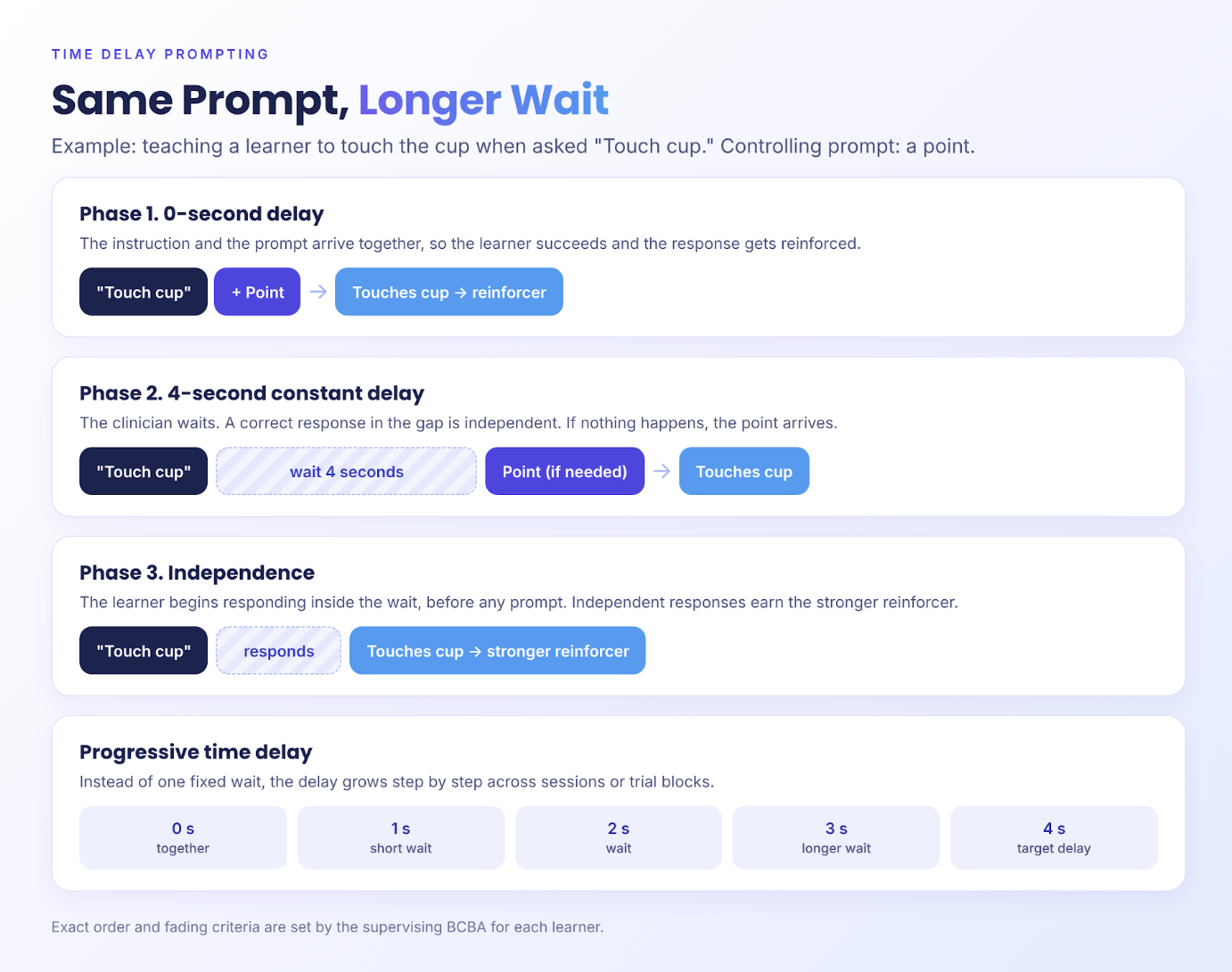
Time delay does not change the prompt. It changes when the prompt arrives.
In constant time delay (CTD), you start with a 0-second delay, so the SD and the controlling prompt arrive together. After a set number of trials, you switch to a fixed delay, such as 4 seconds, and wait that long before prompting. If the learner responds correctly in the gap, that is an independent response.
In progressive time delay (PTD), the wait grows gradually, for example 0 seconds, then 1, 2, 3, and 4 seconds across sessions or blocks of trials.
Time Delay Example: Receptive Identification
The goal is for the learner to touch the cup when asked, "Touch cup."
*Phase 1, 0-second delay (first 4 trials):* The RBT says "Touch cup" and points to the cup at the same moment. The learner touches the cup. The RBT delivers reinforcement.
*Phase 2, 4-second constant delay:* The RBT says "Touch cup" and waits 4 seconds.
- If the learner touches the cup during the wait, it is recorded as an independent correct response and receives the stronger reinforcer.
- If the learner does not respond, the RBT points. The learner touches the cup and gets standard reinforcement. It is recorded as a prompted correct response.
- If the learner touches the wrong item, the RBT follows the program's error correction step.
**Phase 3, independence:**Over time, the learner touches the cup before the point arrives. The delay stays the same until independent responding meets criterion, and then the prompt is removed.
Time delay is attractive because it creates a built-in chance for independence on every trial without letting errors pile up. A review of 36 constant time delay studies with discrete behaviors found it to be an effective procedure, and a review of 22 studies with children with autism found constant and progressive time delay similar in effectiveness on several variables. For a short practical walkthrough, the University of Nevada, Reno has a constant time delay tip sheet.
Other Fading Options
Time delay, MTL, and LTM are the three most common, but they are not the only ones.
- Simultaneous prompting delivers the controlling prompt on every teaching trial and checks independence separately in probe trials without prompts.
- Graduated guidance adjusts the amount and location of physical help moment by moment, fading from hand-over-hand to a shadowing touch.
- Stimulus fading changes the materials rather than the clinician's behavior, such as gradually making the correct card look more like the other cards.
If you want a free, practitioner-friendly walkthrough of these procedures, the AFIRM prompting module from the UNC Frank Porter Graham Child Development Institute covers the steps and includes data collection forms. Prompting is one of the 28 evidence-based practices for autistic learners identified in the National Clearinghouse on Autism Evidence and Practice's 2020 review.
How to Choose a Prompting Hierarchy for a Learner
No chart can pick this for you, but this order of questions helps.
*1. Which prompts actually work for this learner?* Test a few. If a gesture does not produce a correct response, it cannot be your controlling prompt yet.
*2. Is it a single response or a chain?* Single responses (labeling, matching, a one-step instruction) fit well with time delay or LTM. Chains (handwashing, dressing) often work well with MTL, usually paired with a task analysis.
*3. How does this learner react to errors?* If errors lead to protest, escape, or aggression, lean toward procedures that limit errors, such as MTL or MTL with a delay.
*4. How likely is prompt dependence?* Learners with a long history of heavy prompting, and teams that lean on verbal prompts, are at greater risk. Build in independence checks and delay early.
*5. What will be written down?* Put the prompt order, fading criteria, and independence definition in the program, so every RBT runs it the same way.
| Situation | A reasonable place to start |
| Brand new, multi-step skill | Most-to-least with a task analysis |
| Learner has part of the skill | Least-to-most, or time delay |
| Single response with a strong controlling prompt | Constant time delay |
| Strong reaction to errors | MTL, or MTL with a short delay |
| Learner relies on a particular prompt | Add delay, or switch to a less-used prompt type |
| Learner stalls after fading | Return to the last successful level, check reinforcement, review the criteria |
These are starting points for a BCBA's judgment, not rules.
Step-by-Step Example: Teaching Handwashing With Most-to-Least Prompting
Here is how a prompting hierarchy plays out across a chained skill. The task analysis has five steps: turn on water, wet hands, pump soap, scrub, rinse and dry.
The written plan:
- Hierarchy: full physical, partial physical, model, gestural, independent
- Fade to the next level after 2 consecutive independent-or-lower-prompt correct responses on a step
- Return to the previous level after 2 consecutive errors on a step
- Reinforcement: praise at every step, plus the preferred reinforcer for steps completed at the lowest prompt level
Sample data across four sessions (prompt level used on each step):
| Step | Session 1 | Session 2 | Session 3 | Session 4 |
| Full physical | Partial physical | Gestural | Independent |
| Full physical | Partial physical | Model | Gestural |
| Full physical | Full physical | Partial physical | Model |
| Full physical | Partial physical | Partial physical | Gestural |
| Full physical | Partial physical | Model | Gestural |
| Steps independent | 0 of 5 | 0 of 5 | 0 of 5 | 1 of 5 |
At a glance, the learner is moving down the hierarchy on almost every step, and step 3 is the slowest. A BCBA reading this can see exactly where to focus: maybe the pump is hard to operate, or the physical prompt is not matching the motor demand. That insight is only possible because each step's prompt level was recorded.
Fading Criteria and Prompt Dependence
What Are Good Fading Criteria?
Fading criteria answer the question "when do we move on?" Common examples used by teams include:
- 2 or 3 consecutive correct responses at the current prompt level
- a set percentage of correct trials across a session
- correct responding across two consecutive sessions
There is no universal number. The right criterion depends on the learner, the skill, and how costly errors are. What matters is that it is written, applied by everyone, and reviewed by the BCBA.
Signs of Prompt Dependence
Prompt dependence means the learner responds to the prompt instead of the natural SD. Watch for:
- the learner pausing and looking at the RBT before every response
- accuracy that drops sharply when the usual prompt is withheld
- responses that only happen with a particular person
- a skill that looks mastered in sessions but does not show up at home or school
How to Reduce Prompt Dependence
- Fade on a plan, not on a feeling.
- Use time delay so each trial includes a chance to respond alone.
- Reinforce independent responses more strongly than prompted ones.
- Prompt before an error, not after, so errors are not practiced.
- Rotate who delivers instruction so the learner is not tied to one person's cues.
- Move a prompt away from the learner's attention gradually, rather than removing it abruptly.
Common Prompting Mistakes
Leaving the prompt in too long. The prompt becomes part of the routine, and the learner never gets a chance to respond alone.
Fading too fast. Dropping three levels at once after one good trial often leads to errors and a lost day.
Different staff, different hierarchies. If one RBT points and another says the answer, the learner experiences two different programs.
Unplanned prompts. Eye gaze, a head nod, or leaning toward the correct item all act as prompts. If they are not in the plan, they are not being faded.
Not recording prompt level. "80% correct" can hide the fact that every response was prompted.
Using the same hierarchy for every learner. A hierarchy that works for one learner can be too slow or too intrusive for another.
Skipping the reinforcement difference. If independent and prompted responses earn the same thing, there is little reason for the learner to give up the prompt.
How to Record Prompt Data
Accuracy alone is not enough. A learner who answers correctly on 90% of trials with a full physical prompt has not learned the skill.
For each trial or step, record:
- the SD or instruction delivered
- the prompt level used (or "independent")
- whether the response was correct
- what reinforcement was delivered
From that, you can graph two things that tell different stories: percent correct and percent independent. The first tells you whether the learner is responding. The second tells you whether the learner is learning.
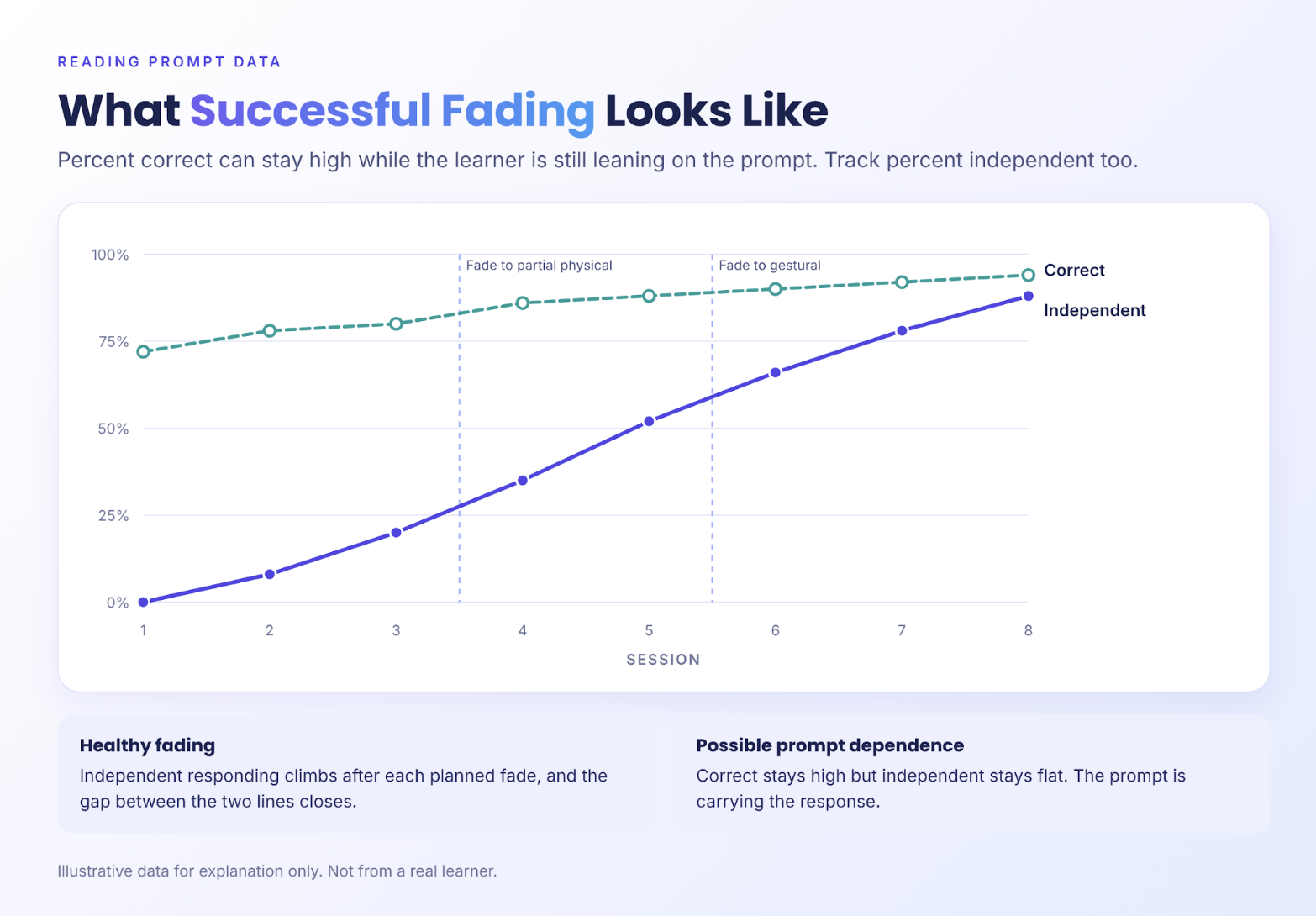
A graph like this, with percent independent climbing while the average prompt level drops, is what successful fading looks like. If the independent line flatlines while the correct line stays high, the learner is being carried by the prompt. For more on choosing how to measure, see our guides to ABA data collection methods and frequency data collection. Trial-by-trial data collection of this type is also the backbone of discrete trial programs.
Paper makes this hard. In a busy session, shorthand like "PP" or "G" gets scribbled, entries are skipped, and prompt data is reconstructed from memory afterward. Digital collection at the moment of instruction removes most of that guesswork.
Prompting in Session Notes and Supervision
Prompt information belongs in the clinical record. Compare these two lines:
Vague: "Client did well with handwashing today."
Objective: "Client completed 3 of 5 handwashing steps with a gestural prompt or less. Step 3 (pump soap) required partial physical. Plan: continue MTL, fade step 2 to gestural."
The second version tells a supervisor, a parent, and a payer reviewer what happened and what comes next. Our guide to ABA session notes examples walks through objective wording, SOAP structure, and the details notes should include.
There is also a billing connection. When a BCBA reviews data and changes a prompting protocol, that clinical work is typically billed under 97155, protocol modification. Our ABA CPT codes guide covers what that code includes and what documentation supports it. Payer rules vary, so check the current policy for each payer.
If you are adopting AI tools for note drafting, our breakdown of CASP's AI practice parameters explains why clinician review of anything generated from session data still matters.
Training RBTs on the Prompting Hierarchy
Effective prompting and fading are essential clinical competencies for Registered Behavior Technicians (RBTs). While the BACB's 2nd Edition RBT Task List delineated stimulus control transfer and prompting procedures into separate task items, the updated 3rd Edition Test Content Outline (effective January 1, 2026) continues to emphasize these foundational instructional techniques. Regardless of when staff completed their initial training, daily clinical success relies on consistent execution: delivering prompts as prescribed, recording implementation data accurately, and systematically fading supports based on objective criteria.
To foster high procedural fidelity and prompt-fading proficiency across your clinical team, consider incorporating the following supervisory practices:
- Role-play each level of the hierarchy, including how long to wait before prompting.
- Have supervisors observe sessions with the written hierarchy in hand, and check fidelity.
- Review prompt-level data in supervision, not just percent correct.
- Use free resources like the AFIRM prompting module.
- Look at our continuing education options, including Increasing RBT Effectiveness and Verbal Operants.
How Theralytics Helps Teams Track Prompting and Fading
Prompt fading is a data problem as much as a teaching problem. Teams need the plan in one place, the data captured while the session is running, and the graph ready when the BCBA sits down to make a decision.
Theralytics was built by a BCBA who ran ABA organizations, and its clinical tools are designed around that workflow:
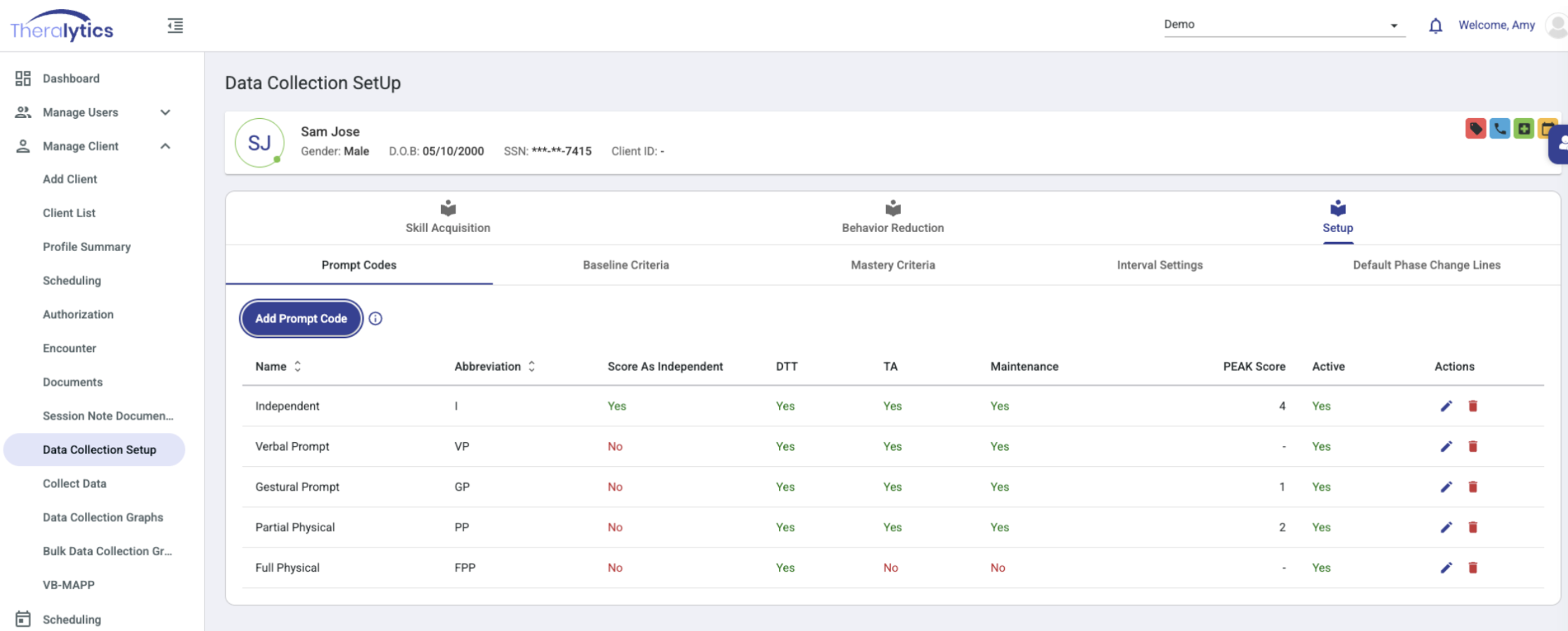
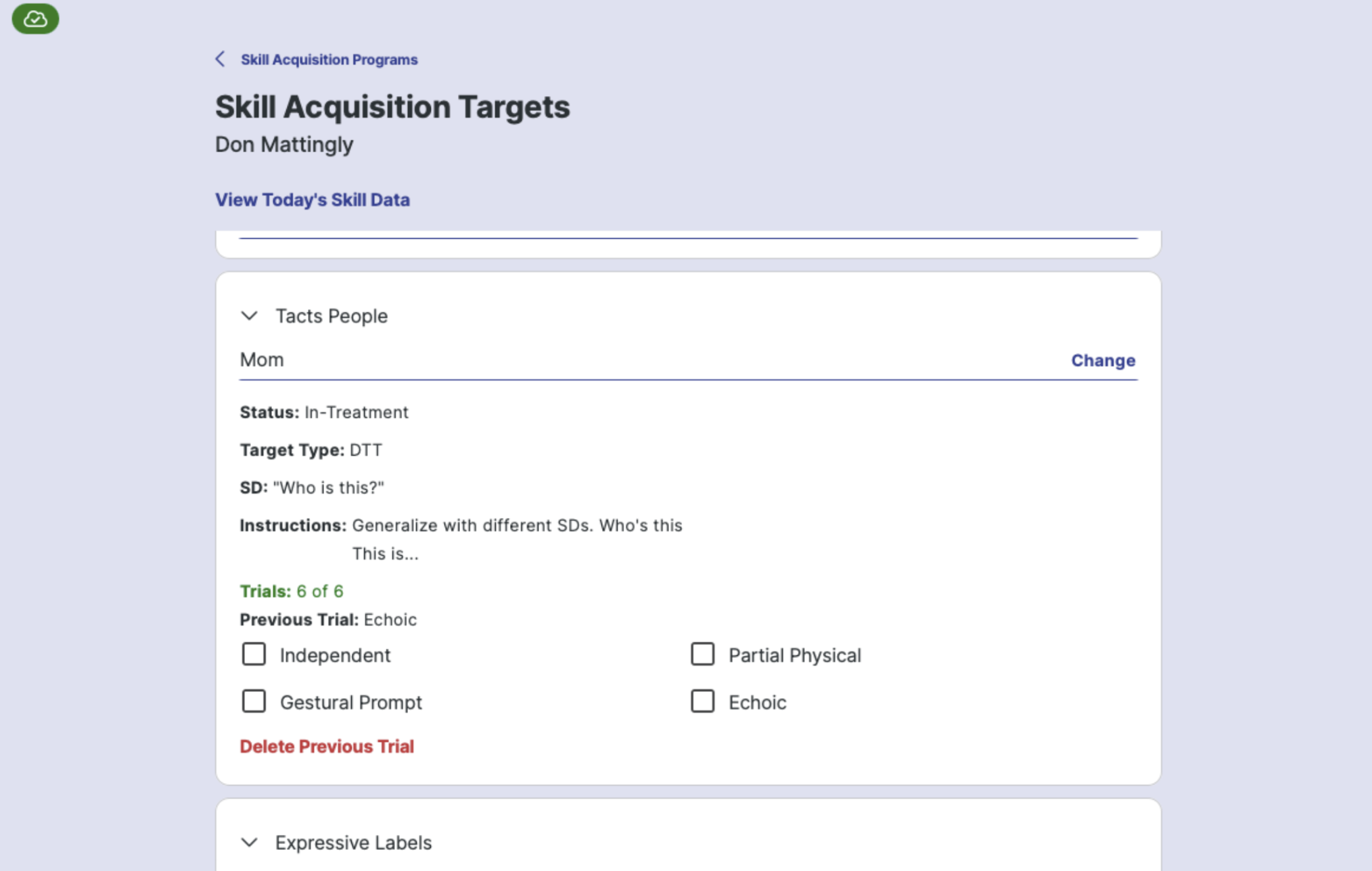
- Data collection: Capture DTT and NET data, along with Task Analysis where prompt hierarchy can be customized for each client.
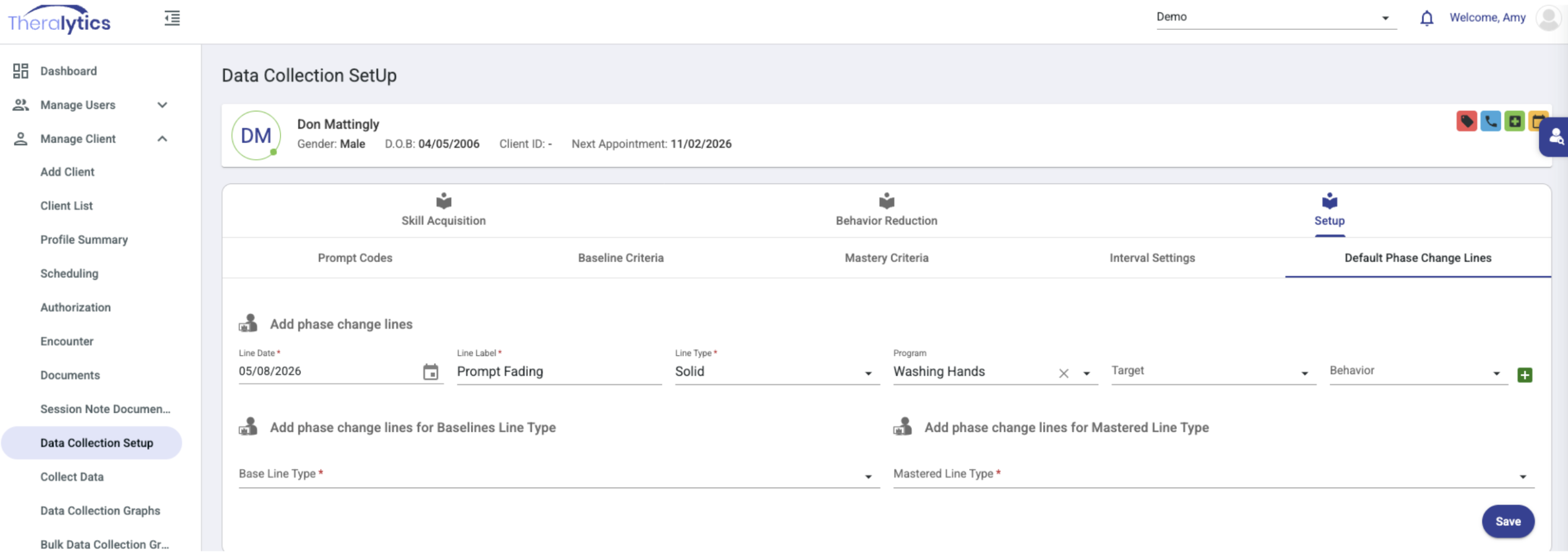
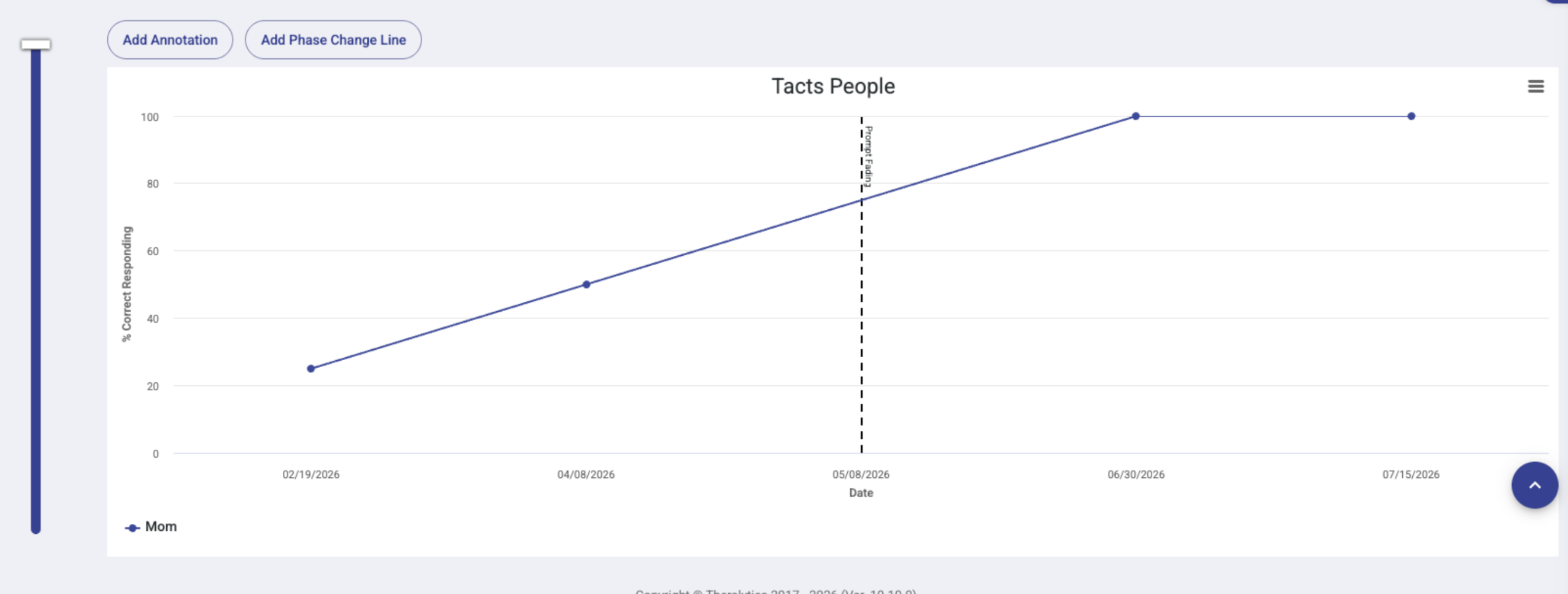
- Graphs with phase change lines and annotations: Mark the date a fading step changed or a new prompt level was introduced, so the context for every shift in the data is on the graph.
- Mobile app: Collect data in sessions, including without an internet connection, then sync securely when the device reconnects.
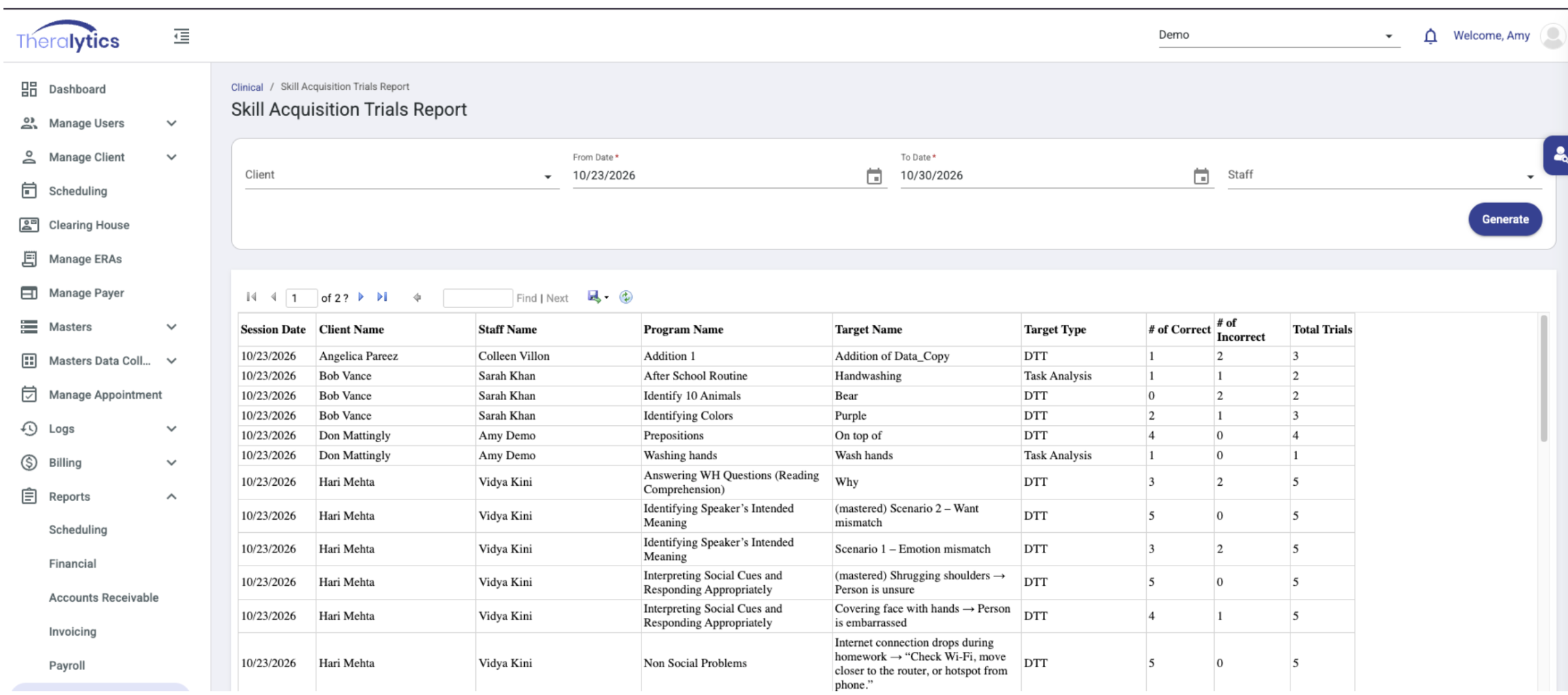
- Reporting and analytics: Review progress by client, staff member, or time period, and export reports for supervision, funders, or caregivers.
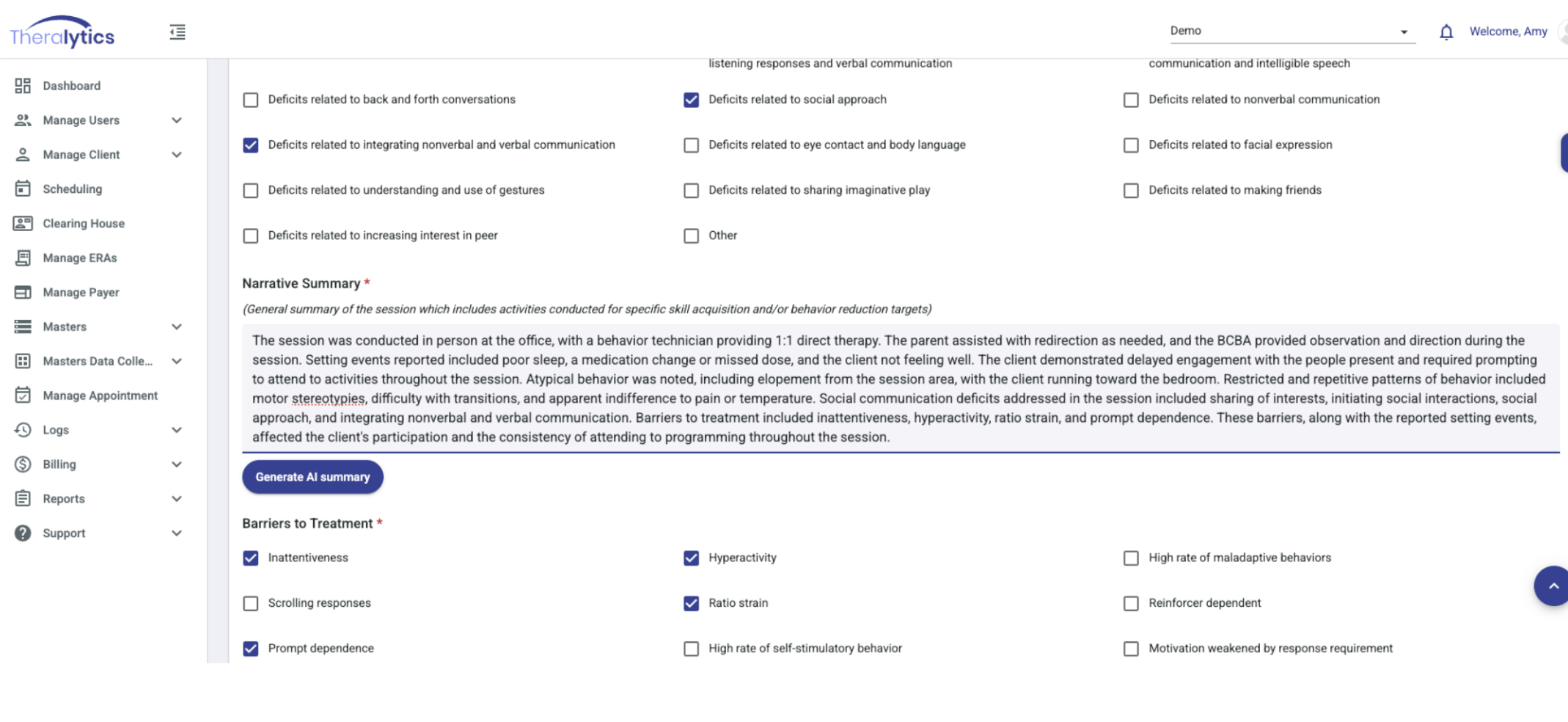
- AI-powered narrative summaries: Generate AI narrative summaries from the data collected in the session, for the clinician to review, edit, and sign.
If you are not sure how your current setup records prompt levels, a short demo is a good way to see how Theralytics handles it for your programs. You can also compare plans on the pricing page.
Conclusion
A prompting hierarchy is only as useful as the plan around it. Choose prompts that work for the learner. Pick a fading procedure that fits the skill and the learner's response to errors. Write down the criteria. Record the prompt level on every trial. Then let the graph tell you whether the learner is moving toward independence or leaning on the support.
If your team wants prompt data captured during the session and visible on a graph when it is time to decide, book a free 15-minute demo and see how Theralytics handles data collection, documentation, and reporting in one place.
Frequently Asked Questions
What is a prompting hierarchy in ABA?
A prompting hierarchy is an ordered list of prompts, from the most intrusive (full physical) to the least intrusive (a natural cue or positional prompt), used to guide a learner toward independent responding. It tells staff which prompt to use first, how to move between levels, and when to stop prompting.
What are the types of prompts in ABA?
The most common are full physical, partial physical, model, gestural, verbal (direct and indirect), visual, and positional prompts. Which ones are included, and in what order, should be set for each learner.
What is the difference between most-to-least and least-to-most prompting?
Most-to-least starts with the highest level of support and fades it as the learner succeeds. Least-to-most starts with the lightest support and adds more only if the learner does not respond correctly. MTL tends to produce fewer errors. LTM builds in more chances to respond independently.
Which is better, MTL or LTM?
Neither is better in every case. Studies comparing the two have found different results for different learners, and some learners do better with time delay. A BCBA should choose based on the skill, the learner's error history, and which prompts work, then review the data and switch if progress stalls.
What is a controlling prompt?
A controlling prompt is a prompt that reliably produces the correct response. A prompting hierarchy should be built from prompts that control the learner's behavior.
What is prompt dependence and how do you prevent it?
Prompt dependence is when a learner waits for or relies on the prompt instead of responding to the natural cue. To prevent it, fade on written criteria, build in time delay, reinforce independent responses more than prompted ones, and record prompt levels on every trial.
How long should a learner stay at one prompt level?
It depends on the learner and the skill. Many teams set a criterion such as a set number of consecutive correct responses or a percentage correct across a session. The criterion should be written in the program and reviewed by the BCBA.
Is time delay a prompting hierarchy?
Time delay is a fading procedure, not a hierarchy. It uses one prompt and changes the time between the instruction and the prompt. It can be used on its own or combined with a hierarchy, as in most-to-least with a delay.
Who decides which prompting hierarchy to use?
The BCBA designs it, based on assessment and ongoing data. RBTs implement it as written and report what they see. If the learner is not progressing, the BCBA adjusts the plan.