


For Ops Managers and IT Implementers in ABA organizations, integrating AI is more than just turning on a new software feature. It is a strategic operational shift. The Council of Autism Service Providers recently published the Practice Parameters for Artificial Intelligence Use in Applied Behavior Analysis, providing a structured framework for organizational oversight and the responsible deployment of AI tools. To successfully harness the efficiency benefits of AI, organizations must carefully manage its introduction, continuously monitor its performance, and ensure strict human oversight is maintained throughout the clinical workflow.
CASP's 4-Pillar Framework: Communication, Timing, Training, Implementation
To ensure a smooth transition that minimizes disruption, CASP recommends that organizations carefully consider four critical areas of AI integration: communication, timing, training, and implementation.
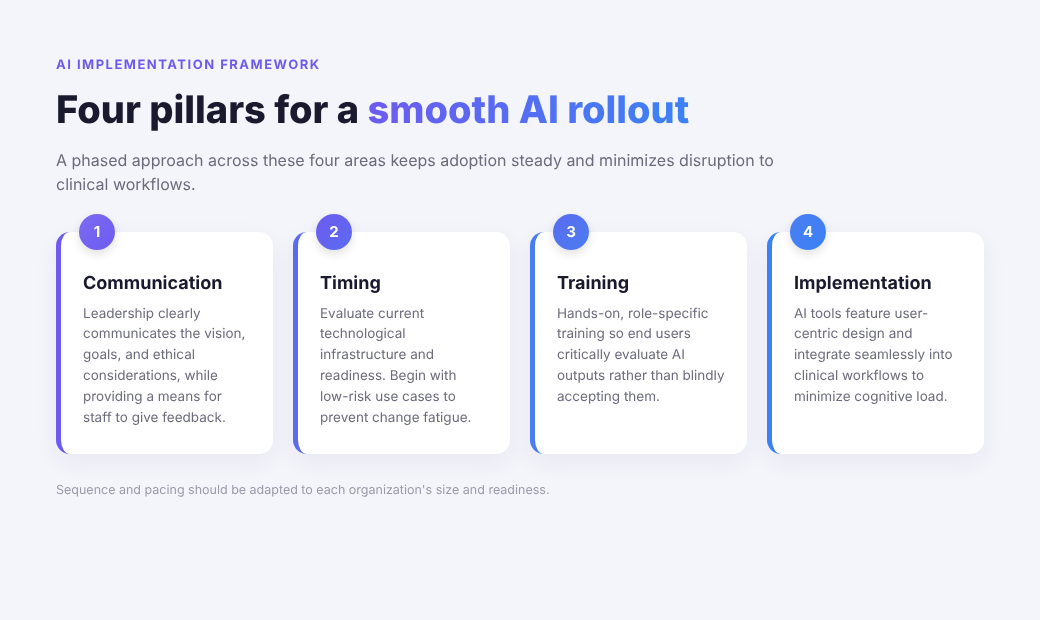
- Communication: A well-articulated strategy promotes transparency and collaboration among employees. Leadership must clearly communicate the vision, goals, and ethical considerations surrounding the AI integration, while also providing a means for staff to provide feedback.
- Timing: Evaluating current technological infrastructure and organizational readiness is essential. Organizations should consider a phased approach, beginning with low-risk use cases to prevent change fatigue and align with natural operational cycles.
- Training: Establishing an effective onboarding process with hands-on, role-specific training ensures staff are comfortable using the technology. End users must be trained to critically evaluate AI outputs rather than blindly accepting them.
- Implementation: AI tools must feature user-centric design and integrate seamlessly into existing clinical workflows to minimize cognitive load.
The Crucial Role of Human-in-the-Loop Monitoring
Once an AI system is deployed, the work of operations teams shifts to ongoing oversight. CASP emphasizes the necessity of continuous monitoring to detect unintended consequences, misalignment with ethical standards, or "performance drift," which is the gradual degradation of an AI system’s accuracy over time.
To safely manage these risks, CASP highlights the absolute necessity of "human-in-the-loop" monitoring. Fully automated execution is not appropriate for clinical documentation. Behavior analysts and supervisors must actively review AI-generated outputs to confirm clinical appropriateness.
Human oversight is especially critical when implementing specific generative and auditing features:
- Monitoring Generative Summaries: If a practice uses AI to translate raw session data into a written summary, clinicians must rigorously monitor this output. They must verify that the generated text has not "hallucinated" or confabulated details (e.g., filling in gaps with incorrect targets) and that it accurately reflects the client’s exact response to the intervention.
- Monitoring AI Note Review Results: When using AI to audit notes for compliance (such as checking for individualization or clinical justification), supervisors and clinicians must evaluate the AI’s feedback. The AI identifies potential concerns, but the clinician must decide if the feedback is clinically accurate and make the necessary modifications.
Structured Error Reporting and Theralytics Integration
To support this human-in-the-loop approach, operations teams must establish robust error-reporting mechanisms. A structured, accessible process allows providers to safely flag instances of incorrect data interpretation, biased recommendations, or system failures, triggering swift remediation.
Theralytics is built specifically to support a responsible, supervised rollout. As a platform that adapts to existing data collection routines, Theralytics integrates its AI Narrative Summary and AI Note Review directly into the clinician's natural workflow. By design, these tools do not function autonomously. They require the clinician to review, edit, and finalize all narrative summaries and to consider all audit feedback before any note is submitted.
For IT and operations leaders, rolling out Theralytics means deploying a system that enforces human oversight by default. This ensures your ABA practice can safely achieve the administrative efficiencies of AI while preserving complete clinical accountability and protecting patient welfare.