


We compared 10+ ABA billing software options and narrowed it down to 5 that consistently lower denial rates, accelerate reimbursement, and don't bury you in implementation costs. Here are the best ABA billing software options for your clinic in 2026, plus how to choose between them.
Managing billing for ABA (Applied Behavior Analysis) practices involves numerous challenges, including handling claims, tracking payments, and ensuring compliance with industry standards. To streamline these tasks, ABA billing companies have emerged as essential partners for ABA practices. These companies provide specialized billing services to simplify financial operations, improve efficiency, and allow practitioners to focus on delivering quality care.
In this guide, we'll walk you through the 5 best ABA billing software options for clinics in 2026.
5 best ABA billing software: TL;DR
| Software | Best For | Pricing | Key Strength | HIPAA Compliant? |
|---|---|---|---|---|
| 1. Theralytics Top Pick | Clinics that want a software billing feature plus optional managed billing | $20/client/month (software) or 4.5% of receivables (managed billing) | Office Ally + Claim.MD clearinghouses, ABA-specialized billing team | YesSOC 2 Type 2, ONC certified |
| 2. CentralReach | Multi-site and enterprise ABA providers | Quote | AI-powered RCM, 97.4% gross collection rate in year 1 | Yes |
| 3. MeasurePM | Practices wanting automation built around ABA-specific codes | Quote (bundle discounts) | Direct submission to 100+ payers, 85% first-pass clean claim rate | Yes |
| 4. AlohaABA | Small-to-mid practices wanting native PM software with billing | $29.99/staff/month (Practice Management with billing) + $10–12/client for Data Collection | Session-to-claim workflow with built-in claim scrubbing | Yes |
| 5. Ensora ABA Suite | Growing practices wanting an all-in-one suite with optional managed billing | Quote (≈$500/month per third-party listings) | BCBA-built all-in-one with billing, scheduling, telehealth, and optional RCM team | Yes |
Pricing reflects publicly available figures as of 2026. Final pricing may vary based on practice size, payer mix, and add-ons.
1. Theralytics: Best for software billing feature plus optional managed billing
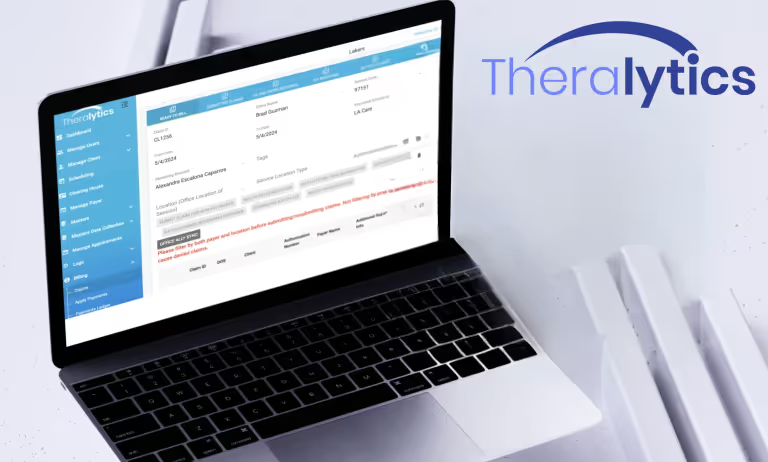
Theralytics is an ABA practice management software with a full billing feature built in, including claim submission, denial alerts, Office Ally and Claim.MD clearinghouse integrations, and real-time AR dashboards. For practices that want hands-off billing, Theralytics also offers a fully managed billing service staffed by ABA-specialized billers, priced at 4.5% of receivables. The managed service covers the entire revenue cycle (claim submission and scrubbing, denial management and appeals, payment posting and reconciliation, AR management, authorization and eligibility verification, and patient invoicing) backed by decades of experience across multiple payers in all 50 states.
Who it's for ABA clinics that want flexibility. Start with the software billing feature if you have an internal biller, switch to the managed billing service if you don't want to hire and manage one. Especially strong for practices working across Medicaid and commercial payers, where denial rates can quietly destroy margin.
Key features
- Software billing feature with full revenue cycle support: Create, submit, and track claims from inside the same software you use for scheduling and documentation. Generate 1500 forms, mark claims as submitted from a third-party biller, or submit electronically. Your call.
- Dual clearinghouse integration (Office Ally + Claim.MD): Submit claims directly to most major payers through either clearinghouse, with real-time status updates pulled back into your dashboard. No more logging into a separate clearinghouse to chase down last month's claims.
- Optional managed billing service at 4.5% of receivables: A team of ABA-specialized billers handles claim submission, denial follow-up, invoicing, and payment posting. Billed only when you actually get paid, so the vendor wins when you win.
- Real-time financial reporting: Customizable AR aging, payer mix, billable vs. non-billable hours, cancellation rates, and revenue dashboards. Filter by location, payer, appointment type, or staff.
- Enterprise-grade security: SOC 2 Type 2 compliant, ONC certified, HIPAA Seal of Compliance, hosted on AWS with WAF protection, two-factor authentication, and encryption at rest and in transit.
Pros
- Lowest software pricing on this list. $20/client/month for Practice Management and $20/client/month for Data Collection separately, or $30/client/month bundled
- Managed billing service available at a predictable 4.5% of receivables, billed only on collection
- Strong Capterra reputation (4.8 stars from 108 reviews)
- Two clearinghouse options (Office Ally and Claim.MD) instead of just one
- Award-winning support. Software Advice "Best Customer Support" multiple years running
Cons
- 10-client minimum and $200–$300 monthly base fee, so very small practices may pay more per client than the headline rate suggests
- Per-claim pricing may apply in some states for the managed billing service. Verify for your specific market
- Some users report occasional system errors and extra steps on claim resubmissions in edge cases
Pricing
- Software only: $20/client/month for Practice Management, $20/client/month for Data Collection, $30/client/month bundled. Per-user pricing also available ($30, $30, $45/user/month, respectively).
- Managed billing service: 4.5% of receivables, billed only when you collect (most states and payers).
- BCBA Startup Package: Free for 6 months or until your first paying client, requires a 1-year subscription.
- Bundle discount: Signing up for billing services unlocks 50–100% off subscription costs.
- 10-client minimum, $200–$300/month base fee depending on package.
Bottom line: If you're spending evenings chasing denials or paying a generalist outsourced biller 8-10% to do that job badly, Theralytics fixes both problems. You can start with the software billing feature and an internal biller, then add the managed service later if you decide outsourcing makes more sense. Either way, you get a system that actually understands ABA.
Book a free 15-minute demo to see how Theralytics handles billing for your practice →
2. CentralReach: Best for multi-site enterprise providers
CentralReach BillMax is an AI-powered managed revenue cycle service built on top of CentralReach's enterprise ABA software. A dedicated CR billing team handles claim submission, scrubbing, follow-up, and reporting using AI-driven workflows that the company claims help customers reach a 92% gross collection rate within the first three months and 97.4% in the first year.
Who it's for: Multi-location ABA providers and large clinics processing thousands of claims monthly. Practices big enough that dedicated account management, AI-driven claim auditing, and integration depth actually pay for themselves.
Key features
- AI-powered managed billing: Billing experts run your revenue cycle inside CentralReach, with AI tools like CR ClaimCheckAI auditing claims for errors and CR ClaimAcceleratorAI flagging revenue recovery opportunities.
- High collection rates as reported by CentralReach: Customers see an average 92% gross collection rate in the first 3 months and 97.4% in the first year, according to CR.
- Integrated billing inside CentralReach software: Claim submission, denial follow-up, and AR live inside the same software as scheduling and clinical data, so finance and clinical teams look at the same numbers.
- Real-time and predictive analytics: Dashboards cover claim status, AR aging, payer trends, and revenue forecasting. Important at scale where small percentage shifts move real money.
- ABA-specialized billing experts: The outsourced team knows ABA CPT codes, modifiers, and payer behaviors, not generic medical billing.
Pros
- AI-powered claim scrubbing and revenue recovery reduce manual error rates
- Solid Capterra rating (4.3 stars from 156 reviews)
- Strong fit for high-volume, multi-site operations
- Real customer-reported collection rate benchmarks (92% / 97.4%) to compare against your current numbers
Cons
- No public pricing. Quote-only process slows down evaluation
- Heavy implementation that can take months
- Often overkill (and overpriced) for small-to-mid clinics
- Users report support response times can lag at the scale CR operates at
Pricing: Contact CentralReach for a quote. Pricing typically scales with claim volume.
Bottom line: CentralReach BillMax is built for multi-site ABA practices with claim volumes that justify a dedicated RCM team and AI-driven claim auditing. If you're running 5+ clinics and processing thousands of claims a month, the 97.4% first-year collection rate they cite is a real benchmark to push for, and the price pencils out.
If you're a 3-clinician startup, it doesn't. Implementation alone will take months, and you'll end up with 80% more software than you need at 3x the cost of simpler alternatives. Match the software to your scale.
3. MeasurePM: Best for ABA-specific billing automation
MeasurePM is an all-in-one ABA practice management software that automates the revenue cycle from claims to payments. The billing feature is purpose-built for ABA, with pre-filled CPT codes, direct submission to 100+ payers, and built-in error checks before claims go out. MeasurePM reports an 85% first-pass clean claim rate, a 25% reduction in rejections, and a 20% revenue increase among users.
Who it's for: ABA practices that want billing automated inside the same software they use for scheduling and clinical data, with internal billing staff (or light-touch billing) instead of a fully managed service.
Key features
- Direct submission to 100+ payers: Claims submit directly to 100+ insurance payers, including Medicaid, Aetna, and Blue Cross, bypassing some clearinghouse intermediaries and speeding up processing.
- Pre-filled ABA CPT codes: Codes like 97153 (adaptive behavior treatment by protocol) and 97155 (with protocol modification) pre-populate from session data, cutting the manual coding errors that drive most ABA denials.
- Built-in error checks (25% rejection reduction): Pre-submission validation catches errors before claims leave the system. MeasurePM reports this cuts rejection rates by 25% and supports an 85% first-pass clean claim rate.
- Revenue cycle management with authorization tracking: Track authorizations, verify eligibility, and manage copays inside the billing feature. MeasurePM says users report a 20% revenue increase from these tools.
- Mobile billing access: iOS, Android, and Kindle apps with offline mode for clinicians collecting session data in the field.
Pros
- Purpose-built for ABA. Codes, modifiers, and payer behaviors are baked into the workflow
- Direct payer submission cuts out the clearinghouse middleman costs
- Concrete, measurable claims (25% rejection reduction, 85% first-pass clean claim, 20% revenue increase) that are more verifiable than competitors' vague "fewer denials" promises
- 99.99% uptime with audit-ready compliance reporting
- Bundle discounts available. Combining data, scheduling, and billing reduces total cost
- Built and supported by BCBAs, with 15+ years of ABA billing expertise on the billing team
Cons
- No public pricing. Quote-only
- Limited transparent customer review volume compared to others on this list
- Software-only. You still need staff (or a third-party biller) to operate the billing feature
- "100+ payers direct" is a vendor claim. Verify your specific Medicaid plans are supported during the demo
Pricing Contact MeasurePM for a quote. Month-to-month plans available, with bundle discounts when you combine data collection, scheduling, and billing.
Case study Thrive ABA reduced claim processing time from 5 days to 1 day after switching to MeasurePM, and recovered $50,000 in unpaid claims within the first 6 months.
Bottom line MeasurePM does the heavy lifting most billing software skips. Pre-filled ABA codes mean your biller isn't manually distinguishing 97153 from 97155 for every session. The pre-submission error checks catch the small mistakes that would otherwise sit in AR for 60 days before someone notices.
The software doesn't replace your biller. It makes them dramatically faster. If you don't have one (or don't want one), look at managed billing services like Theralytics or CentralReach BillMax instead.
4. AlohaABA: Best for native PM software with integrated billing
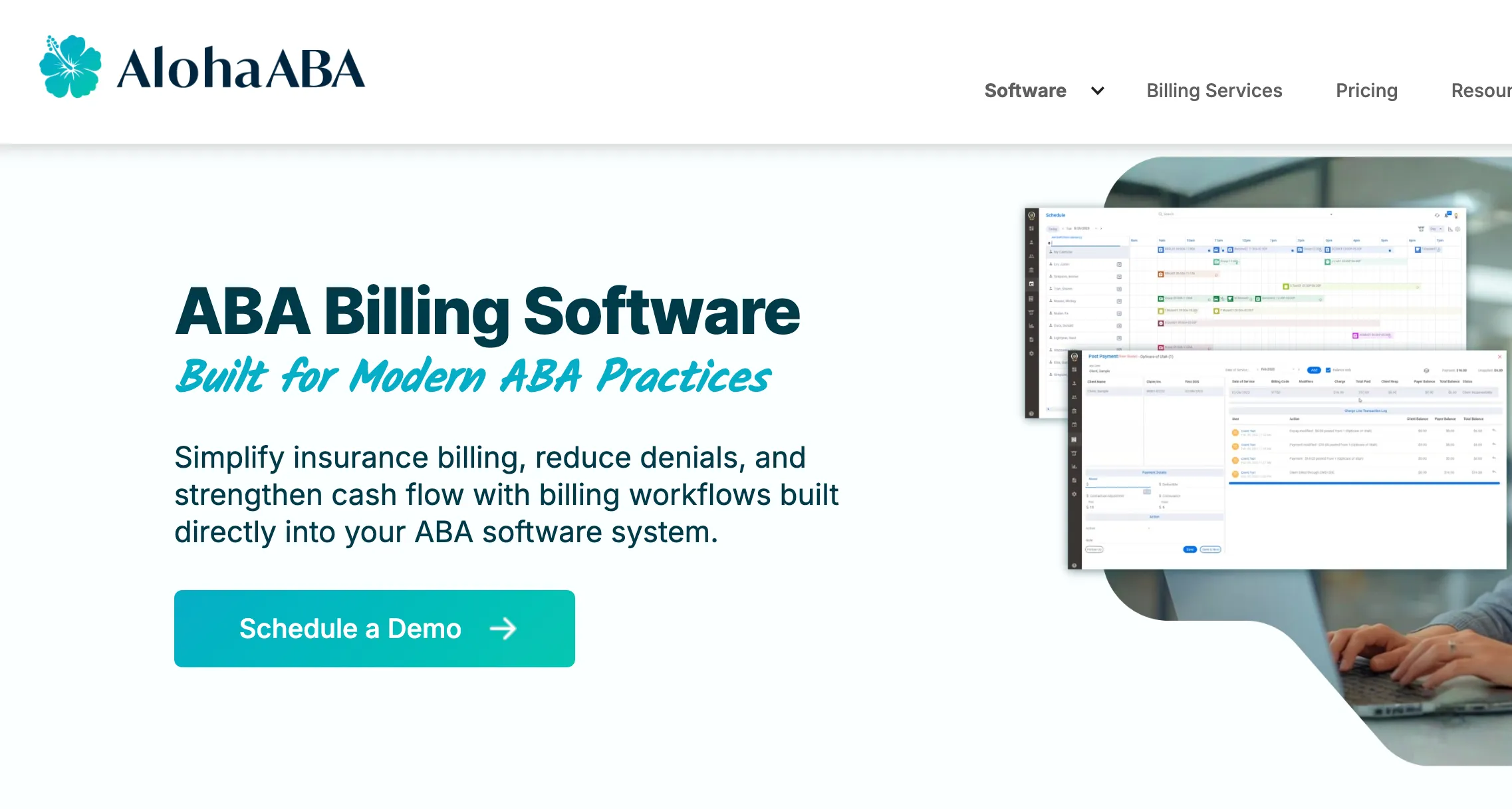
AlohaABA is an all-in-one ABA practice management software with billing built directly into the core workflow. Scheduling, clinical documentation, authorizations, and claim submission all live in one system, with relevant data flowing automatically from session to claim. Used by 1,000+ ABA practices, with optional managed billing services available separately.
Who it's for: Small-to-mid ABA practices that want billing tightly integrated with the rest of their PM software, not bolted on as a separate module that creates duplicate entry and tab-switching between platforms.
Key features
- Real-time claim scrubbing and validation: Built-in insurance rules catch coding and submission errors before claims go out, lowering first-pass denial rates and reducing rework.
- Authorization tracking inside the billing feature: Auth status feeds directly into claim submission, preventing the overages and rejections tied to expired or missing authorizations. A common revenue leak in ABA.
- Multi-payer management with clearinghouse integrations: Integrations with Office Ally, Availity, Sandata, and others handle Medicaid plus commercial payers. Important for practices with a mixed payer base.
- Custom billing rules and AR dashboards: Configure rules for your specific payer mix, with visibility into AR aging, payer trends, billing summaries, and overall revenue.
- Session-to-claim automation: Scheduling and documentation flow directly into billing, eliminating the manual reconciliation that comes with disconnected tools.
- Optional managed billing service: Available separately for practices that want to outsource the billing workflow entirely (separate pricing, request a quote).
Pros
- Highest Capterra rating on this list (4.9 stars from 59 reviews)
- Public pricing. $29.99/staff/month for Practice Management (including the billing feature)
- Used by 1,000+ ABA practices, with strong adoption among small and growing clinics
- Tight PM + billing integration means cleaner data and less double entry
- 30-day free trial, no implementation fee, unlimited clients
- Responsive support team. Consistently the strongest theme in user reviews
Cons
- Data Collection module is only available alongside Practice Management, not standalone
- Some users report bugs with note saving and address autocomplete on appointments
- Best suited for small-to-mid practices. Less proven at multi-site enterprise scale
- Managed billing service pricing isn't published. Separate quote required
Pricing
- Practice Management (includes the billing feature): $29.99/staff/month
- Data Collection add-on: $10–12/client/month (only available alongside Practice Management)
- No implementation fee, unlimited clients, 30-day free trial
- Managed billing services: Available separately. Contact AlohaABA for pricing
Bottom line AlohaABA is the right pick if you've outgrown spreadsheets but aren't ready for enterprise software. The session-to-claim integration means scheduling, documentation, and the billing feature all live in one place. No duplicate entry, no syncing tools, no opening three different tabs to figure out why a claim got rejected last Tuesday.
Pricing is one of AlohaABA's quiet advantages. $29.99/staff/month is one of the only public prices in ABA billing software, which makes it easy to budget before a sales call. If you want the billing workflow run by someone else entirely, ask about their separate managed billing service during the demo, or look at Theralytics for a software-plus-service combination.
5. Ensora ABA Suite (formerly WebABA): Best for growing practices wanting an all-in-one suite
Ensora ABA Suite (formerly WebABA) is an ABA practice management software built by BCBAs that combines scheduling, insurance billing and payments, employee tracking, payroll, reporting, and revenue cycle management in one system. The billing feature handles claim submission and payment tracking, automatically splits CPT category III codes, and generates CMS-1500 forms. For practices that want help running billing, Ensora also offers an optional team of billing professionals to manage claim submission, denied claims, invoices, and unpaid statements.
Who it's for: Growing ABA practices that want billing bundled with scheduling, telehealth, payroll, and a parent portal under one roof, with the option to add a managed billing team as they scale. It is part of the broader Ensora Health family, which also serves mental health and rehab therapy.
Key features
- ABA-specific billing automation: Automatically splits CPT category III codes (the 97151-97158 family ABA practices live in) and generates CMS-1500 forms, reducing manual coding work.
- Optional managed billing team: Beyond the software billing feature, Ensora offers billing professionals who handle claim submission, denied claims, invoicing, and unpaid statements, similar to a managed RCM service.
- Intelligent group scheduling: The scheduler accounts for staff availability and client conflicts, with reminders and a full-featured parent portal.
- Optional Ensora Data Collection integration: Pairs with Ensora Data Collection (formerly Catalyst) so clinical data and billing live closer together, though some users report sync delays between the two.
- All-in-one operations: Billing sits alongside payroll, employee tracking, telehealth, electronic signature capture, and HIPAA-compliant document management.
Pros
- Built by BCBAs specifically for ABA workflows
- Software billing feature plus an optional managed billing team, so you can scale your involvement
- Broad all-in-one feature set (billing, scheduling, telehealth, payroll, parent portal)
- Auto-splits CPT category III codes and generates CMS-1500 forms, a genuinely ABA-specific billing convenience
- Backed by Ensora Health, a large multi-disciplinary EHR company with 200,000+ providers across its product family
Cons
- Quote-based pricing with add-ons that can stack up, making total cost hard to predict
- Users report glitches (slow appointment cancellation, browser bugs) and sync delays between WebABA and Catalyst/Ensora Data Collection
- Support responsiveness is a recurring complaint in reviews
- Mobile app is relatively new; historically the platform was browser-only
- Reviews are mixed compared to the higher-rated options on this list
Pricing: Quote-based. Third-party listings cite a starting point around $500/month, typically on a 12-month contract, with optional add-ons (managed RCM, payments, telehealth, data collection) priced separately. Contact Ensora for an exact quote.
Bottom line: Ensora ABA Suite is a reasonable fit if you're a growing practice that wants billing bundled with scheduling, telehealth, and payroll, plus the option to hand billing to a managed team later. The CPT category III auto-split and CMS-1500 generation are real ABA-specific conveniences.
The trade-offs are pricing opacity and a more mixed user-review record than the top options here. If sync reliability between data collection and billing matters to you, test that workflow carefully during the demo before committing to a 12-month contract.
How we evaluated these ABA billing software options
We focused on the features and trade-offs that actually matter to ABA clinic owners, not marketing checklists. Here's what we weighted:
- Software billing feature vs. managed billing service: Some vendors give you a billing feature inside the software that you operate yourself. Others give you a team that runs billing for you (a managed service). These are very different products at very different price points, so we made the distinction clear in each entry.
- Claims automation and denial handling: First-pass clean claim rate, denial alerts, and resubmission workflows. ABA denial rates run higher than most specialties, so this matters more here than in general medical billing.
- Pricing transparency: Software with public pricing scored higher than vendors that gate every number behind a sales call. You should be able to budget before booking a demo.
- Integration with the rest of the practice: Billing disconnected from scheduling and clinical documentation creates double-entry and errors. We noted which software unified these and which required workarounds.
- HIPAA and payer compliance: Non-negotiable. All five make this list because they meet the bar; Theralytics goes further with SOC 2 Type 2 and ONC certification.
- Verified customer reviews: We weighted Capterra reviews by volume. A 4.9 average from 59 reviews (AlohaABA) and a 4.8 from 108 (Theralytics) carry different weight than a 4.3 from 156 (CentralReach), so we considered both score and sample size.
- Support quality: Pulled from review patterns, not vendor claims. Responsiveness, resolution speed, and willingness to escalate.
Our process
We analyzed each software option by:
- Reading user reviews across Capterra, G2, and Software Advice
- Reviewing vendor documentation, pricing pages, and feature claims directly from each company's website
- Comparing stated features against patterns in actual customer feedback
- Verifying pricing claims against published rate cards where available
- Prioritizing recurring themes in reviews over isolated complaints or praise
We weighted real user experiences over marketing claims and looked for patterns across multiple reviews rather than isolated voices.
Which ABA billing software should you choose?
The truth is, the best ABA billing software is the one that matches how your practice actually runs. Your size, your payer mix, your staffing, and how much billing work you want to handle in-house.
Choose Theralytics if you:
- Want flexibility between operating a software billing feature yourself and outsourcing to a managed billing service
- Prefer predictable pricing. $20/client/month for software, or 4.5% of receivables for managed billing
- Need dual clearinghouse coverage (Office Ally + Claim.MD)
- Want strong compliance posture (SOC 2 Type 2, ONC certified, HIPAA Seal of Compliance)
- Work across Medicaid plus commercial payers and need someone who knows both
Choose:
- CentralReach if you're running a multi-site or enterprise operation and need AI-powered managed RCM with dedicated account management, and you can absorb the implementation cost
- MeasurePM if you want ABA-specific billing automation (pre-filled CPT codes, direct submission to 100+ payers, 85% first-pass clean claim rate) inside an all-in-one PM software and have internal billing staff
- AlohaABA if you're a small-to-mid practice that wants billing built natively into your PM software at a published price ($29.99/staff/month), with session-to-claim automation and authorization tracking inside one system
- Ensora ABA Suite if you want a BCBA-built all-in-one (billing, scheduling, telehealth, payroll) with the option to add a managed billing team as you grow, and you're comfortable working through custom pricing
Avoid:
- Enterprise software like CentralReach if you're a 1-5 clinician practice. Implementation cost won't pencil out and you'll use 20% of what you pay for
- Software-only options like MeasurePM if you don't have (and don't want to hire) a billing operator
- Quote-only vendors if you need to budget before booking a demo, especially if you're shopping multiple options at once
Our final verdict
No single software works for every ABA clinic, but some fit most practices better than others.
After comparing these options, Theralytics is the strongest pick for most ABA clinics in 2026, especially those that want flexibility between operating the software billing feature themselves and outsourcing to a managed billing service. The $20/client/month software pricing is among the lowest on this list, the 4.5% managed service pricing only kicks in when you collect, and the case study numbers (78% → 98% collection rate, $50K+ in annual savings) are concrete benchmarks to push for.
For specialized needs: CentralReach is the enterprise standard with AI-powered RCM and a 97.4% first-year collection rate benchmark. MeasurePM offers the deepest ABA-specific billing automation, with an 85% first-pass clean claim rate built around pre-filled CPT codes. AlohaABA gives small-to-mid practices the tightest PM + billing integration on the market at a public, predictable $29.99/staff/month. Ensora ABA Suite bundles billing with the broadest set of operational tools (telehealth, payroll, parent portal) for growing practices that want everything under one roof.
But if you're tired of chasing denials, second-guessing your biller, or watching your margin disappear into clearinghouse fees and write-offs, Theralytics solves the biggest problem at the most predictable cost, with the option to scale your involvement up or down as you grow.
Frequently asked questions
Why do ABA practices need specialized billing software?
ABA billing involves session-level claim generation, frequent prior authorizations, and payer-specific rules (especially in Medicaid) that general medical billing tools handle poorly. Specialized ABA billing software cuts denial rates and recovers revenue that generalist tools tend to miss, often 5-10% more of what you bill.
How much does ABA billing software cost?
Pricing varies widely. Software with public pricing ranges from $20/client/month (Theralytics) to $29.99/staff/month (AlohaABA). Managed billing services typically run 4-8% of collected receivables (Theralytics is 4.5%). Most enterprise vendors require a custom quote, so always ask for a written pricing sheet before signing.
What's the difference between a billing feature in software and a managed billing service?
A billing feature inside ABA software gives you the tools to do billing yourself (or have your staff do it). A managed billing service includes the people who actually run billing for you. Theralytics offers both: the software billing feature at $20/client/month, or the managed billing service at 4.5% of receivables. CentralReach BillMax is purely a managed service. MeasurePM and AlohaABA are primarily software, though AlohaABA does offer managed services separately, and Ensora ABA Suite offers an optional managed billing team alongside its software.
How do I know if my ABA billing software is HIPAA compliant?
Ask for a signed Business Associate Agreement (BAA), verify data encryption (in transit and at rest), and confirm access controls and audit logging. Every option on this list meets these requirements. Theralytics goes further with SOC 2 Type 2 and ONC certification, plus the HIPAA Seal of Compliance.
Can I switch ABA billing software without losing historical data?
Yes, but plan for it. Most software supports data export, but the transition window (running parallel systems while AR clears) typically takes 60-90 days. Don't switch in the middle of a payer credentialing cycle or year-end close.
Will billing software actually help me get paid faster?
It can, but only if your clinical documentation upstream is clean. Software automates submission and tracking. It doesn't fix bad notes or missing authorizations. The biggest gains usually come from cleaner first-pass claims, not faster submission. MeasurePM cites 85% first-pass clean rate and Theralytics customers have hit 98% collection rates after switching.
Do these software options handle Medicaid?
All five do. MeasurePM integrates directly with Medicaid, Aetna, and Blue Cross. Theralytics integrates with Office Ally and Claim.MD, which between them cover most state Medicaid plans. Always verify your specific state Medicaid program is supported during the demo. Medicaid varies dramatically by state.
What's a reasonable denial rate for ABA practices?
Industry benchmarks vary, but well-run ABA practices typically maintain first-pass clean claim rates above 90% (MeasurePM cites 85% as their average, above industry norms), with denial rates under 10%. If you're consistently above 15%, your billing process likely needs a structural fix, not just more follow-up.
Also Read
10 Best ABA Practice Management Software Solutions in 2026: A ranked look at 10 ABA practice management tools, compared by practice size, workflow compatibility, and room to scale.
5 Best ABA Data Collection Software of 2026: In ABA therapy, dependable data collection is the foundation of strong clinical results, so the software handling it has to be both clinically capable and secure. This guide compares the leading data collection tools across features, ease of use, and value.