


For most ABA practice owners, billing starts out feeling manageable, then quietly turns into one of their biggest operational headaches. The self-billing vs outsourcing decision isn't just about cost. It's about where your team's attention lands, how fast your claims move, and whether your practice can actually grow. Knowing what each model genuinely demands is where you start picking the right ABA billing solution.
What's the Difference Between Self-Billing and Outsourcing?
Self-billing and outsourcing are different operating models, and the gap between them goes well beyond who submits the claims.
According to ABA billing services experts, ABA billing is distinct from most medical specialties because it combines time-based CPT codes 97151 through 97158 with dense prior authorization requirements, payer-specific modifier rules, and high per-client claim volume. That reality shapes what each model demands operationally.
ABA practices generate far more billable units per client than most outpatient specialties, meaning billing errors scale up fast.
Self-Billing: You Handle Claims In-House
Self-billing means your team manages the entire revenue cycle: eligibility checks, authorization tracking, claim generation, submission, ERA posting, and denial follow-up. You control every step. You also own every error.
Direct visibility is the main advantage of self-billing. You know exactly where each claim stands, and you can move immediately when something goes sideways. Purpose-built practice management software is what makes self-billing operationally viable in the first place. Without it, the sheer claim volume ABA generates spins out of control fast.
| Dimension | Self-Billing | Outsourced Billing |
| Who submits claims | In-house staff | Third-party RCM company |
| Operational control | Full | Shared / delegated |
| Revenue visibility | Real-time (if software integrated) | Dependent on partner reporting |
| Cost structure | Fixed (salary + software) | Variable (% of collections) |
| ABA expertise | Depends on staff | Specialist-provided |
| Scalability | Tied to headcount | Scales with volume |
| Startup cost | Higher (hiring, training) | Lower (no immediate hire needed) |
| Compliance ownership | Internal | Shared with vendor |
Outsourced Billing: A Third Party Manages Everything
Outsourcing hands your revenue cycle to a specialist company that handles coding, submission, denial appeals, and payment posting. You get reports; they do the actual work. Control is traded for specialization, and fixed overhead is traded for a percentage fee.
Weighing the Pros and Cons of Each Approach
Neither model is universally better. The right choice depends on your practice's size, staff capacity, and tolerance for operational risk.
Self-billing carries lower startup costs - you're not paying an outsourced fee from day one - but it creates higher long-term operational risk when staff turn over or payer rules shift. In-house billing makes sense when a practice has a dedicated, ABA-trained biller (not a front-desk hybrid) and sufficient volume to justify the fixed overhead. Self-billing genuinely does build internal expertise. Your staff learns your payers, your authorization patterns, and your denial trends in a way an external team never fully replicates.
Outsourcing frees your administrative staff to concentrate on scheduling, intake, and client support instead. According to Staffingly's ABA RCM overview, specialist billing teams stay current on CPT changes, payer policy updates, and state Medicaid rules as a core business function, not as something squeezed in between other duties. The tradeoff is reduced daily visibility and a fee that grows alongside your revenue.
Before outsourcing, read through the security and vetting checklist for ABA billing partners carefully. HIPAA compliance alone isn't enough, Theralytics' outsourcing guide specifically outlines the security standards ABA practices should demand from any RCM partner, including how to evaluate a vendor's data protection posture beyond basic HIPAA claims. The leading self-billing options for ABA practices include features detailed in the top ABA billing software roundup.
The Real Costs of Handling ABA Billing In-House
In-house billing is not free. It just packages its costs differently.
ABA billing ranks among the most claims-intensive outpatient specialties in healthcare. An industry breakdown published by Breaking News ABA puts the scale clearly: a single client receiving 25 hours of weekly therapy generates more than 5,000 billable units per year. That volume needs dedicated staff, not shared administrative time. Practices that ignore this find out the hard way when rising operational costs start compressing margins.
| Cost Category | In-House Estimate | Outsourced Equivalent |
| Staff salary (biller) | $45,000 to $75,000/year | Included in % fee |
| Benefits (20 to 30% of salary) | $9,000 to $22,500/year | Included |
| Compliance training | $500 to $1,000/course | Absorbed by vendor |
| Practice management software | $500 to $1,500/month | Partially included |
| Denial rework cost | $25 to $30/denied claim | Absorbed by vendor |
| Fully loaded annual total | $70,000 to $100,000+ | 4 to 8% of collections |
Direct Labor and Hiring Costs
That $70,000 to $100,000 fully loaded figure (MSBureau, 2026) is the ceiling most practices hit before they factor in any productivity losses from onboarding or coverage gaps. For practices billing under $1 million annually, that fixed cost often beats what an outsourced fee would run. Strong billing compliance also demands ongoing staff education, CPT code updates, payer policy changes, and HIPAA requirements don't wait while your team catches up.
Training, Compliance, and Staff Turnover
Billing staff turnover is a serious operational risk most practice owners underestimate. Claims stall the moment your biller walks out the door. Replacing a single billing employee costs $9,000 to $12,000 in recruiting and training alone, according to Aspirion's RCM guidance, and that figure doesn't include the revenue sitting untouched while claims go unworked.
The cash flow hit from even a two-week billing gap can push days in A/R past 45, which is where key features of your practice management software - automated claim generation, authorization alerts, and denial tracking - become the difference between a manageable gap and a real problem.
Compliance exposure also rises during staff transitions. A behavioral health billing cost analysis from MediBill RCM finds that practices without a dedicated compliance function are disproportionately exposed to HIPAA and Medicaid audit risk.
Technology, Denial Management, and Overheads
Software subscriptions, clearinghouse fees, and IT security add $500 to $1,500 per month to the in-house cost stack. Denied claims still cost $25 to $30 each to rework manually, which compounds fast at ABA claim volumes. Clearinghouse setup and claim submission through an SFTP account with Office Ally is one of the foundational technical steps that in-house teams need to configure correctly to keep that pipeline moving.
What Outsourced Billing Actually Costs
The outsourced fee range sits at 4 to 8% of collected revenue for most ABA billing vendors, according to PaceMave's comparison of billing models, full-service RCM lands at the higher end, while A/R-only support runs closer to 3 to 5%. According to top ABA billing service reviews, specialist vendors handle CPT 97151 through 97158 coding, modifier compliance, payer-specific rules, denial management, and AR follow-up. That coverage is what justifies the fee.
But the catch is what flat-fee models sometimes exclude: telehealth modifier rules, Medicaid-specific billing requirements, or ABA therapy codes 97153 through 97156. Read the contract carefully. ABA therapy billing services that specialize in ABA keep current on changing payer rules as part of their regular operation, which is something generalist billing companies rarely do as well.
When reviewing your billing partner's security posture, look for HIPAA audit trails, SOC 2 Type II certification, and a signed BAA before anything else.
Service Fees and What They Cover
A 5% outsourced fee on $1 million in collections runs $50,000 annually, stack that against a fully loaded in-house biller at $70,000 to $100,000, and the math usually favors outsourcing. That's true unless your denial rate is already low and your biller manages high volume efficiently. Theralytics' own ABA billing service charges 4.5% of receivables and includes full revenue cycle management plus a discount on practice management software.
When You Save Money vs. Break Even
Outsourcing typically becomes cost-competitive at annual collections under $2 million, when in-house overhead as a share of revenue starts exceeding the outsourced fee.
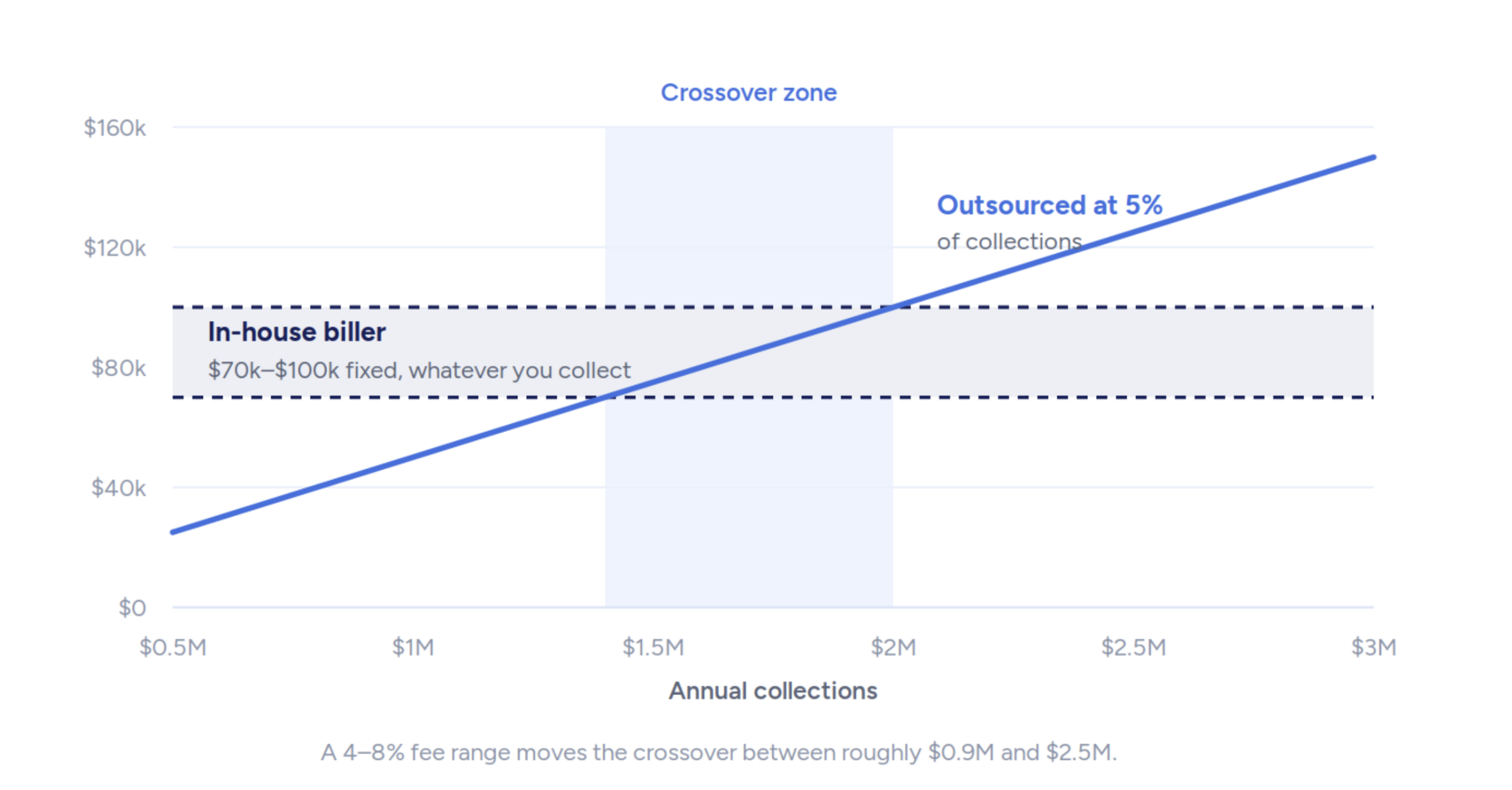
The transparent pricing structure of combined platforms - billing plus software - lets you model the real comparison for your specific practice size. Mastering the end-to-end billing workflow through an integrated platform also positions self-billing practices to stay competitive if they choose to keep claims in-house.
Claim Denials: In-House vs. Outsourced Performance
Denial rate is where the self-billing vs outsourcing decision gets concrete.
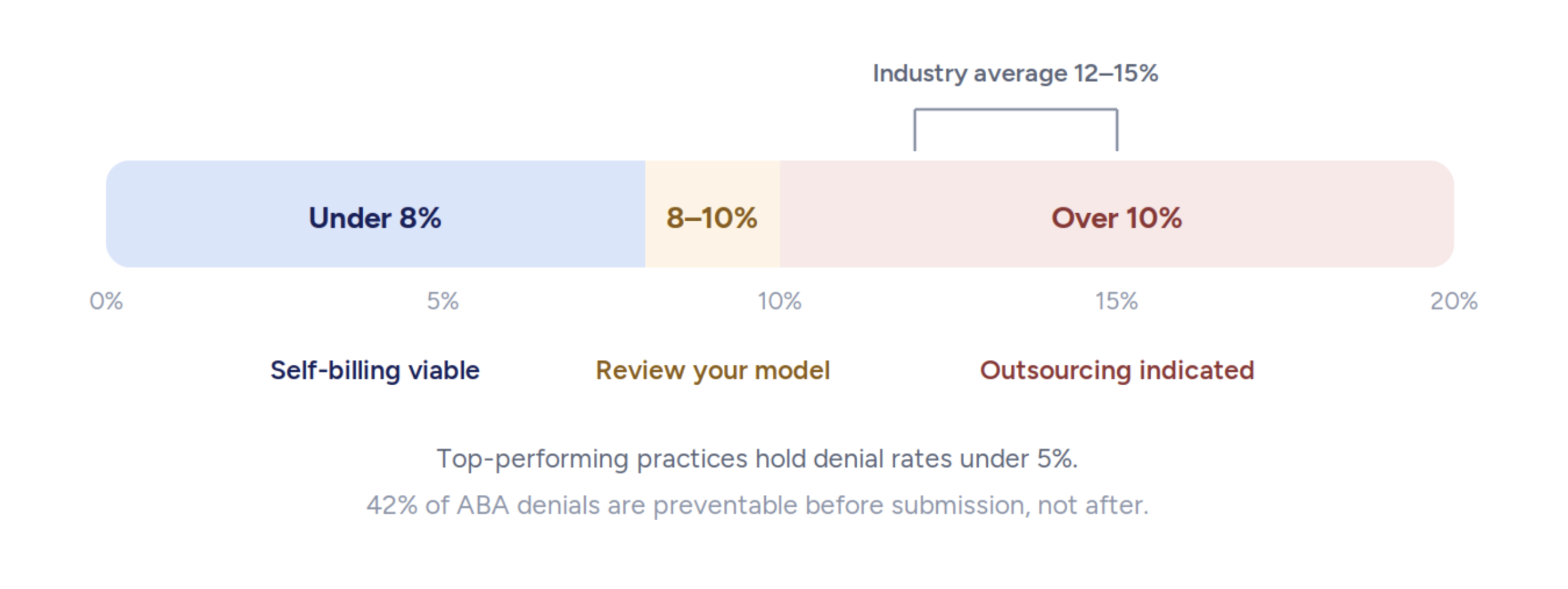
Industry-wide behavioral health denial rates have climbed to between 12 and 15%, while top-performing practices hold theirs under 5%, according to a VGSoft ABA billing analysis. That 10-point gap is almost entirely explained by pre-submission validation, not post-denial appeals. Outsourced specialists run pre-submission checks as a standard step; many in-house teams skip or rush them. Running claim readiness and validation before submission catches the administrative errors that most commonly drive preventable denials.
Denial-related revenue leakage rose 25% in 2025, surpassing $48 billion across more than 2,300 hospitals, according to data from Healthcare Finance News. ABA practices face the same macro trend. A Fierce Healthcare investigation confirms that despite improved cash flow in some segments, providers still lost significant revenue to increased payer denials in 2025.
First-pass denial prevention and post-denial appeal handling are two separate performance dimensions. Outsourced teams typically excel at both because denial management is their business. Per Experian Health's State of Claims report, up to 60% of denied claims are never resubmitted by in-house teams. That's pure revenue loss.
Building audit-ready billing processes means integrated documentation, automated safeguards, and pre-submission scrubbing, Theralytics designed its platform specifically with automated guardrails to keep billing compliant and audit-ready as payer scrutiny has intensified in 2026. That's what separates practices that weather payer scrutiny from those that don't. Reducing billing mistakes at the source is far cheaper than appealing denials after they've already landed.
Prior authorization burden compounds the denial problem. Managing that volume without dedicated authorization tracking is one of the fastest ways to bleed revenue, and per IMO Health's RCM guidance, medical necessity denials are rising precisely because authorization management has grown too complex for generalist staff. DataRovers' denial management analysis puts the average cost of managing denials at a level that materially erodes self-billing economics for smaller practices.
Revenue visibility is a genuine tradeoff with outsourcing. You gain specialist training and lower denial rates; you give up daily control over your claims pipeline. Reputable outsourced partners provide real-time dashboards, but those views are never quite the same as owning the system yourself. Check for performance guarantees, defined clean claim rate targets, and clear exit clauses before signing anything. A denial rate analysis from OS Healthcare recommends spelling out denial rate thresholds explicitly in service contracts.
Tracking submitted claims and denial monitoring on an ongoing basis gives both in-house teams and outsourced partners the post-submission visibility needed to catch stalled or rejected claims before they age out of timely filing windows. ERA posting and claims management workflow problems - mismatched payment amounts, unmatched remittance files, and posting errors - are among the most common sources of A/R drag regardless of which billing model a practice runs.
How to Decide: Self-Billing or Outsourcing for Your Practice
The right ABA billing solution comes down to four variables: headcount, denial rate, growth trajectory, and leadership time.
Track your core billing KPIs - days in A/R, denial rate, net collection rate, and clean claim rate - before making any decision. These numbers show you exactly where your current model is breaking down. Choosing ABA practice management software that gives you real-time visibility into these metrics matters regardless of which model you end up running. Billing metrics and KPI reporting across your revenue cycle consolidate those numbers into the practice-level view you need to spot trends and act before small gaps become structural problems.
The 98% collection rate case study from a Theralytics client - up from 78% - shows what targeted billing improvements actually look like on the ground. Per CareRCM's ABA billing company rankings, the highest-performing practices pair purpose-built software with either dedicated in-house billers or specialist outsourced partners. Don't go with a hybrid of general admin staff and a generic RCM company. Per Human Medical Billing's KPI benchmarks, a clean claim rate below 95% or days in A/R above 45 are both red flags that call for a model review.
Self-Billing Works Best If...
- Your denial rate is already under 8%
- You have a dedicated, ABA-trained billing specialist (not shared admin)
- Annual collections exceed $1.5 million and support the fixed overhead
- You prioritize real-time claims control and internal data ownership
Outsourcing Works Best If...
- You're in a growth phase, adding providers, locations, or payer contracts
- Your denial rate exceeds 10% or days in A/R exceed 45
- Billing staff turnover has occurred in the past 12 months
- Your team's time is stretched by clinical and operational demands
The Hybrid Approach: When It Makes Sense
Some practices keep eligibility checks and authorization tracking in-house while outsourcing claim submission and denial appeals. This preserves daily front-end visibility while offloading the most time-intensive back-end work. But it only works when your software and your outsourced partner share clean data, otherwise you're just managing two disconnected systems.
Frequently Asked Questions
How long does it typically take to see a return on investment with outsourced billing?
Most practices see measurable collection rate improvements within 60 to 90 days of switching to a qualified outsourced ABA billing partner. The gains come primarily from pre-submission validation catching errors that previously slipped through, faster claim turnaround, and systematic denial follow-up. Practices starting with denial rates above 15% tend to see the most immediate results.
What happens to my claims if my outsourced billing vendor goes out of business or drops ABA as a service line?
Your data belongs to you. Confirm this in writing before signing any contract. Ask the vendor specifically about data export formats, transition timelines, and whether they have a contingency protocol for service discontinuation. A 30 to 60 day wind-down clause with full data export rights is the minimum you should accept.
Can I switch between self-billing and outsourcing, or am I locked into one approach?
You're not locked in permanently, but transitions take real planning. Moving from outsourced back to in-house means hiring and training before you can realistically turn off the vendor. Moving from in-house to outsourced requires a clean handoff of open claims, payer credentials, and authorization data. The cleaner your software records are, the smoother either direction will go.
Conclusion
The self-billing vs outsourcing decision doesn't have a universal right answer - but it does have a right answer for your practice's current size, denial rate, and growth plan. Self-billing builds internal skills and gives you control; outsourcing brings specialization and lowers your denial exposure. Most practices that struggle aren't choosing the wrong model. They're running the right model on the wrong infrastructure. Theralytics is built to support both approaches: integrated billing workflows, payer-specific configuration, automated authorization tracking, and clearinghouse connections through Office Ally, Claim.MD, and Stedi give your team what it needs to bill cleanly in-house - and the same platform supports outsourced partners who need clean data to work from. Request a demo to see how the platform performs in your workflow.