


ABA practices lose a significant portion of potential revenue every year from preventable billing problems, not from fraud, but from expired authorizations, mismatched CPT codes, incomplete session notes, and missed filing windows. The practices that collect consistently aren't doing anything extraordinary. They've just built systems that catch these mistakes before they become denials.
This guide walks through the 12 most common ABA billing mistakes and exactly how to prevent them.
Why ABA Billing Mistakes Are Costly and How to Prevent Them
A denied claim costs an average of $25, $30 to rework manually, and 90% of denied claims require at least some human review before resubmission, per Experian Health's 2025 State of Claims survey. Scale that across a practice billing 20-40 hours per client per week. The administrative overhead becomes impossible to manage.
Three core strategies break through the noise. Pre-claim verification catches errors before submission. Documentation integrity ensures what's billed matches what's recorded. Denial tracking turns every rejection into process improvement. The ABA Billing Best-Practice Checklist addresses all three, giving your team a repeatable framework rather than individual fixes scattered across different desks. Here's the thing: billing problems in ABA don't live in one person's inbox. They span scheduling, clinical documentation, credentialing, and claims management. A team-wide approach actually works.
1. Failing to Verify Insurance Eligibility Before Service Delivery
Confirm the client's active coverage, ABA benefits, payer requirements, and any visit, unit, or dollar limits before the first session is scheduled. That's the first line of defense against avoidable claim denials.
Eligibility verification should include confirmation of active coverage, primary and secondary insurance information, authorization requirements, referral requirements, and any service limitations that may apply. Different payers require different documentation to approve ABA services. Some require a comprehensive Functional Behavior Assessment (FBA), while others may accept a physician referral, treatment plan, diagnostic evaluation, or additional supporting documentation. Understanding each payer's requirements before services begin can help prevent authorization delays and eligibility-related denials.
An automated eligibility verification process and periodic re-verification throughout treatment can help identify coverage changes, terminated policies, coordination of benefits (COB) updates, or authorization issues before claims are submitted.
Tracking Authorization Expiration Dates
Authorization expiration ranks among the top denial causes across ABA payers. Submit renewals 2-4 weeks before the current authorization ends and attach any required supporting documentation.
Mapping Services to BCBA vs. RBT Provider Roles
Each service must be billed according to the provider's role, credentials, and payer requirements. Billing services under the wrong provider type, such as billing 97155 under an RBT's NPI, may result in denials and compliance concerns. Your ABA documentation management software should enforce role-based billing rules at the point of claim generation, not after the fact.
2. Using Incorrect or Outdated ABA CPT Codes
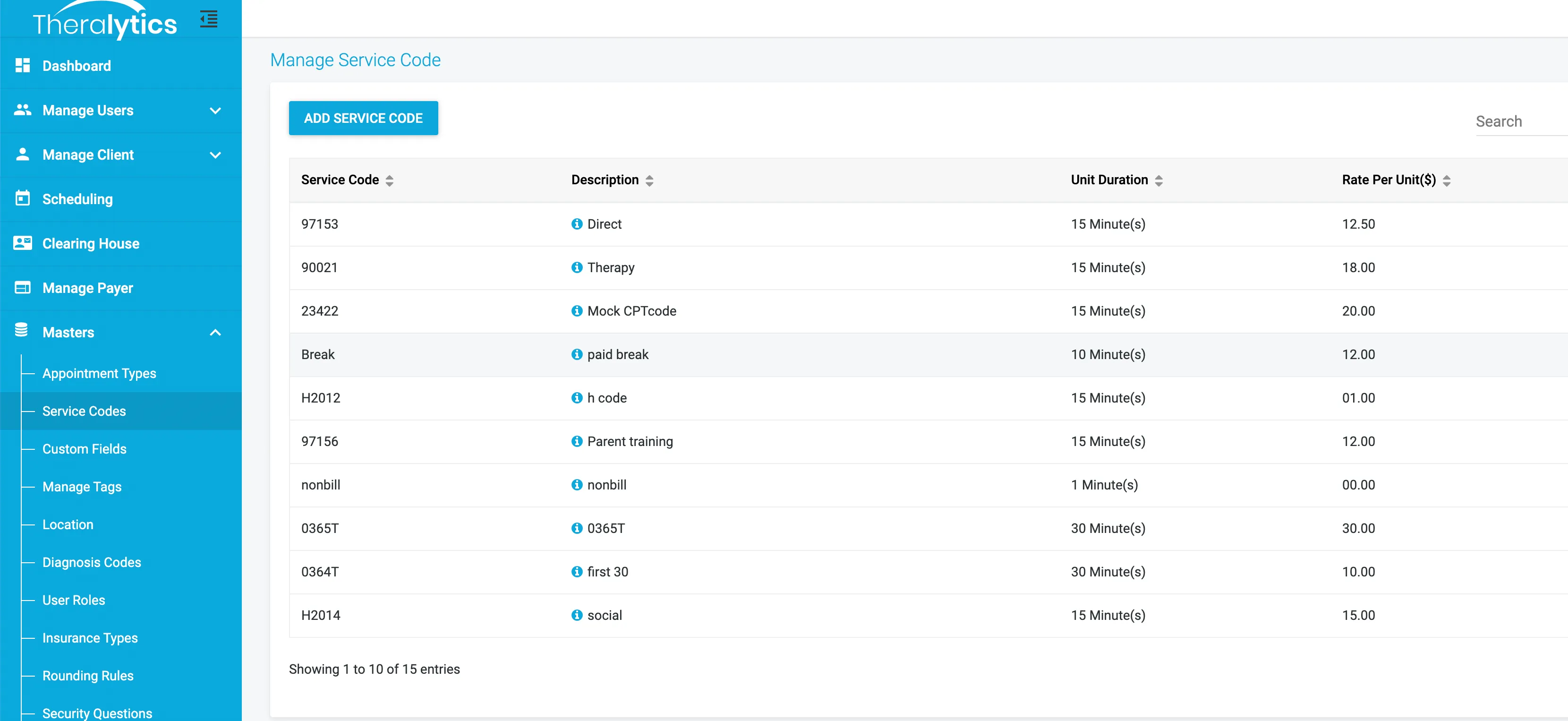
ABA services use CPT codes 97151-97158, plus HCPCS codes such as H2019, H0031, H0032, H2014, H2020, T1016, and other payer-specific HCPCS codes. Pick the wrong code and denials follow fast. Common ABA billing mistakes show that even experienced billers confuse 97153 (direct treatment by technician) with 97155 (protocol modification by BCBA) because they carry entirely different credentialing and supervision requirements.
Modifiers matter just as much. Telehealth modifier requirements vary by payer. Some require Modifier 95, others require GT, and some have payer-specific telehealth billing requirements. Missing or wrong modifiers send clean claims straight to denial.
Understanding ABA-Specific Modifiers and When to Apply Them
Check each payer's modifier requirements annually. Some Medicaid plans reject modifier 95 entirely and want GT instead. Document your payer-specific modifier rules in your billing system rather than relying on memory.
Adjusting Code Selection for Different Service Delivery Models
In-home, clinic-based, and hybrid telehealth delivery all affect code selection. Place-of-service codes must match the actual location where the session occurred. A clinic-billed claim for a session delivered in the client's home is a documentation mismatch that will trigger review. Review your ABA CPT code setup guide to confirm codes and modifiers are configured correctly at the payer level.
3. Incomplete or Illegible Clinical Documentation and Session Notes
Each session note must capture four elements: start and stop times (to the minute), specific interventions delivered, behavioral data collected, and the plan-of-care alignment for each goal addressed. Missing any one of these is enough for a payer to deny the claim. The HHS-OIG's 2026 Colorado audit found that documentation failures drove $77.8 million in improper ABA Medicaid payments, with incomplete session notes as the leading cause.
Standardizing your ABA session notes format across all staff eliminates the variance that creates billing exposure. When every RBT and BCBA uses the same template, audits become easier to survive and billing staff can verify documentation faster.
Required Signatures and Same-Day Note Completion
Session notes should be signed according to payer, agency, and supervision requirements. Missing required signatures may result in claim denials or audit findings. Same-day completion isn't negotiable; notes written 48 hours later are a red flag that payers and OIG auditors both catch.
Calculating Billable Time: Exclusions and Unit Verification
Break time, transition gaps between locations, and parent debrief time that isn't documented as parent training can't be included in billable minutes. The math must work: billed units multiplied by 15 must equal or be less than documented direct service minutes. A session note showing 45 minutes of service but a claim billing five 15-minute units (75 minutes) is an automatic denial and may create compliance concerns during audits or payer reviews.
4. Missing Prior Authorization or Referral Requirements
Most insurance plans, including commercial insurance, Medicaid, and Medicaid managed care plans, require prior authorization for ABA services. An authorization that lapses mid-treatment or was never obtained can result in denials for all affected services. Those denials are often difficult to overturn because the issue is administrative rather than clinical.
Authorization workflows vary by state and by payer. Some states require a separate physician referral before an ABA authorization can even be requested. Others have specific assessment tools or diagnostic codes that must accompany the request. A standardized authorization tracking process, not a spreadsheet one person maintains, is the only way to manage this at scale without billing problems piling up.
Payer-Specific Authorization Criteria and Documentation Requirements
Build a payer reference sheet listing each payer's authorization criteria, required documentation, and renewal timeline. Review this whenever a payer updates its coverage policy, which can happen mid-year without notice.
5. Failing to Follow Payer-Specific Billing Rules
Many ABA billing errors occur because different payers have different requirements for CPT codes, modifiers, rendering providers, NPIs, authorizations, telehealth billing, and concurrent services. A billing process that works for one payer may result in denials with another. Providers should maintain payer-specific billing references and review policy updates regularly to ensure claims are submitted according to current requirements.
6. Credentialing, Enrollment, and Rendering Provider Mismatches
Common payer-specific billing issues include credentialing discrepancies, rendering provider information mismatches, incorrect NPI or taxonomy information, provider enrollment issues, and inactive or incomplete group credentialing. Claims may be rejected or denied when the provider information submitted on the claim does not match the payer's credentialing or enrollment records. Regular review of individual and group credentialing status, provider enrollment, rendering provider information, and taxonomy details can help prevent these errors.
Rendering providers must be enrolled and credentialed according to each payer's requirements. Some payers require providers to be individually credentialed, while others allow services to be billed under the group's credentialing and enrollment. Verifying credentialing requirements before billing can help prevent avoidable claim denials.
ABA agencies may also experience payment delays due to incomplete EFT enrollment, incorrect pay-to addresses, outdated billing addresses, or other payer enrollment issues. Some payers, including Tricare and CHAMPVA, may require EFT enrollment before payments can be issued. Regular validation of provider demographic information, payment addresses, ERA enrollment, and EFT enrollment status with each payer can help prevent payment delays, missing checks, and reimbursement disruptions.
7. Billing Without Proper Supervision Documentation
Supervision records aren't optional. They're billing evidence. Documentation should support the provider involvement and protocol modification activities required by the payer's billing guidelines for 97155. When you bill 97153, the RBT's service must tie to an active treatment plan authorized by a BCBA. Missing supervision records rank among the top reasons ABA claims get denied, according to the HHS-OIG's 2025 Wisconsin audit finding $18.5 million in improper payments.
Billing staff must understand BACB supervision standards well enough to flag sessions where documentation is missing before claims go out. Role-specific training, not just general billing training, is what closes this gap. BCBAs, RBTs, and administrative staff each have distinct documentation responsibilities, and confusing them creates its own category of billing error.
8. Submitting Claims After Payer Deadline Cutoffs
Most commercial payers require claims within 90 to 180 days of the service date. Medicaid timely filing limits vary by state; many are 90 days, some extend to 365 days. Miss the window and the denial is automatic with no clinical appeal path. That revenue's gone.
Every claim submission needs a defensible timestamp: date of service, date claim was generated, and date it was transmitted to the clearinghouse. Practice management software alerts that flag sessions not yet billed after 48 hours are the safest safeguard against timely filing denials.
Theralytics billing workflow moves completed sessions into a "Ready to Bill" queue automatically, giving billing staff a daily view of what needs to go out. Review your submitted claims guide to confirm your submission timestamps are consistently recorded.
9. Billing Overlapping or Concurrent ABA Services Incorrectly
Concurrent billing requirements vary significantly by payer. Some payers allow overlapping supervision and treatment services, while others prohibit concurrent billing entirely.
This error looks different in in-home versus clinic settings. In a clinic, a client might receive 97153 with an RBT and then transition to 97155 with the BCBA in the same afternoon block. The two service periods must not overlap, and the transition time between them typically isn't billable. When concurrent services are legitimately allowable, use modifiers correctly to distinguish them; confirm the payer's specific rules in writing before billing.
10. Neglecting to Follow Up on Denied Claims
Denied claims don't resolve themselves. A practice that doesn't track, categorize, and appeal denials is leaving earned revenue on the table. ABA denial rates reach 20-30%, and the benchmark for a healthy practice is a 95% or greater claim acceptance rate on first submission.
Categorizing Denial Types to Identify Recurring Billing Problems
Sort denials into categories: eligibility, authorization, coding, documentation, and timely filing. When one category accounts for more than 20% of your denials, that's a process failure, not a one-off error. Tracking denial categories monthly turns individual rejections into pattern data your team can act on.
Building a Denial Appeal Workflow with Supporting Documentation
Most payers allow 90 to 180 days to file an appeal. The appeal package for ABA denials typically needs the original claim, the denial explanation, corrected session notes, the authorization letter, and a written rebuttal citing the payer's own coverage policy. Track appeal outcomes separately; a high appeal win rate on authorization denials might mean your prior auth process needs earlier intervention, not better appeals.
11. Failing to Train Staff on Updated Billing and Compliance Protocols
The AMA released the CPT 2025 code set with 270 new codes, 112 deletions, and 38 revisions. Practices that didn't retrain staff before January 1, 2025 saw denial spikes in Q1 that took months to recover from. Annual CPT updates require a scheduled training cycle, not a one-time staff email.
Training frequency should match the pace of payer policy changes: at minimum annually for CPT updates and quarterly for payer-specific rule reviews. State-level regulatory variation means a biller in California needs different knowledge than one in Texas; a generic billing training program won't cover both.
Role-Specific Training for Clinical and Administrative Staff
BCBAs need to understand documentation requirements for 97155 and supervision ratios. RBTs need to know what makes a session note billable versus incomplete. Administrative staff need to manage authorization workflows and timely filing windows. Mixing these audiences in a single training produces confusion, not competency. Separate tracks with role-specific checklists work far better.
Keeping Pace with State Regulations and Payer Policy Changes
Subscribe to Medicaid bulletin updates for every state you operate in. Assign one staff member to monitor payer policy pages quarterly and flag any changes to the billing team before they affect claims. Updating payer configurations in your billing system immediately after a policy change prevents denials from building up before anyone notices. Your payer-specific CPT code configuration should reflect every active policy change within 30 days of the effective date.
12. Skipping Regular Internal Audits and Compliance Reviews
Internal audits catch billing discrepancies before payers do. The HHS-OIG has now audited ABA Medicaid billing in at least four states, and their findings show that 100% of sampled claims in Indiana, Wisconsin, Maine, and Colorado contained at least one improper or potentially improper payment. Waiting for a payer audit to find your errors costs far more than finding them yourself first.
Conduct retrospective claim reviews monthly (reviewing claims from the prior 30-60 days) and prospective documentation checks weekly (reviewing session notes before claims are submitted). Run a full audit quarterly of a random sample of 25-50 claims across payers.
Metrics to Track Billing Error Reduction Over Time
Track these monthly:
| Metric | Target |
|---|---|
| First-pass acceptance rate | 95% or higher |
| Denial rate | Below 5% |
| Days in accounts receivable | Under 30 days |
| Appeal win rate | Above 70% |
| Timely filing denials | Zero |
Using Audit Findings to Close Training and Process Gaps
Every audit finding should generate a corrective action: a training update, a process change, or a billing system configuration fix. An audit that doesn't change anything is just documentation. Close the loop by reviewing the same claim categories in the next audit cycle to confirm the fix actually held.
Building a Billing Error Prevention System for Your ABA Practice
Reducing billing mistakes across your ABA practice comes down to three things working together: verify before you bill, document what you deliver, and follow up on everything that's denied. No single fix addresses all three. You need a system.
The ABA Billing Best-Practice Checklist: What It Covers and How to Use It
The downloadable Best-Practice Checklist for how to reduce billing mistakes in ABA covers pre-service eligibility and authorization verification, session note documentation standards, CPT code and modifier accuracy checks, timely filing tracking, denial categorization, and internal audit schedules. Use it as a staff training tool, a monthly self-audit instrument, and a reference guide when payer policies change. Print it, assign checklist ownership by role, and review completion weekly.
Adapting Billing Workflows for In-Home, Clinic, and Telehealth Models
The checklist applies across all service delivery models, but a few items need model-specific customization. In-home services require EVV compliance and GPS-verified time stamps. Clinic-based billing needs place-of-service code accuracy and concurrent service documentation. Telehealth sessions require modifier 95 (or GT, depending on the payer) and documented consent for audio-visual service delivery. Build a one-page model-specific addendum to the checklist for each setting your practice operates in.
How Theralytics Supports Billing Accuracy Across Your ABA Practice
Theralytics was built to close the gap between clinical documentation and clean claim submission. Generic billing platforms often require staff to manually cross-reference authorization data, session documentation, CPT codes, modifiers, provider information, and payer requirements before claims can be submitted.
- The platform pulls authorization details directly into each claim and validates billed units against approved authorization limits before submission. Billing staff are alerted when claims exceed authorized units, fall outside approved date ranges, or contain authorization-related discrepancies. This helps reduce authorization-related denials and minimizes the need for manual claim review.
- Theralytics also supports payer-specific billing configurations, allowing practices to configure CPT codes, HCPCS codes, modifiers, rendering provider requirements, NPIs, taxonomies, authorization rules, and concurrent billing restrictions based on each payer's requirements. Since ABA billing requirements vary significantly across commercial insurance, Medicaid, Medicaid managed care plans, Tricare, and other payers, payer-specific configuration helps reduce claim errors before submission. These payer-specific configurations can be customized at the payer level, allowing practices to align billing workflows with unique payer requirements without relying on manual claim corrections.
- The platform helps prevent credentialing and enrollment-related issues by supporting payer-specific rendering provider configurations and provider enrollment requirements. Billing teams can configure payer-specific NPI, taxonomy, and provider information to align with payer credentialing records and reduce avoidable denials.
- Theralytics also supports electronic secondary claim submission by transmitting primary payment and claim processing information electronically to secondary insurance when supported by the payer and clearinghouse. This helps reduce manual secondary claim submission workflows and improves billing efficiency.
-The platform's full ABA billing service manages the entire revenue cycle, from claim submission through OfficeAlly, ClaimMD, and other clearinghouses to denial follow-up, payment posting, and accounts receivable management. ERA processing, payer-specific billing configurations, authorization tracking, and billing workflow automation help reduce administrative workload while improving claim accuracy. Theralytics can synchronize ERA files electronically from supported clearinghouses, helping automate payment posting and reduce manual reconciliation work while maintaining support for manual EOB posting when ERA is not available.
One ABA agency using Theralytics went from a 78% collection rate to a 98% collection rate after standardizing their billing workflows through the platform. The ABA scheduling software integrates directly with billing, so sessions completed on the schedule flow into the Ready to Bill queue without manual re-entry, reducing transcription errors at the source. For practices working through the Best-Practice Checklist, Theralytics makes most checklist items automated defaults rather than manual steps.
Closing Thoughts on Reducing ABA Billing Mistakes
Billing problems in ABA aren't random. They cluster around the same failure points: unverified eligibility, expired authorizations, incomplete notes, wrong codes, and missed follow-up on denied claims. Knowing how to reduce billing mistakes in ABA means building a system that catches each of these before they become denials. Start with the Best-Practice Checklist, assign ownership by role, and audit your results every 30 days. The practices that collect 95 cents of every earned dollar don't do anything exceptional. They just don't let errors slip past without a process designed to catch them.